

GRP78/Bip Monoclonal Antibody [8G3]
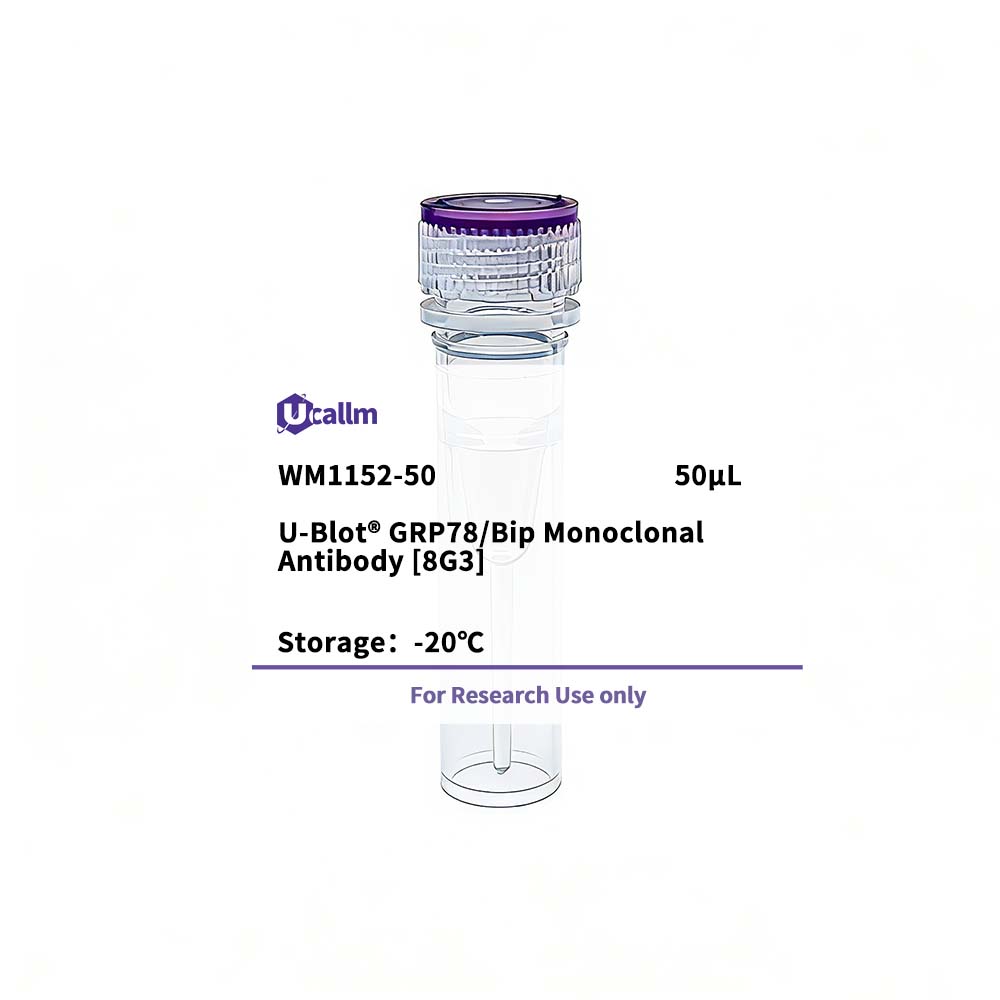
Ucallm_WM1152-50
Price range: $268.00 through $328.00
Product details
Background:
The protein encoded by this gene is a member of the heat shock protein 70 (HSP70) family. It is localized in the lumen of the endoplasmic reticulum (ER), and is involved in the folding and assembly of proteins in the ER. As this protein interacts with many ER proteins, it may play a key role in monitoring protein transport through the cell.[provided by RefSeq, Sep 2010],
Specifications
| Size | 50μL/100μL |
| Target | HSP A5/GRP78 |
| Reactivity | Human, Rat |
| Applications | WB, IHC, IF |
| MW(Calculated) | |
| MW(Observed) | 78kD |
| Host Species | Mouse |
| Isotype | |
| Conjugate/Modification | Unmodified |
| Recommended Dilution Ratio | WB 1:1000-2000; IHC 1:100-200; IF 1:50-200 / Note: For IHC, we suggest antigen retrieval with TE buffer pH 9.0 (Cat#WT1004) |
| Formulation | Liquid in PBS containing 50% glycerol, 0.5% BSA and 0.02% sodium azide. |
| Purification | The antibody was affinity-purified from mouse ascites by affinity-chromatography using specific immunogen. |
| Storage | -15°C to -25°C/1 year(Do not lower than -25°C) |
| Concentration | 1 mg/ml |
| Clonality | Monoclonal |
| Clone Number | 8G3 |
| Immunogen | Synthetic Peptide of GRP78/Bip |
| Specificity | GRP78/Bip protein detects endogenous levels of GRP78/Bip |
| Gene Name | HSPA5 GRP78 |
| Protein Name | 78 kDa glucose-regulated protein (GRP-78) (Endoplasmic reticulum lumenal Ca(2+)-binding protein grp78) (Heat shock 70 kDa protein 5) (Immunoglobulin heavy chain-binding protein) (BiP) |
| Other Name | HSPA5; / GRP78; / 78 kDa glucose-regulated protein; / GRP-78; / Endoplasmic reticulum lumenal Ca; / 2+; / -binding protein grp78; / Heat shock 70 kDa protein 5; / Immunoglobulin heavy chain-binding protein; / BiP |
| Species | Human |
| Gene ID | 3309 |
| Uniprot | P11021, |
| Species.1 | Mouse |
| Gene ID.1 | 14828 |
| Uniprot.1 | P20029, |
| Species.2 | Rat |
| Gene ID.2 | |
| Uniprot.2 | P06761 |
| Cellular Localization | Endoplasmic reticulum lumen . Melanosome . Cytoplasm . Cell surface . Identified by mass spectrometry in melanosome fractions from stage I to stage IV (PubMed:12643545). Localizes to the cell surface of epithelial cells in response to high levels of free iron (PubMed:20484814, PubMed:24355926, PubMed:27159390). . |
| Tissue Expression | Articular cartilage,Brain,Cajal-Retzius cell,Cervix carcino |
| Signaling_pathway | Organismal Systems >> Immune system >> Antigen processing and presentation;Human Diseases >> Neurodegenerative disease >> Parkinson disease;Human Diseases >> Neurodegenerative disease >> Amyotrophic lateral sclerosis;Human Diseases >> Neurodegenerative disease >> Prion disease;Human Diseases >> Neurodegenerative disease >> Pathways of neurodegeneration - multiple diseases;Genetic Information Processing >> Folding, sorting and degradation >> Protein processing in endoplasmic reticulum |
| Research Areas | >>Protein export; / >>Protein processing in endoplasmic reticulum; / >>Antigen processing and presentation; / >>Thyroid hormone synthesis; / >>Parkinson disease; / >>Amyotrophic lateral sclerosis; / >>Prion disease; / >>Pathways of neurodegeneration - multiple diseases; / >>Lipid and atherosclerosis |
| Function | Disease:Autoantigen in rheumatoid arthritis [MIM:180300].,Function:Probably plays a role in facilitating the assembly of multimeric protein complexes inside the ER.,similarity:Belongs to the heat shock protein 70 family.,subcellular location:Identified by mass spectrometry in melanosome fractions from stage I to stage IV.,subunit:Interacts with DNAJC1 (via J domain) (By similarity). Component of an EIF2 complex at least composed of CUGBP1, CALR, CALR3, EIF2S1, EIF2S2, HSP90B1 and HSPA5. Part a large chaperone multiprotein complex comprising CABP1, DNAJB11, HSP90B1, HSPA5, HYOU, PDIA2, PDIA4, PPIB, SDF2L1, UGT1A1 and very small amounts of ERP29, but not, or at very low levels, CALR nor CANX. Interacts with TMEM132A., |
Please login to post questions
Related products





