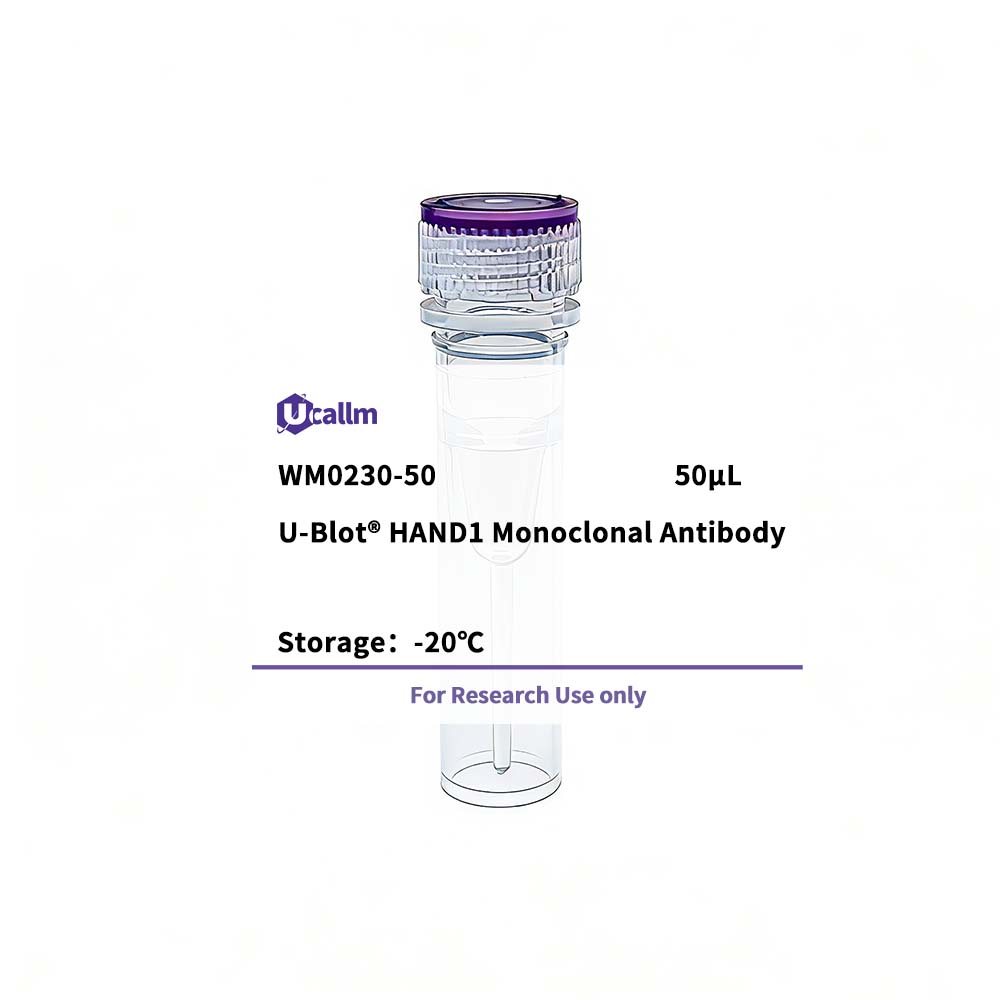
SKU: WM0230 Categories: ,

HAND1 Monoclonal Antibody

Price range: $268.00 through $328.00

SKU: WM0230-50
Enter the quantity you would like, or drag the panel to find the quantity and price that best for you
Bulk QuoteAuthorize OEM & ODM

Product details

Background:
The protein encoded by this gene belongs to the basic helix-loop-helix family of transcription factors. This gene product is one of two closely related family members, the HAND proteins, which are asymmetrically expressed in the developing ventricular chambers and play an essential role in cardiac morphogenesis. Working in a complementary fashion, they function in the formation of the right ventricle and aortic arch arteries, implicating them as mediators of congenital heart disease. In addition, it has been suggested that this transcription factor may be required for early trophoblast differentiation. [provided by RefSeq, Jul 2008],

Specifications

Size50μL/100μL
TargetHAND1
ReactivityHuman
ApplicationsWB, ELISA
MW(Calculated)24kD
MW(Observed)
Host SpeciesMouse
Isotype
Conjugate/ModificationUnmodified
Recommended Dilution RatioWB 1:500-1:2000; ELISA 1:10000; Not yet tested in other applications.
FormulationLiquid in PBS containing 50% glycerol, 0.5% BSA and 0.02% sodium azide.
PurificationAffinity purification
Storage-15°C to -25°C/1 year(Do not lower than -25°C)
Concentration
ClonalityMonoclonal
Clone Number6C6
ImmunogenPurified recombinant fragment of HAND1 (aa90-190) expressed in E. Coli.
SpecificityHAND1 Monoclonal Antibody detects endogenous levels of HAND1 protein.
Gene NameHAND1
Protein NameHeart- and neural crest derivatives-expressed protein 1
Other NameHAND1; / BHLHA27; / EHAND; / Heart- and neural crest derivatives-expressed protein 1; / Class A basic helix-loop-helix protein 27; / bHLHa27; / Extraembryonic tissues; / heart, autonomic nervous system and neural crest derivatives-expressed protein 1; / eH
SpeciesHuman
Gene ID9421
UniprotO96004,
Species.1Mouse
Gene ID.1
Uniprot.1Q64279
Species.2
Gene ID.2
Uniprot.2
Cellular LocalizationNucleus, nucleoplasm . Nucleus, nucleolus . Interaction with MDFIC sequesters it into the nucleolus, preventing the transcription factor activity. Phosphorylation by PLK4 disrupts the interaction with MDFIC and releases it from the nucleolus, leading to transcription factor activity (By similarity). .
Tissue ExpressionHeart.
Signaling_pathwayCellular Processes >> Cellular community - eukaryotes >> Signaling pathways regulating pluripotency of stem cells
Research Areas>>Signaling pathways regulating pluripotency of stem cells
FunctionFunction:Plays an essential role in early trophoblast differentiation and in cardiac morphogenesis. In the adult, could be required for ongoing expression of cardiac-specific genes. Binds the DNA sequence 5'-NRTCTG-3' (non-canonical E-box).,similarity:Contains 1 basic helix-loop-helix (bHLH) domain.,subunit:Efficient DNA binding requires dimerization with another bHLH protein. Forms homodimers and heterodimers with TCF3 gene products E12 and E47, HAND2 and HEY1, HEY2 and HEYL (hairy-related transcription factors).,tissue specificity:Heart.,
Please login to post questions
Back to Top
Product has been added to your cart

