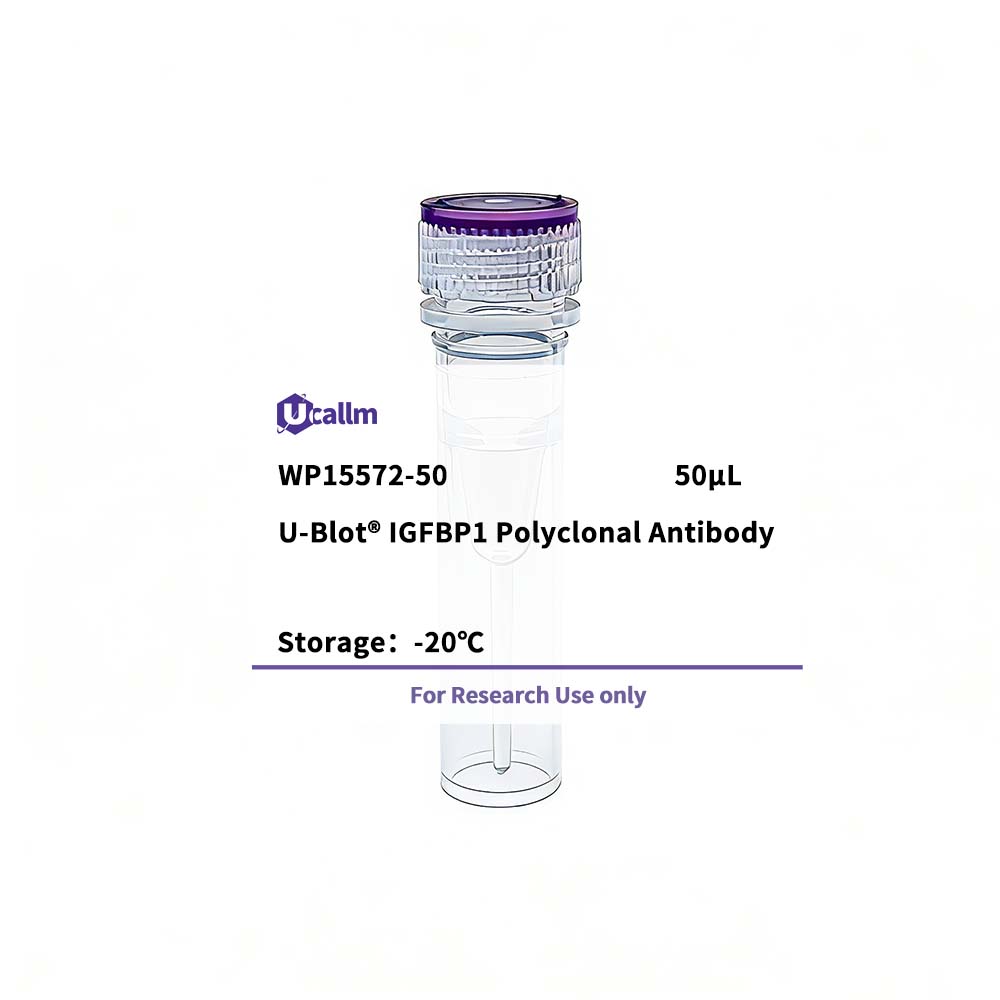
SKU: WP15572 Categories: ,

IGFBP1 Polyclonal Antibody

Price range: $268.00 through $328.00

SKU: WP15572-100
Enter the quantity you would like, or drag the panel to find the quantity and price that best for you
Bulk QuoteAuthorize OEM & ODM

Product details

Background:

This gene is a member of the insulin-like growth factor binding protein (IGFBP) family and encodes a protein with an IGFBP domain and a thyroglobulin type-I domain. The protein binds both insulin-like growth factors (IGFs) I and II and circulates in the plasma. Binding of this protein prolongs the half-life of the IGFs and alters their interaction with cell surface receptors. [provided by RefSeq, Jul 2008],

Specifications

Size50μL/100μL
TargetIGFBP1
ReactivityHuman, Mouse, Rat
ApplicationsWB, IHC, IF, ELISA
MW(Calculated)
MW(Observed)28kD
Host SpeciesRabbit
IsotypeIgG
Conjugate/ModificationUnmodified
Recommended Dilution RatioWB 1:500-1:2000; IHC: 1:100-1:300; ELISA 1:10000; IF 1:50-200 / Note: For IHC, we suggest antigen retrieval with TE buffer pH 9.0 (Cat#WT1004)
FormulationLiquid in PBS containing 50% glycerol, 0.5% BSA and 0.02% sodium azide.
PurificationThe antibody was affinity-purified from rabbit antiserum by affinity-chromatography using epitope-specific immunogen.
Storage-15°C to -25°C/1 year(Do not lower than -25°C)
Concentration1 mg/ml
ClonalityPolyclonal
Clone Number
ImmunogenThe antiserum was produced against synthesized peptide derived from the Internal region of human IGFBP1. AA range:91-140
SpecificityIGFBP1 Polyclonal Antibody detects endogenous levels of IGFBP1 protein.
Gene NameIGFBP1
Protein NameInsulin-like growth factor-binding protein 1
Other NameIGFBP1; / IBP1; / Insulin-like growth factor-binding protein 1; / IBP-1; / IGF-binding protein 1; / IGFBP-1; / Placental protein 12; / PP12
SpeciesHuman
Gene ID3484
UniprotP08833,
Species.1Mouse
Gene ID.116006
Uniprot.1P47876,
Species.2Rat
Gene ID.225685
Uniprot.2P21743
Cellular LocalizationSecreted.
Tissue ExpressionAmniotic fluid,Decidua,Liver,Placenta,Skin,
Signaling_pathway
Research Areas
FunctionFunction:IGF-binding proteins prolong the half-life of the IGFs and have been shown to either inhibit or stimulate the growth promoting effects of the IGFs on cell culture. They alter the interaction of IGFs with their cell surface receptors. Promotes cell migration.,PTM:Phosphorylated; probably by casein kinase II. Alters the affinity of the protein for IGFs.,similarity:Contains 1 IGFBP N-terminal domain.,similarity:Contains 1 thyroglobulin type-1 domain.,subunit:Binds equally well IGF1 and IGF2.,
Please login to post questions
Back to Top
Product has been added to your cart

