SKU: WR5137 Categories: ,

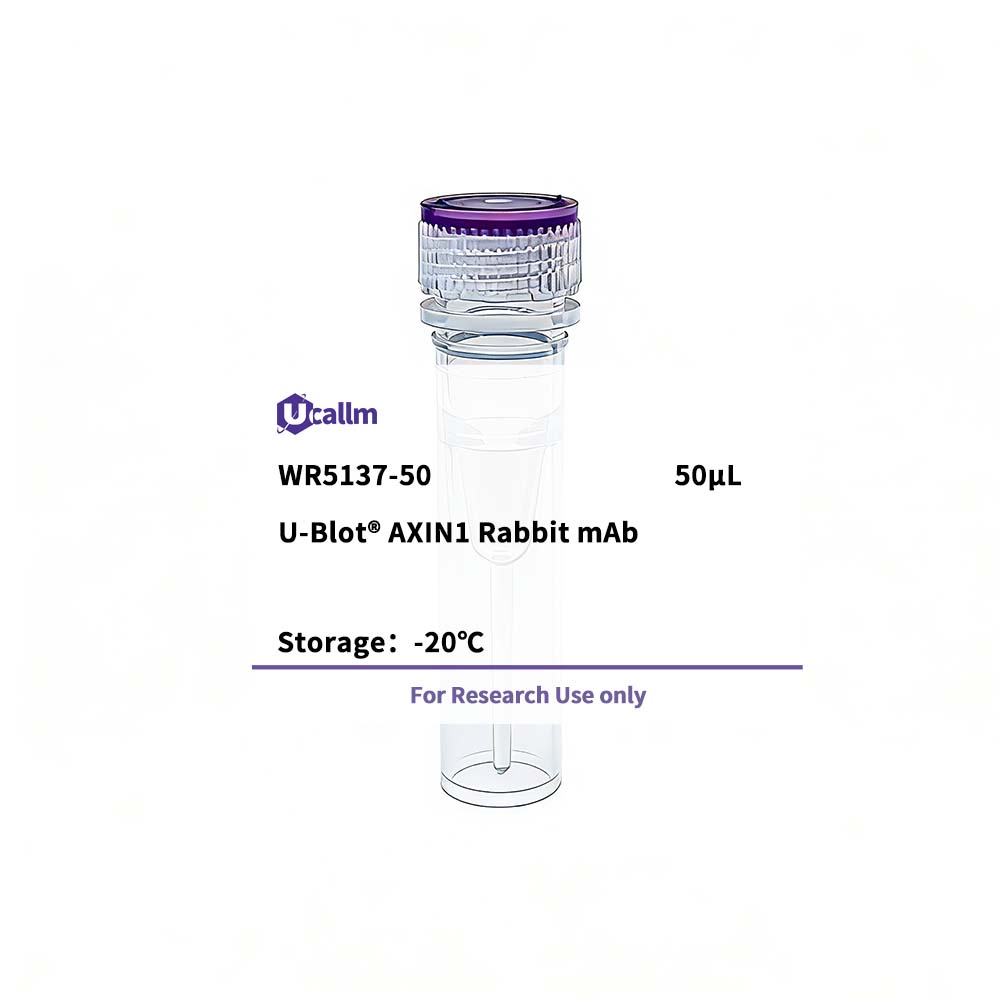
U-Blot® AXIN1 Rabbit mAb

Price range: $268.00 through $328.00

SKU: WR5137-50
Enter the quantity you would like, or drag the panel to find the quantity and price that best for you
Bulk QuoteAuthorize OEM & ODM

Product details

Background:This gene encodes a cytoplasmic protein which contains a regulation of G-protein signaling (RGS) domain and a dishevelled and axin (DIX) domain. The encoded protein interacts with adenomatosis polyposis coli, catenin beta-1, glycogen synthase kinase 3 beta, protein phosphate 2, and itself. This protein functions as a negative regulator of the wingless-type MMTV integration site family, member 1 (WNT) signaling pathway and can induce apoptosis. The crystal structure of a portion of this protein, alone and in a complex with other proteins, has been resolved. Mutations in this gene have been associated with hepatocellular carcinoma, hepatoblastomas, ovarian endometriod adenocarcinomas, and medullablastomas. Alternative splicing results in multiple transcript variants. [provided by RefSeq, Jan 2016],

Specifications

Size50μL/100μL
TargetAXIN1
ReactivityHuman, Mouse
ApplicationsWB, IHC, IF, IP, ELISA
MW(Calculated)96kD
MW(Observed)110kD
Host SpeciesRabbit
IsotypeIgG,Kappa
Conjugate/ModificationUnmodified
Recommended Dilution RatioIHC 1:200-1:1000; WB 1:2000-1:10000; IF 1:200-1:1000; ELISA 1:5000-1:20000; IP 1:50-1:200; / Note: For IHC, we suggest antigen retrieval with TE buffer pH 9.0 (Cat#WT1004)
FormulationPBS, 50% glycerol, 0.05% Proclin 300, 0.05%BSA
PurificationRecombinant Antibody expressed in animal component-free (ACF) media, purified via Protein A affinity chromatography.
Storage-15°C to -25°C/1 year(Do not lower than -25°C)
Concentration
ClonalityMonoclonal
Clone NumberRM1362R
ImmunogenThe specific immunogen used to produce this antibody is proprietary information.
SpecificityEndogenous
Gene NameAXIN1 AXIN
Protein NameAxin-1 (Axis inhibition protein 1) (hAxin)
Other Name
SpeciesHuman
Gene ID8312
UniprotO15169,
Species.1Mouse
Gene ID.1
Uniprot.1O35625,
Species.2Rat
Gene ID.2
Uniprot.2O70239
Cellular LocalizationCytoplasm . Nucleus . Membrane . Cell membrane . MACF1 is required for its translocation to cell membrane (By similarity). On UV irradiation, translocates to the nucleus and colocalizes with DAAX (PubMed:17210684). .
Tissue ExpressionUbiquitously expressed.
Signaling_pathwayCellular Processes >> Cellular community - eukaryotes >> Signaling pathways regulating pluripotency of stem cells;Human Diseases >> Cancer: overview >> Pathways in cancer;Human Diseases >> Cancer: specific types >> Colorectal cancer;Human Diseases >> Cancer: specific types >> Hepatocellular carcinoma;Human Diseases >> Cancer: specific types >> Gastric cancer;Human Diseases >> Cancer: specific types >> Basal cell carcinoma;Human Diseases >> Cancer: specific types >> Endometrial cancer;Human Diseases >> Cancer: specific types >> Breast cancer;Human Diseases >> Neurodegenerative disease >> Alzheimer disease;Human Diseases >> Neurodegenerative disease >> Pathways of neurodegeneration - multiple diseases;Environmental Information Processing >> Signal transduction >> Wnt signaling pathway;Environmental Information Processing >> Signal transduction >> Hippo signaling pathway
Research Areas>>Wnt signaling pathway; / >>Hippo signaling pathway; / >>Signaling pathways regulating pluripotency of stem cells; / >>Cushing syndrome; / >>Alzheimer disease; / >>Pathways of neurodegeneration - multiple diseases; / >>Human papillomavirus infection; / >>Pathways in cancer; / >>Colorectal cancer; / >>Endometrial cancer; / >>Basal cell carcinoma; / >>Breast cancer; / >>Hepatocellular carcinoma; / >>Gastric cancer
FunctionDisease:Defects in AXIN1 are involved in hepatocellular carcinoma (HCC) [MIM:114550].,Disease:Hypermethylation of the AXIN1 promoter may be associated with caudal duplication anomaly [MIM:607864]. Caudal duplication anomaly is characterized by the occurrence of duplications of different organs in the caudal region.,Function:Controls dorsoventral patterning via two opposing effects; down-regulates beta-catenin to inhibit the Wnt signaling pathway and ventralize embryos, but also dorsalizes embryos by activating a Wnt-independent JNK signaling pathway. In Wnt signaling, probably facilitates the phosphorylation of beta-catenin and APC by GSK3B. Likely to function as a tumor suppressor. Facilitates the phosphorylation of TP53 by HIPK2 upon ultraviolet irradiation. Wild-type axin 1 can induce apoptosis in hepatocellular and colorectal cancer cells. Enhances TGF-beta signaling by recruiting the RNF111 E3 ubiquitin ligase and promoting the degradation of inhibitory SMAD7.,PTM:Probably phosphorylated by GSK3B and dephosphorylated by PP2A.,similarity:Contains 1 DIX domain.,similarity:Contains 1 RGS domain.,subunit:Homodimer (By similarity). Interacts with TP53 and HIPK2. Probably part of a complex consisting of TP53, HIPK2 and AXIN1. Interacts with glycogen synthase kinase-3 beta (GSK3B) and beta-catenin. The interaction between axin and beta-catenin occurs via the armadillo repeats contained in beta-catenin. Ternary complex. Also binds to plakoglobin (gamma-catenin), APC, DVL and PP2A. Interacts with SMAD6, SMAD7 and RNF111. Interacts with DIXDC1; prevents interaction with MAP3K1. Interacts with MAP3K4, MDFI and MDFIC. Interacts with ANKRD6. Interacts with AIDA.,tissue specificity:Ubiquitously expressed.,
Please login to post questions
Back to Top
Product has been added to your cart


