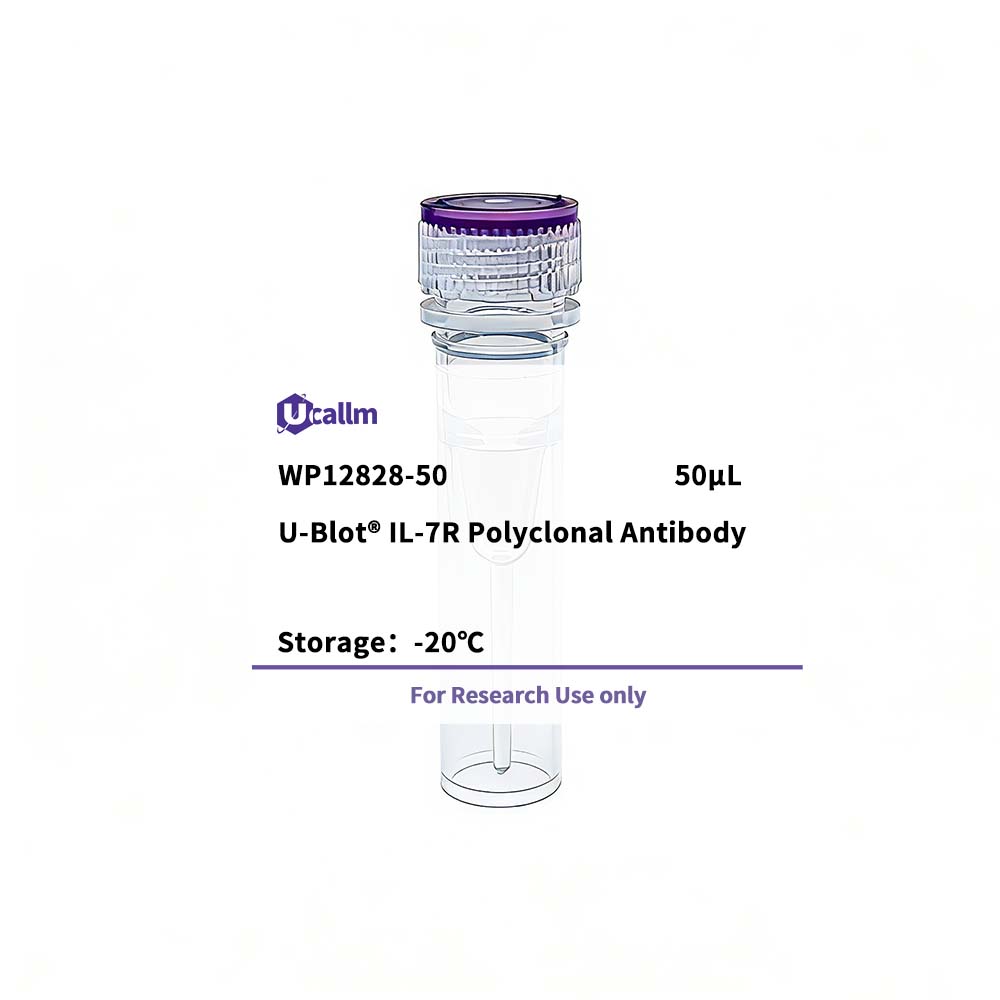
SKU: WP12828 Categories: ,

IL-7R Polyclonal Antibody

Price range: $268.00 through $328.00

SKU: WP12828-100
Enter the quantity you would like, or drag the panel to find the quantity and price that best for you
Bulk QuoteAuthorize OEM & ODM

Product details

Background:

The protein encoded by this gene is a receptor for interleukin 7 (IL7). The function of this receptor requires the interleukin 2 receptor, gamma chain (IL2RG), which is a common gamma chain shared by the receptors of various cytokines, including interleukins 2, 4, 7, 9, and 15. This protein has been shown to play a critical role in V(D)J recombination during lymphocyte development. Defects in this gene may be associated with severe combined immunodeficiency (SCID). Alternatively spliced transcript variants have been found. [provided by RefSeq, Dec 2015],

Specifications

Size50μL/100μL
TargetIL-7R
ReactivityHuman, Mouse, Monkey
ApplicationsWB, ELISA
MW(Calculated)
MW(Observed)52 60kD
Host SpeciesRabbit
IsotypeIgG
Conjugate/ModificationUnmodified
Recommended Dilution RatioWB 1:500-1:2000; ELISA 1:40000; Not yet tested in other applications.
FormulationLiquid in PBS containing 50% glycerol, 0.5% BSA and 0.02% sodium azide.
PurificationThe antibody was affinity-purified from rabbit antiserum by affinity-chromatography using epitope-specific immunogen.
Storage-15°C to -25°C/1 year(Do not lower than -25°C)
Concentration1 mg/ml
ClonalityPolyclonal
Clone Number
ImmunogenThe antiserum was produced against synthesized peptide derived from human IL-7R/CD127. AA range:410-459
SpecificityIL-7R Polyclonal Antibody detects endogenous levels of IL-7R protein.
Gene NameIL7R
Protein NameInterleukin-7 receptor subunit alpha
Other NameIL7R; / Interleukin-7 receptor subunit alpha; / IL-7 receptor subunit alpha; / IL-7R subunit alpha; / IL-7R-alpha; / IL-7RA; / CDw127; / CD antigen CD127
SpeciesHuman
Gene ID3575
UniprotP16871,
Species.1Mouse
Gene ID.116197
Uniprot.1P16872
Species.2
Gene ID.2
Uniprot.2
Cellular Localization[Isoform 1]: Cell membrane; Single-pass type I membrane protein.; [Isoform 3]: Cell membrane; Single-pass type I membrane protein.; [Isoform 4]: Secreted.
Tissue ExpressionB-cell,Epithelium,Spleen,Testis,
Signaling_pathwayOrganismal Systems >> Immune system >> Hematopoietic cell lineage;Human Diseases >> Cancer: overview >> Pathways in cancer;Human Diseases >> Immune disease >> Primary immunodeficiency;Environmental Information Processing >> Signal transduction >> JAK-STAT signaling pathway;Environmental Information Processing >> Signal transduction >> FoxO signaling pathway;Environmental Information Processing >> Signal transduction >> PI3K-Akt signaling pathway;Environmental Information Processing >> Signaling molecules and interaction >> Cytokine-cytokine receptor interaction
Research Areas>>Cytokine-cytokine receptor interaction; / >>FoxO signaling pathway; / >>PI3K-Akt signaling pathway; / >>JAK-STAT signaling pathway; / >>Hematopoietic cell lineage; / >>Pathways in cancer; / >>Primary immunodeficiency
FunctionDisease:A genetic variation in transmembrane domain of IL7R is associated with susceptibility to multiple sclerosis (MS) [MIM:126200]. Overtransmission of the major 'C' allele coding for Thr-244 are detected in offspring affected with multiple sclerosis. In vitro analysis of transcripts from minigenes containing either 'C' allele (Thr-244) or 'T' allele (Ile-244) shows that the 'C' allele results in an approximately two-fold increase in the skipping of exon 6, leading to increased production of a soluble form of IL7R. Thus, the multiple sclerosis associated 'C' risk allele of IL7R would probably decrease membrane-bound expression of IL7R. As this risk allele is common in the general population, some additional triggers are probably required for the development and progression of MS.,Disease:Defects in IL7R are a cause of autosomal recessive severe combined immunodeficiency T-cell-negative/B-cell-positive/NK cell-positive (T(-)/B(+)/NK(+) SCID) [MIM:608971]. SCID refers to a genetically and clinically group of rare congenital disorders characterized by impairment of both humoral and cell-mediated immunity, leukopenia, and low or absent antibody levels. Patients with SCID present in infancy with recurrent, persistent infections by opportunistic organisms, including Candida albicans, Pneumocystis carinii, and cytomegalovirus, among many others. The common characteristic of all types of SCID is absence of T-cell-mediated cellular immunity due to a defect in T-cell development.,Domain:The box 1 motif is required for JAK interaction and/or activation.,Domain:The WSXWS motif appears to be necessary for proper protein folding and thereby efficient intracellular transport and cell-surface receptor binding.,Function:Receptor for interleukin-7. Also acts as a receptor for thymic stromal lymphopoietin (TSLP).,online information:IL7R mutation db,sequence Caution:Contaminating sequence. Potential poly-A sequence.,similarity:Belongs to the type I cytokine receptor family. Type 4 subfamily.,similarity:Contains 1 fibronectin type-III domain.,subunit:The IL7 receptor is an heterodimer of IL7R and IL2RG. The TSLP receptor is an heterodimer of CRLF2 and IL7R.,
Please login to post questions
Back to Top
Product has been added to your cart
