

U-Blot® Integrin α6 Rabbit mAb
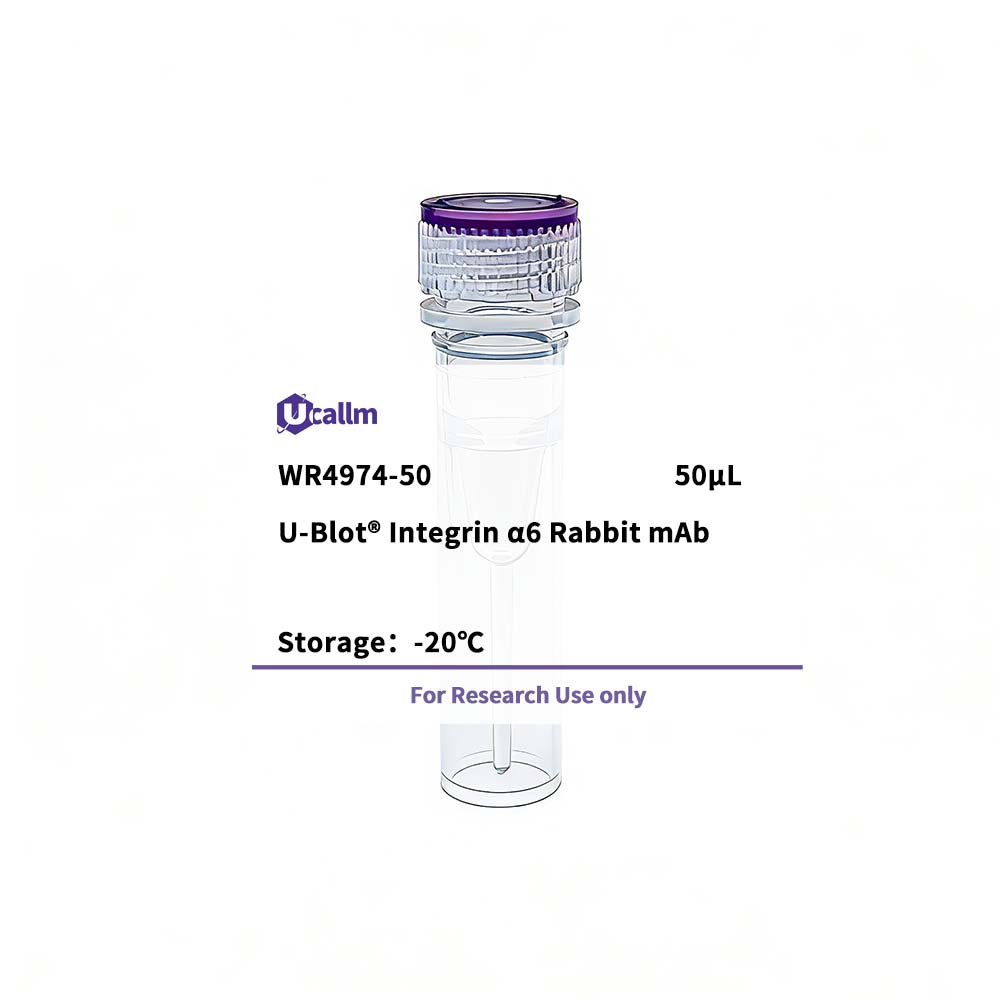
Ucallm_WR4974-50
Price range: $268.00 through $328.00
Product details
Background:integrin subunit alpha 6(ITGA6) Homo sapiens The gene encodes a member of the integrin alpha chain family of proteins. Integrins are heterodimeric integral membrane proteins composed of an alpha chain and a beta chain that function in cell surface adhesion and signaling. The encoded preproprotein is proteolytically processed to generate light and heavy chains that comprise the alpha 6 subunit. This subunit may associate with a beta 1 or beta 4 subunit to form an integrin that interacts with extracellular matrix proteins including members of the laminin family. The alpha 6 beta 4 integrin may promote tumorigenesis, while the alpha 6 beta 1 integrin may negatively regulate erbB2/HER2 signaling. Alternative splicing results in multiple transcript variants. [provided by RefSeq, Oct 2015],
Specifications
| Size | 50μL/100μL |
| Target | Integrin α6 |
| Reactivity | Human, Mouse, Rat |
| Applications | WB, IHC, IF, ELISA |
| MW(Calculated) | 127kD |
| MW(Observed) | 127kD |
| Host Species | Rabbit |
| Isotype | IgG,Kappa |
| Conjugate/Modification | Unmodified |
| Recommended Dilution Ratio | IHC 1:100-1:400; WB 1:2000-1:10000; IF 1:200-1:1000; ELISA 1:5000-1:20000; / Note: For IHC, we suggest antigen retrieval with TE buffer pH 9.0 (Cat#WT1004) |
| Formulation | PBS, 50% glycerol, 0.05% Proclin 300, 0.05%BSA |
| Purification | Recombinant Antibody expressed in animal component-free (ACF) media, purified via Protein A affinity chromatography. |
| Storage | -15°C to -25°C/1 year(Do not lower than -25°C) |
| Concentration | |
| Clonality | Monoclonal |
| Clone Number | RM1206R |
| Immunogen | The specific immunogen used to produce this antibody is proprietary information. |
| Specificity | Endogenous |
| Gene Name | ITGA6 |
| Protein Name | Integrin alpha-6 |
| Other Name | ITGA6; / Integrin alpha-6; / CD49 antigen-like family member F; / VLA-6; / CD49f |
| Species | Human |
| Gene ID | 3655 |
| Uniprot | P23229, |
| Species.1 | Mouse |
| Gene ID.1 | |
| Uniprot.1 | Q61739 |
| Species.2 | |
| Gene ID.2 | |
| Uniprot.2 | |
| Cellular Localization | Cell membrane; Single-pass type I membrane protein . Cell membrane; Lipid-anchor . |
| Tissue Expression | Integrin alpha-6/beta-4 is predominantly expressed by epithelia. Isoforms containing segment X1 are ubiquitously expressed. Isoforms containing segment X1X2 are expressed in heart, kidney, placenta, colon, duodenum, myoblasts and myotubes, and in a limited number of cell lines; they are always coexpressed with the ubiquitous isoform containing segment X1. In some tissues (e.g. Salivary gland), isoforms containing cytoplasmic segment A and isoforms containing segment B are detected while in others, only isoforms containing one cytoplasmic segment are found (segment A in epidermis and segment B in kidney). Processed integrin alpha-6: Expressed at low levels in normal prostate tissue with elevated levels in prostate cancer tissue (at protein level) (PubMed:15023541). |
| Signaling_pathway | Cellular Processes >> Cellular community - eukaryotes >> Focal adhesion;Cellular Processes >> Cell motility >> Regulation of actin cytoskeleton;Organismal Systems >> Immune system >> Hematopoietic cell lineage;Human Diseases >> Cancer: overview >> Pathways in cancer;Human Diseases >> Cancer: specific types >> Small cell lung cancer;Environmental Information Processing >> Signal transduction >> PI3K-Akt signaling pathway;Environmental Information Processing >> Signaling molecules and interaction >> ECM-receptor interaction;Environmental Information Processing >> Signaling molecules and interaction >> Cell adhesion molecules |
| Research Areas | >>PI3K-Akt signaling pathway; / >>Focal adhesion; / >>ECM-receptor interaction; / >>Cell adhesion molecules; / >>Hematopoietic cell lineage; / >>Regulation of actin cytoskeleton; / >>Toxoplasmosis; / >>Human papillomavirus infection; / >>Pathways in cancer; / >>Small cell lung cancer; / >>Hypertrophic cardiomyopathy; / >>Arrhythmogenic right ventricular cardiomyopathy; / >>Dilated cardiomyopathy |
| Function | Alternative products:Additional isoforms seem to exist. There is a combination of at least four alternatively spliced domains, two extracellular (X1 and X2) and two cytoplasmic (A and B). So far detected are isoform Alpha-6X1A, isoform Alpha-6X1B and isoform Alpha-6X1X2A (minor). Experimental confirmation may be lacking for some isoforms,Disease:Defects in ITGA6 are a cause of epidermolysis bullosa with pyloric atresia (EB-PA) [MIM:226730]; also known as aplasia cutis congenita with gastrointestinal atresia. EB-PA is an autosomal recessive disease characterized by mucocutaneous fragility and gastrointestinal atresia, which most commonly affects the pylorus.,Function:Integrin alpha-6/beta-1 is a receptor for laminin on platelets. Integrin alpha-6/beta-4 is a receptor for laminin in epithelial cells and it plays a critical structural role in the hemidesmosome.,PTM:Isoforms containing segment A, but not segment B, are the major targets for PMA-induced phosphorylation. Phosphorylation occurs on 'Ser-1103' of isoform alpha-6X1X2A. Phosphorylation is not required for the induction of integrin alpha-6A/beta-1 high affinity but may reduce the affinity for ligand.,similarity:Belongs to the integrin alpha chain family.,similarity:Contains 7 FG-GAP repeats.,subunit:Heterodimer of an alpha and a beta subunit. The alpha subunit is composed of an heavy and a light chain linked by a disulfide bond. Alpha-6 associates with either beta-1 or beta-4. Interacts with HPS5. Interacts with RAB21.,tissue specificity:Integrin alpha-6/beta-4 is predominantly expressed by epithelia. Isoforms containing segment X1 are ubiquitously expressed. Isoforms containing segment X1X2 are expressed in heart, kidney, placenta, colon, duodenum, myoblasts and myotubes, and in a limited number of cell lines; they are always coexpressed with the ubiquitous isoform containing segment X1. In some tissues (e.g. Salivary gland), isoforms containing cytoplasmic segment A and isoforms containing segment B are detected while in others, only isoforms containing one cytoplasmic segment are found (segment A in epidermis and segment B in kidney)., |
Please login to post questions
Related products




