

U-Blot® IRE1α Rabbit mAb
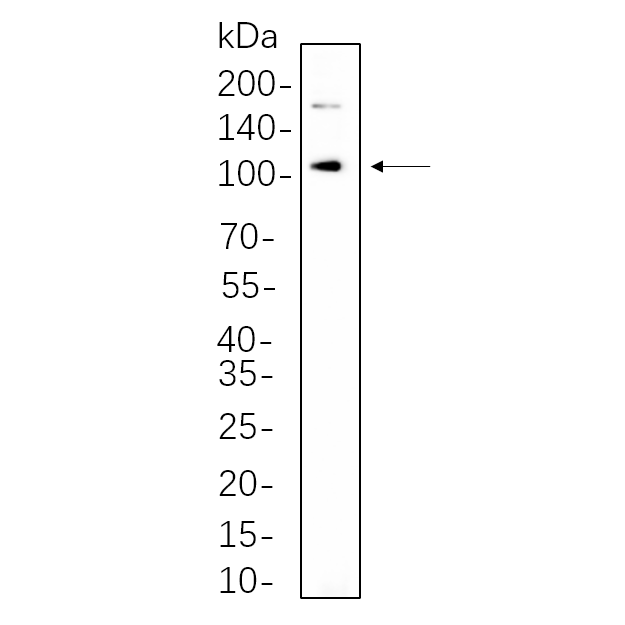
WR4194 LnCap whole cell lysates were separated by 10% SDS-PAGE, and the membrane was blotted with primary antibody(1:1000). The HRP-conjugated Goat anti-Rabbit IgG(H + L) antibody was used to detect the antibody.
Price range: $268.00 through $328.00
Product details
Background:The protein encoded by this gene is the ER to nucleus signalling 1 protein, a human homologue of the yeast Ire1 gene product. This protein possesses intrinsic kinase activity and an endoribonuclease activity and it is important in altering gene expression as a response to endoplasmic reticulum-based stress signals. [provided by RefSeq, Jul 2008],
Specifications
| Size | 50μL/100μL |
| Target | IRE1α |
| Reactivity | Human, Mouse, Rat |
| Applications | WB, IHC, IF, IP, ELISA |
| MW(Calculated) | 110kD |
| MW(Observed) | 110kD |
| Host Species | Rabbit |
| Isotype | IgG,Kappa |
| Conjugate/Modification | Unmodified |
| Recommended Dilution Ratio | IHC 1:100-1:500; WB 1:2000-1:10000; IF 1:200-1:1000; ELISA 1:5000-1:20000; IP 1:50-1:200; / Note: For IHC, we suggest antigen retrieval with TE buffer pH 9.0 (Cat#WT1004) |
| Formulation | PBS, 50% glycerol, 0.05% Proclin 300, 0.05%BSA |
| Purification | Recombinant Antibody expressed in animal component-free (ACF) media, purified via Protein A affinity chromatography. |
| Storage | -15°C to -25°C/1 year(Do not lower than -25°C) |
| Concentration | |
| Clonality | Monoclonal |
| Clone Number | RM0365R |
| Immunogen | The specific immunogen used to produce this antibody is proprietary information. |
| Specificity | Endogenous |
| Gene Name | ERN1 IRE1 |
| Protein Name | Serine/threonine-protein kinase/endoribonuclease IRE1 |
| Other Name | ERN1; / IRE1; / Serine/threonine-protein kinase/endoribonuclease IRE1; / Endoplasmic reticulum-to-nucleus signaling 1; / Inositol-requiring protein 1; / hIRE1p; / Ire1-alpha; / IRE1a |
| Species | Human |
| Gene ID | 2081 |
| Uniprot | O75460, |
| Species.1 | Mouse |
| Gene ID.1 | 78943 |
| Uniprot.1 | Q9EQY0 |
| Species.2 | |
| Gene ID.2 | |
| Uniprot.2 | |
| Cellular Localization | Endoplasmic reticulum membrane |
| Tissue Expression | Ubiquitously expressed. High levels observed in pancreatic tissue. |
| Signaling_pathway | Cellular Processes >> Transport and catabolism >> Autophagy - animal;Cellular Processes >> Cell growth and death >> Apoptosis;Human Diseases >> Neurodegenerative disease >> Alzheimer disease;Human Diseases >> Neurodegenerative disease >> Parkinson disease;Human Diseases >> Neurodegenerative disease >> Amyotrophic lateral sclerosis;Human Diseases >> Neurodegenerative disease >> Huntington disease;Human Diseases >> Neurodegenerative disease >> Spinocerebellar ataxia;Human Diseases >> Neurodegenerative disease >> Pathways of neurodegeneration - multiple diseases |
| Research Areas | >>Autophagy - animal; / >>Protein processing in endoplasmic reticulum; / >>Apoptosis; / >>Non-alcoholic fatty liver disease; / >>Alzheimer disease; / >>Parkinson disease; / >>Amyotrophic lateral sclerosis; / >>Huntington disease; / >>Spinocerebellar ataxia; / >>Pathways of neurodegeneration - multiple diseases; / >>Lipid and atherosclerosis |
| Function | Catalytic activity:ATP + a protein = ADP + a phosphoprotein.,cofactor:Magnesium.,enzyme regulation:The kinase domain is activated by trans-autophosphorylation. Kinase activity is required for activation of the endoribonuclease domain.,Function:Senses unfolded proteins in the lumen of the endoplasmic reticulum via its N-terminal domain which leads to enzyme auto-activation. The active endoribonuclease domain splices XBP1 mRNA to generate a new C-terminus, converting it into a potent unfolded-protein response transcriptional activator and triggering growth arrest and apoptosis.,PTM:Autophosphorylated.,similarity:Belongs to the protein kinase superfamily. Ser/Thr protein kinase family.,similarity:Contains 1 KEN domain.,similarity:Contains 1 protein kinase domain.,subunit:Homodimer; disulfide-linked. Dimer formation is driven by hydrophobic interactions within the N-terminal luminal domains and stabilized by disulfide bridges. Also binds HSPA5, a negative regulator of the unfolded protein response. This interaction may disrupt homodimerization and prevent activation of ERN1.,tissue specificity:Ubiquitously expressed. High levels observed in pancreatic tissue., |
Please login to post questions
Related products





