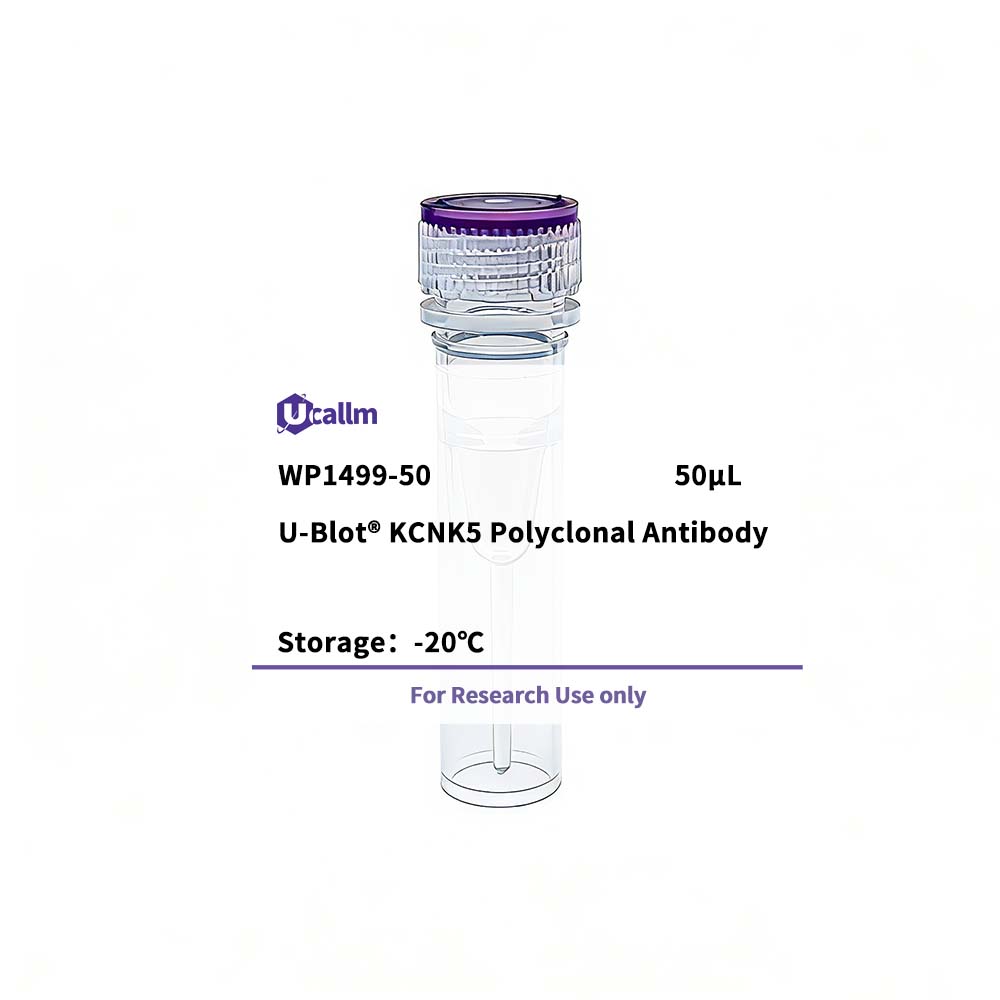
SKU: WP1499 Categories: ,

KCNK5 Polyclonal Antibody

Price range: $268.00 through $328.00

SKU: WP1499-100
Enter the quantity you would like, or drag the panel to find the quantity and price that best for you
Bulk QuoteAuthorize OEM & ODM

Product details

Background:

This gene encodes one of the members of the superfamily of potassium channel proteins containing two pore-forming P domains. The message for this gene is mainly expressed in the cortical distal tubules and collecting ducts of the kidney. The protein is highly sensitive to external pH and this, in combination with its expression pattern, suggests it may play an important role in renal potassium transport. [provided by RefSeq, Jul 2008],

Specifications

Size50μL/100μL
TargetKCNK5
ReactivityHuman
ApplicationsWB, ELISA
MW(Calculated)
MW(Observed)54kD
Host SpeciesRabbit
IsotypeIgG
Conjugate/ModificationUnmodified
Recommended Dilution RatioWB 1:500-2000; ELISA 1:5000-20000
FormulationLiquid in PBS containing 50% glycerol,0.5% BSA and 0.02% sodium azide.
PurificationThe antibody was affinity-purified from rabbit antiserum by affinity-chromatography using epitope-specific immunogen.
Storage-15°C to -25°C/1 year(Do not lower than -25°C)
Concentration1 mg/ml
ClonalityPolyclonal
Clone Number
ImmunogenSynthesized peptide derived from human protein . at AA range: 230-310
SpecificityKCNK5 Polyclonal Antibody detects endogenous levels of protein.
Gene NameKCNK5 TASK2
Protein NamePotassium channel subfamily K member 5 (Acid-sensitive potassium channel protein TASK-2) (TWIK-related acid-sensitive K(+) channel 2)
Other Name
SpeciesHuman
Gene ID8645
UniprotO95279
Species.1
Gene ID.1
Uniprot.1
Species.2
Gene ID.2
Uniprot.2
Cellular LocalizationMembrane; Multi-pass membrane protein .
Tissue ExpressionAbundant expression in kidney, also detected in liver, placenta and small intestine. In the kidney, expression is restricted to the distal tubules and collecting ducts (PubMed:9812978). Not expressed in proximal tubules or glomeruli (PubMed:9812978).
Signaling_pathway
Research Areas>>Taste transduction; / >>Protein digestion and absorption
FunctionFunction:pH-dependent, voltage insensitive, outwardly rectifying potassium channel. Outward rectification is lost at high external K(+) concentrations.,miscellaneous:Inhibited by quinine, quinidine and external acidification.,similarity:Belongs to the two pore domain potassium channel (TC 1.A.1.8) family.,subunit:Homodimer; disulfide-linked.,tissue specificity:Abundant expression in kidney, also detected in liver, placenta and small intestine. In the kidney, expression is restricted to the distal tubules and collecting ducts. Not expressed in proximal tubules or glomeruli.,
Please login to post questions
Back to Top
Product has been added to your cart


