



KIN17 rabbit pAb
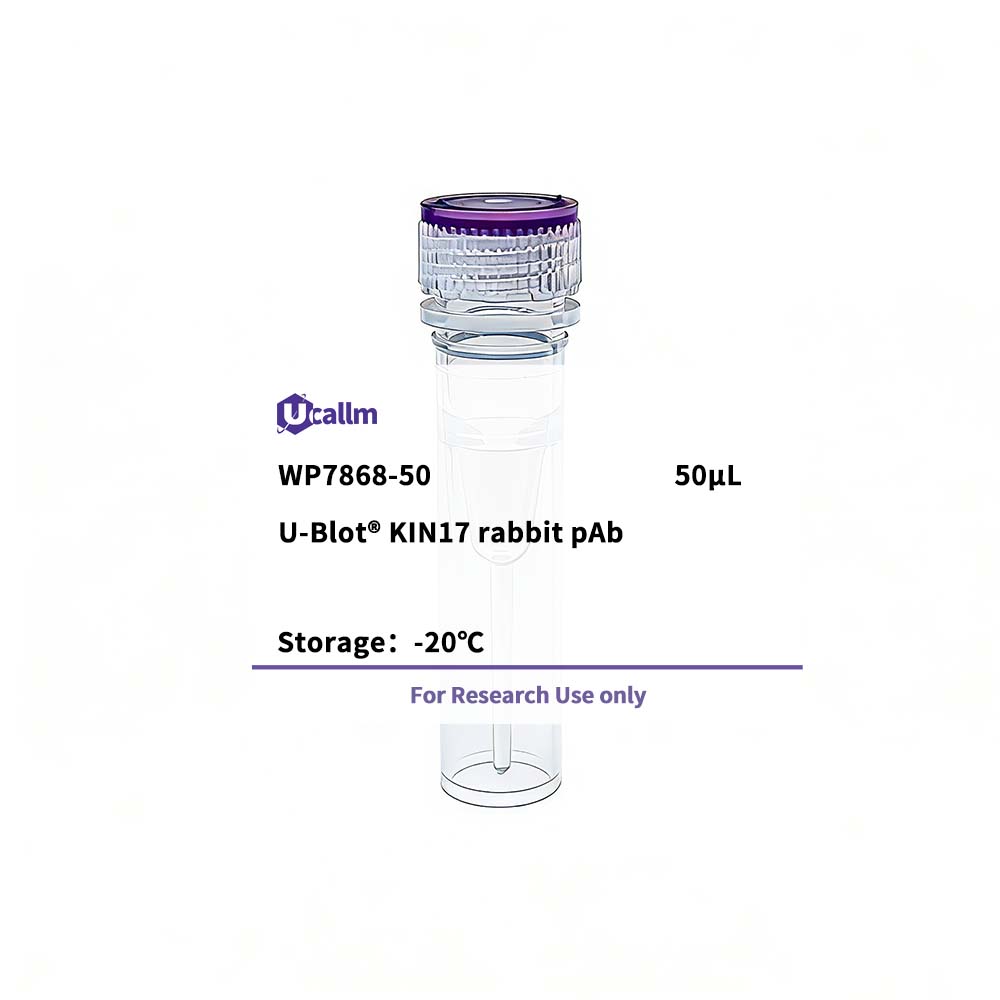
Ucallm_WP7868-50
Price range: $268.00 through $328.00
Product details
Background:
Specifications
| Size | 50μL/100μL |
| Target | KIN |
| Reactivity | Human, Mouse |
| Applications | WB |
| MW(Calculated) | 43kD |
| MW(Observed) | |
| Host Species | Rabbit |
| Isotype | IgG |
| Conjugate/Modification | Unmodified |
| Recommended Dilution Ratio | WB 1:500-2000 |
| Formulation | Liquid in PBS containing 50% glycerol, 0.5% BSA and 0.02% sodium azide. |
| Purification | The antibody was affinity-purified from rabbit antiserum by affinity-chromatography using epitope-specific immunogen. |
| Storage | -15°C to -25°C/1 year(Do not lower than -25°C) |
| Concentration | 1 mg/ml |
| Clonality | Polyclonal |
| Clone Number | |
| Immunogen | Synthesized peptide derived from human KIN17 |
| Specificity | This antibody detects endogenous levels of KIN17 at Human, Mouse |
| Gene Name | KIN BTCD KIN17 |
| Protein Name | DNA/RNA-binding protein KIN17 (Binding to curved DNA) (KIN, antigenic determinant of recA protein homolog) |
| Other Name | |
| Species | Human |
| Gene ID | 22944 |
| Uniprot | O60870, |
| Species.1 | Mouse |
| Gene ID.1 | 16588 |
| Uniprot.1 | Q8K339 |
| Species.2 | |
| Gene ID.2 | |
| Uniprot.2 | |
| Cellular Localization | Nucleus . Cytoplasm . During S phase, strongly associated with the nuclear matrix, and to chromosomal DNA in the presence of DNA damage. Also shows cytoplasmic localization in elongated spermatids. . |
| Tissue Expression | Ubiquitously expressed in all tissues examined, with highest levels in skeletal muscle, heart and testis. Differentially expressed in non-tumorigenic and tumorigenic cell lines. Highly expressed in proliferating epithelial keratinocyte cells in vitro (at protein level). |
| Signaling_pathway | |
| Research Areas | |
| Function | Involved in DNA replication and the cellular response to DNA damage. May participate in DNA replication factories and create a bridge between DNA replication and repair mediated by high molecular weight complexes. May play a role in illegitimate recombination and regulation of gene expression. May participate in mRNA processing. Binds, in vitro, to double-stranded DNA. Also shown to bind preferentially to curved DNA in vitro and in vivo (By similarity). Binds via its C-terminal domain to RNA in vitro. |
Please login to post questions
Related products





