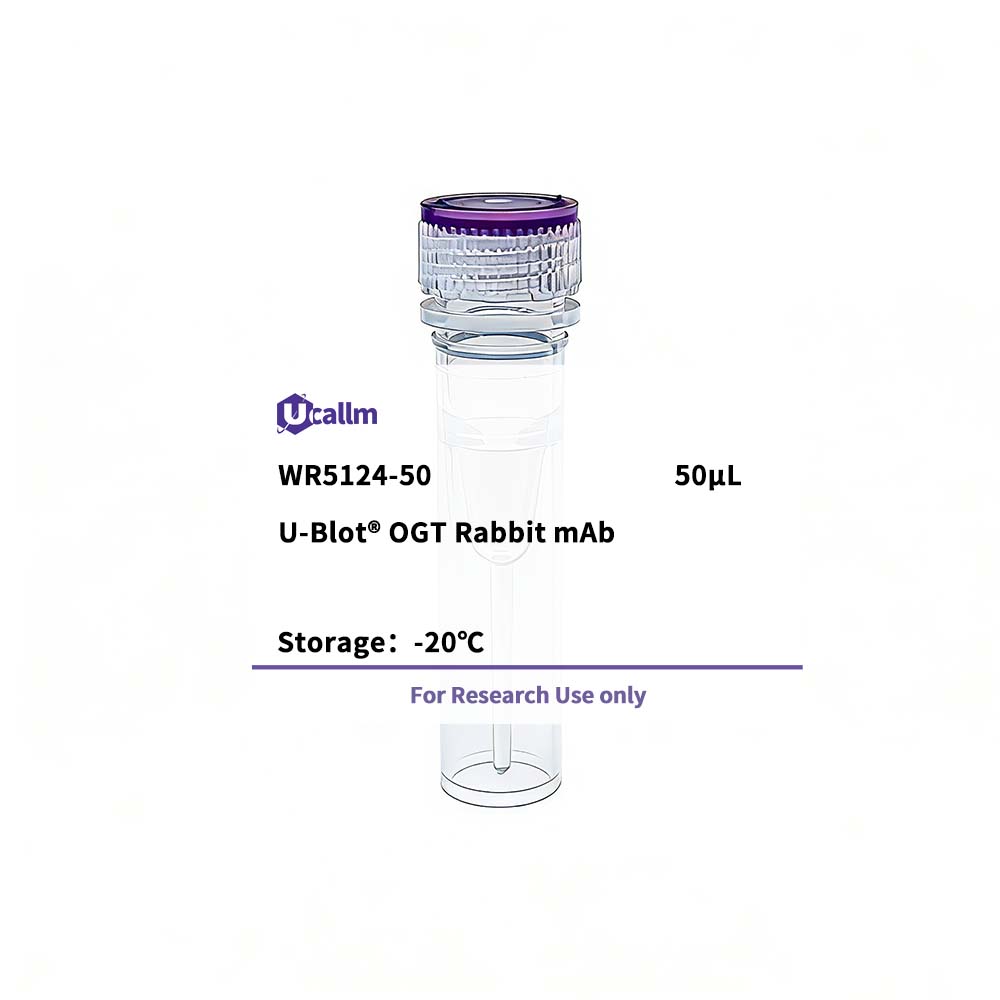
SKU: WR5124 Categories: ,

U-Blot® OGT Rabbit mAb

Price range: $268.00 through $328.00

SKU: WR5124-50
Enter the quantity you would like, or drag the panel to find the quantity and price that best for you
Bulk QuoteAuthorize OEM & ODM

Product details

Background:This gene encodes a glycosyltransferase that catalyzes the addition of a single N-acetylglucosamine in O-glycosidic linkage to serine or threonine residues. Since both phosphorylation and glycosylation compete for similar serine or threonine residues, the two processes may compete for sites, or they may alter the substrate specificity of nearby sites by steric or electrostatic effects. The protein contains multiple tetratricopeptide repeats that are required for optimal recognition of substrates. Alternatively spliced transcript variants encoding distinct isoforms have been found for this gene. [provided by RefSeq, Oct 2009],


Specifications

Size50μL/100μL
TargetOGT
ReactivityHuman, Mouse, Rat
ApplicationsWB, IHC, IF, ELISA
MW(Calculated)117kD
MW(Observed)117kD
Host SpeciesRabbit
IsotypeIgG,Kappa
Conjugate/ModificationUnmodified
Recommended Dilution RatioIHC 1:200-1:1000; WB 1:2000-1:10000; IF 1:200-1:1000; ELISA 1:5000-1:20000; / Note: For IHC, we suggest antigen retrieval with TE buffer pH 9.0 (Cat#WT1004)
FormulationPBS, 50% glycerol, 0.05% Proclin 300, 0.05%BSA
PurificationRecombinant Antibody expressed in animal component-free (ACF) media, purified via Protein A affinity chromatography.
Storage-15°C to -25°C/1 year(Do not lower than -25°C)
Concentration
ClonalityMonoclonal
Clone NumberRM1337R
ImmunogenThe specific immunogen used to produce this antibody is proprietary information.
SpecificityEndogenous
Gene NameOGT
Protein NameUDP-N-acetylglucosamine--peptide N-acetylglucosaminyltransferase 110 kDa subunit (O-GlcNAc transferase subunit p110) (O-linked N-acetylglucosamine transferase 110 kDa subunit) (OGT)
Other NameUDP-N-acetylglucosamine--peptide N-acetylglucosaminyltransferase 110 kDa subunit; / O-GlcNAc transferase subunit p110; / O-linked N-acetylglucosamine transferase 110 kDa subunit; / OGT
SpeciesHuman
Gene ID8473
UniprotO15294,
Species.1Mouse
Gene ID.1108155
Uniprot.1Q8CGY8,
Species.2Rat
Gene ID.226295
Uniprot.2P56558
Cellular LocalizationNucleus . Cytoplasm . Predominantly localizes to the nucleus. .; [Isoform 2]: Mitochondrion . Membrane . Associates with the mitochondrial inner membrane. .; [Isoform 3]: Cytoplasm . Nucleus . Cell membrane . Mitochondrion membrane . Cell projection . Mostly in the nucleus. Retained in the nucleus via interaction with HCFC1 (PubMed:21285374). After insulin induction, translocated from the nucleus to the cell membrane via phosphatidylinositide binding. Colocalizes with AKT1 at the plasma membrane. TRAK1 recruits this protein to mitochondria. In the absence of TRAK1, localizes in cytosol and nucleus (By similarity). .; [Isoform 4]: Cytoplasm. Nucleus.
Tissue ExpressionHighly expressed in pancreas and to a lesser extent in skeletal muscle, heart, brain and placenta. Present in trace amounts in lung and liver.
Signaling_pathway
Research Areas>>Other types of O-glycan biosynthesis; / >>Insulin resistance
FunctionCatalytic activity:UDP-N-acetyl-D-glucosamine + peptide = UDP + N-acetyl-beta-D-glucosaminyl-peptide.,Function:Addition of nucleotide-activated sugars directly onto the polypeptide through O-glycosidic linkage with the hydroxyl of serine or threonine.,online information:UDP-N-acetylglucosamine--peptide N-acetylglucosaminyltransferase 110kDa subunit,pathway:Protein modification; protein glycosylation.,similarity:Belongs to the O-GlcNAc transferase family.,similarity:Contains 13 TPR repeats.,subunit:Heterotrimer of two 110 kDa and one 70 kDa subunits. It is not known if the 70 kDa subunit is encoded by a separate gene or is the product of either of a proteolytic degradation or an alternative initiation of the 110 kDa subunit (By similarity). Interacts with HCFC1.,tissue specificity:Highly expressed in pancreas and to a lesser extent in skeletal muscle, heart, brain and placenta. Present in trace amounts in lung and liver.,
Please login to post questions
Back to Top
Product has been added to your cart
