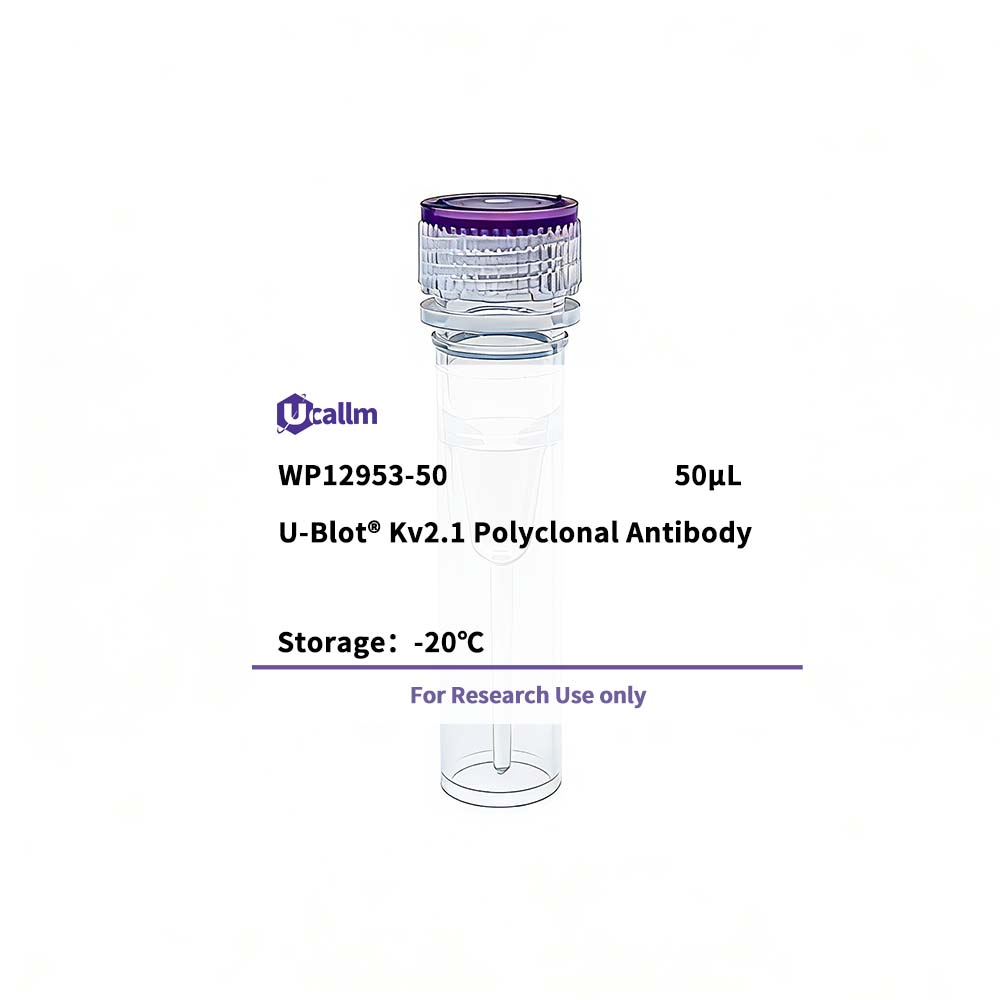
SKU: WP12953 Categories: ,

Kv2.1 Polyclonal Antibody

Price range: $268.00 through $328.00

SKU: WP12953-100
Enter the quantity you would like, or drag the panel to find the quantity and price that best for you
Bulk QuoteAuthorize OEM & ODM

Product details

Background:

Voltage-gated potassium (Kv) channels represent the most complex class of voltage-gated ion channels from both functional and structural standpoints. Their diverse functions include regulating neurotransmitter release, heart rate, insulin secretion, neuronal excitability, epithelial electrolyte transport, smooth muscle contraction, and cell volume. Four sequence-related potassium channel genes – shaker, shaw, shab, and shal – have been identified in Drosophila, and each has been shown to have human homolog(s). This gene encodes a member of the potassium channel, voltage-gated, shab-related subfamily. This member is a delayed rectifier potassium channel and its activity is modulated by some other family members. [provided by RefSeq, Jul 2008],

Specifications

Size50μL/100μL
TargetKv2.1
ReactivityHuman, Mouse, Rat
ApplicationsIHC, IF, ELISA
MW(Calculated)96kD
MW(Observed)
Host SpeciesRabbit
IsotypeIgG
Conjugate/ModificationUnmodified
Recommended Dilution RatioIHC 1:100-1:300; IF 1:200-1:1000; ELISA 1:20000; Not yet tested in other applications. / Note: For IHC, we suggest antigen retrieval with TE buffer pH 9.0 (Cat#WT1004)
FormulationLiquid in PBS containing 50% glycerol, 0.5% BSA and 0.02% sodium azide.
PurificationThe antibody was affinity-purified from rabbit antiserum by affinity-chromatography using epitope-specific immunogen.
Storage-15°C to -25°C/1 year(Do not lower than -25°C)
Concentration1 mg/ml
ClonalityPolyclonal
Clone Number
ImmunogenThe antiserum was produced against synthesized peptide derived from human Kv2.1/KCNB1. AA range:533-582
SpecificityKv2.1 Polyclonal Antibody detects endogenous levels of Kv2.1 protein.
Gene NameKCNB1
Protein NamePotassium voltage-gated channel subfamily B member 1
Other NameKCNB1; / Potassium voltage-gated channel subfamily B member 1; / Delayed rectifier potassium channel 1; / DRK1; / h-DRK1; / Voltage-gated potassium channel subunit Kv2.1
SpeciesHuman
Gene ID3745
UniprotQ14721,
Species.1Mouse
Gene ID.116500
Uniprot.1Q03717,
Species.2Rat
Gene ID.225736
Uniprot.2P15387
Cellular LocalizationCell membrane . Perikaryon . Cell projection, axon . Cell projection, dendrite . Membrane; Multi-pass membrane protein. Cell junction, synapse, postsynaptic cell membrane . Cell junction, synapse . Cell junction, synapse, synaptosome . Lateral cell membrane . Cell membrane, sarcolemma . Localizes to high-density somatodendritic clusters and non-clustered sites on the surface of neocortical and hippocampal pyramidal neurons in a cortical actin cytoskeleton-dependent manner (PubMed:24477962). Localizes also to high-density clusters in the axon initial segment (AIS), at ankyrin-G-deficient sites, on the surface of neocortical and hippocampal pyramidal neurons (PubMed:24477962). KCNB1-containing AIS clusters localize either in close apposition to smooth endoplasmic reticulum cisternal organelles or with GABA-A receptor-containing synapses of hippocampal and cortical pyramidal neurons, respectively (PubMed:24477962). Localizes to high-density clusters on the cell surface of atrial and ventricular myocytes and at the lateral plasma membrane in epithelial cells. Localizes both to the axial and transverse tubules (T tubule) and sarcolemma in ventricular myocytes. Associated with lipid raft domains. In cortical neurons, apoptotic injuries induce de novo plasma membrane insertion in a SNARE-dependent manner causing an apoptotic potassium current surge. .
Tissue ExpressionExpressed in neocortical pyramidal cells (PubMed:24477962). Expressed in pancreatic beta cells (at protein level) (PubMed:12403834, PubMed:14988243). Expressed in brain, heart, lung, liver, colon, kidney and adrenal gland (PubMed:19074135). Expressed in the cortex, amygdala, cerebellum, pons, thalamus, hypothalamus, hippocampus and substantia nigra (PubMed:19074135).
Signaling_pathway
Research Areas
FunctionDomain:The segment S4 is probably the voltage-sensor and is characterized by a series of positively charged amino acids at every third position.,Domain:The tail may be important in modulation of channel activity and/or targeting of the channel to specific subcellular compartments.,Function:Mediates the voltage-dependent potassium ion permeability of excitable membranes. Channels open or close in response to the voltage difference across the membrane, letting potassium ions pass in accordance with their electrochemical gradient.,PTM:Highly phosphorylated on serine residues in the C-terminal. Differential phosphorylation on a subset of serines allows graded activity-dependent regulation of channel gating. Phosphorylation on Ser-457, Ser-541, Ser-567, Ser-607, Ser-656 and Ser-720 as well as the N-terminal Ser-15 are all regulated by calcineurin-mediated dephosphorylation. Particularly, Ser-607 and Tyr-128 are significant sites of voltage-gated regulation through phosphorylation/ dephosphorylation activities. Tyr-128 can be dephosphorylated by PTPalpha and cyt-PTPepsilon. Phosphorylation levels on Ser-607 are supersensitive to neuronal activity. Phosphorylation on Ser-567 is reduced during postnatal development with low levels at P2 and P5. Levels then increase to reach adult levels by P14. Phosphorylation levels on Ser-564 and Ser-607 are greatly reduced during seizures, by 40% and 85% respectively.,similarity:Belongs to the potassium channel family. B (Shab) subfamily.,subunit:Heteromultimer with KCNG2, KCNG3, KCNG4, KCNS1, KCNS2, KCNS3 and KCNV2.,
Please login to post questions
Back to Top
Product has been added to your cart
