


LPAAT-γ Polyclonal Antibody
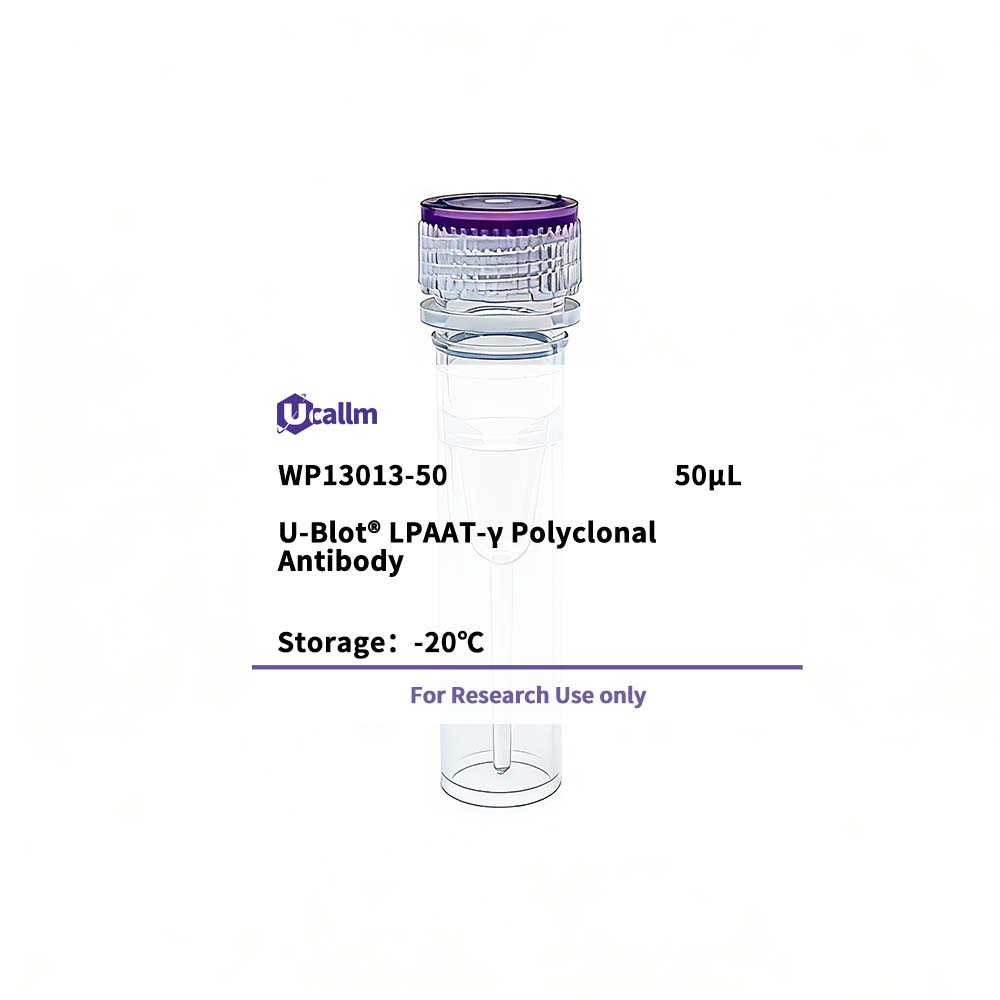
Ucallm_WP13013-50
Price range: $268.00 through $328.00
Product details
Background:
The protein encoded by this gene is an acyltransferase that converts lysophosphatidic acid into phosphatidic acid, which is the second step in the de novo phospholipid biosynthetic pathway. The encoded protein may be an integral membrane protein. Two transcript variants encoding the same protein have been found for this gene. [provided by RefSeq, Jul 2008],
Specifications
| Size | 50μL/100μL |
| Target | LPAAT-γ |
| Reactivity | Human, Mouse, Rat |
| Applications | WB, ELISA, IHC |
| MW(Calculated) | |
| MW(Observed) | 40kD |
| Host Species | Rabbit |
| Isotype | IgG |
| Conjugate/Modification | Unmodified |
| Recommended Dilution Ratio | WB 1:500-2000; IHC 1:50-300; ELISA 1:2000-20000 / Note: For IHC, we suggest antigen retrieval with TE buffer pH 9.0 (Cat#WT1004) |
| Formulation | Liquid in PBS containing 50% glycerol, 0.5% BSA and 0.02% sodium azide. |
| Purification | The antibody was affinity-purified from rabbit antiserum by affinity-chromatography using epitope-specific immunogen. |
| Storage | -15°C to -25°C/1 year(Do not lower than -25°C) |
| Concentration | 1 mg/ml |
| Clonality | Polyclonal |
| Clone Number | |
| Immunogen | The antiserum was produced against synthesized peptide derived from human AGPAT3. AA range:121-170 |
| Specificity | LPAAT-γ Polyclonal Antibody detects endogenous levels of LPAAT-γ protein. |
| Gene Name | AGPAT3 |
| Protein Name | 1-acyl-sn-glycerol-3-phosphate acyltransferase gamma |
| Other Name | AGPAT3; / 1-acyl-sn-glycerol-3-phosphate acyltransferase gamma; / 1-acylglycerol-3-phosphate O-acyltransferase 3; / 1-AGP acyltransferase 3; / 1-AGPAT 3; / Lysophosphatidic acid acyltransferase gamma; / LPAAT-gamma |
| Species | Human |
| Gene ID | 56894 |
| Uniprot | Q9NRZ7, |
| Species.1 | Mouse |
| Gene ID.1 | 28169 |
| Uniprot.1 | Q9D517 |
| Species.2 | |
| Gene ID.2 | |
| Uniprot.2 | |
| Cellular Localization | Endoplasmic reticulum membrane; Multi-pass membrane protein . Nucleus envelope . |
| Tissue Expression | Widely expressed with highest levels in testis, pancreas and kidney, followed by spleen, lung, adipose tissue and liver. |
| Signaling_pathway | Environmental Information Processing >> Signal transduction >> Phospholipase D signaling pathway |
| Research Areas | >>Glycerolipid metabolism; / >>Glycerophospholipid metabolism; / >>Metabolic pathways; / >>Phospholipase D signaling pathway |
| Function | Catalytic activity:Acyl-CoA + 1-acyl-sn-glycerol 3-phosphate = CoA + 1,2-diacyl-sn-glycerol 3-phosphate.,Domain:The HXXXXD motif is essential for acyltransferase activity and may constitute the binding site for the phosphate moiety of the glycerol-3-phosphate.,Function:Converts lysophosphatidic acid (LPA) into phosphatidic acid by incorporating an acyl moiety at the sn-2 position of the glycerol backbone.,pathway:Phospholipid metabolism; CDP-diacylglycerol biosynthesis; CDP-diacylglycerol from sn-glycerol 3-phosphate: step 2/3.,similarity:Belongs to the 1-acyl-sn-glycerol-3-phosphate acyltransferase family., |
Please login to post questions
Related products




