

LPAAT-θ Polyclonal Antibody
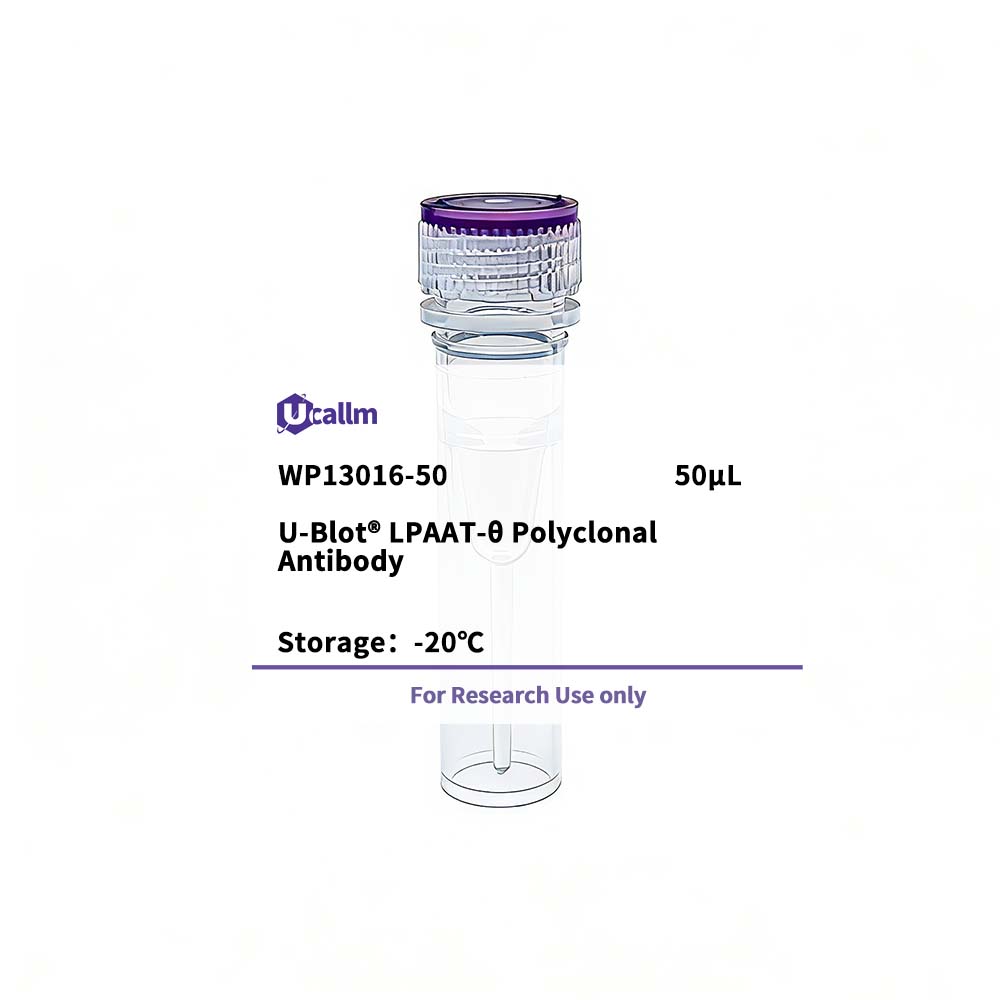
Ucallm_WP13016-50
Price range: $268.00 through $328.00
Product details
Background:
This gene encodes a member of the lysophosphatidic acid acyltransferase protein family. The encoded protein is an enzyme which catalyzes the conversion of glycerol-3-phosphate to lysophosphatidic acid in the synthesis of triacylglycerol. Multiple alternatively spliced variants, encoding the same protein, have been identified. [provided by RefSeq, Jan 2012],
Specifications
| Size | 50μL/100μL |
| Target | LPAAT-θ |
| Reactivity | Human, Mouse, Rat |
| Applications | WB, IHC, IF, ELISA |
| MW(Calculated) | |
| MW(Observed) | 48kD |
| Host Species | Rabbit |
| Isotype | IgG |
| Conjugate/Modification | Unmodified |
| Recommended Dilution Ratio | WB 1:500-1:2000; IHC 1:100-1:300; IF 1:200-1:1000; ELISA 1:10000; Not yet tested in other applications. / Note: For IHC, we suggest antigen retrieval with TE buffer pH 9.0 (Cat#WT1004) |
| Formulation | Liquid in PBS containing 50% glycerol, 0.5% BSA and 0.02% sodium azide. |
| Purification | The antibody was affinity-purified from rabbit antiserum by affinity-chromatography using epitope-specific immunogen. |
| Storage | -15°C to -25°C/1 year(Do not lower than -25°C) |
| Concentration | 1 mg/ml |
| Clonality | Polyclonal |
| Clone Number | |
| Immunogen | The antiserum was produced against synthesized peptide derived from human AGPAT9. AA range:381-430 |
| Specificity | LPAAT-θ Polyclonal Antibody detects endogenous levels of LPAAT-θ protein. |
| Gene Name | AGPAT9 |
| Protein Name | Glycerol-3-phosphate acyltransferase 3 |
| Other Name | AGPAT9; / GPAT3; / MAG1; / HMFN0839; / Glycerol-3-phosphate acyltransferase 3; / GPAT-3; / 1-acylglycerol-3-phosphate O-acyltransferase 9; / 1-AGP acyltransferase 9; / 1-AGPAT 9; / Acyl-CoA:glycerol-3-phosphate acyltransferase 3; / hGPAT3; / Lung cancer metastas-associated protein 1; / Lysophosphatidic acid acyltransferase theta; / LPAAT-theta; / MAG-1 |
| Species | Human |
| Gene ID | 84803 |
| Uniprot | Q53EU6, |
| Species.1 | Mouse |
| Gene ID.1 | 231510 |
| Uniprot.1 | Q8C0N2, |
| Species.2 | Rat |
| Gene ID.2 | 305166 |
| Uniprot.2 | Q4V8J4 |
| Cellular Localization | Endoplasmic reticulum membrane; Multi-pass membrane protein . |
| Tissue Expression | Widely expressed. Expressed in liver, kidney, testis, brain, heart, skeletal muscle, thyroid, prostate, thymus and placenta. Also expressed lung and adipose tissue. |
| Signaling_pathway | |
| Research Areas | >>Glycerolipid metabolism; / >>Glycerophospholipid metabolism; / >>Metabolic pathways |
| Function | Catalytic activity:Acyl-CoA + sn-glycerol 3-phosphate = CoA + 1-acyl-sn-glycerol 3-phosphate.,Domain:The HXXXXD motif is essential for acyltransferase activity and may constitute the binding site for the phosphate moiety of the glycerol-3-phosphate.,enzyme regulation:Inhibited by N-ethylmaleimide (NEM).,Function:Esterifies acyl-group from acyl-ACP to the sn-1 position of glycerol-3-phosphate, an essential step in glycerolipid biosynthesis. Overexpression activates the mTOR pathway.,pathway:Glycerolipid metabolism; triacylglycerol biosynthesis.,pathway:Phospholipid metabolism; CDP-diacylglycerol biosynthesis; CDP-diacylglycerol from sn-glycerol 3-phosphate: step 1/3.,similarity:Belongs to the 1-acyl-sn-glycerol-3-phosphate acyltransferase family.,tissue specificity:Widely expressed. Expressed in liver, kidney, testis, brain, heart, skeletal muscle, thyroid, prostate, thymus and placenta. Also expressed lung and adipose tissue., |
Please login to post questions
Related products




