SKU: WP2949 Categories: ,

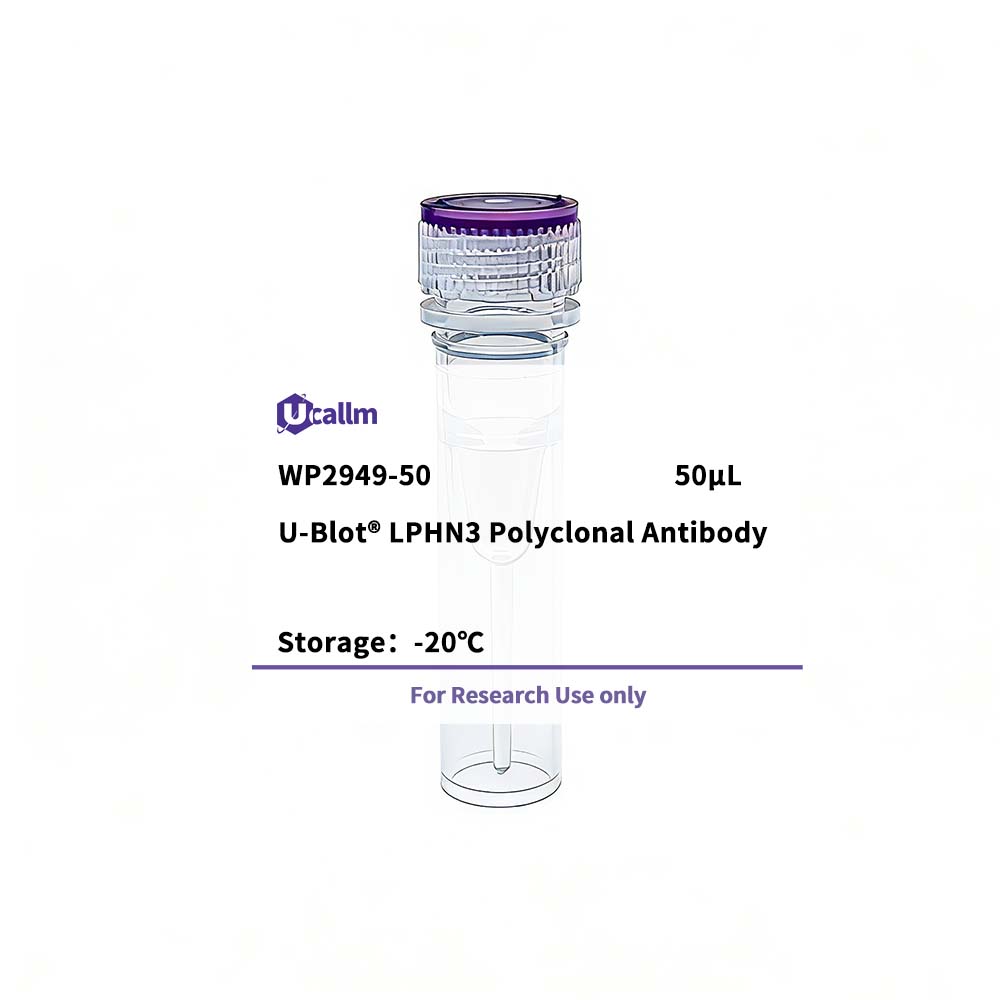
LPHN3 Polyclonal Antibody

Price range: $268.00 through $328.00

SKU: WP2949-100
Enter the quantity you would like, or drag the panel to find the quantity and price that best for you
Bulk QuoteAuthorize OEM & ODM

Product details

Background:

This gene encodes a member of the latrophilin subfamily of G-protein coupled receptors (GPCR). Latrophilins may function in both cell adhesion and signal transduction. In experiments with non-human species, endogenous proteolytic cleavage within a cysteine-rich GPS (G-protein-coupled-receptor proteolysis site) domain resulted in two subunits (a large extracellular N-terminal cell adhesion subunit and a subunit with substantial similarity to the secretin/calcitonin family of GPCRs) being non-covalently bound at the cell membrane. [provided by RefSeq, Jul 2008],

Specifications

Size50μL/100μL
TargetLPHN3
ReactivityHuman, Mouse, Rat
ApplicationsWB, ELISA
MW(Calculated)
MW(Observed)159kD
Host SpeciesRabbit
IsotypeIgG
Conjugate/ModificationUnmodified
Recommended Dilution RatioWB 1:500-2000; ELISA 1:5000-20000
FormulationLiquid in PBS containing 50% glycerol,0.5% BSA and 0.02% sodium azide.
PurificationThe antibody was affinity-purified from rabbit antiserum by affinity-chromatography using epitope-specific immunogen.
Storage-15°C to -25°C/1 year(Do not lower than -25°C)
Concentration1 mg/ml
ClonalityPolyclonal
Clone Number
ImmunogenSynthesized peptide derived from part region of human protein
SpecificityLPHN3 Polyclonal Antibody detects endogenous levels of protein.
Gene NameLPHN3 KIAA0768 LEC3
Protein NameLatrophilin-3 (Calcium-independent alpha-latrotoxin receptor 3) (CIRL-3) (Lectomedin-3)
Other Name
SpeciesHuman
Gene ID23284
UniprotQ9HAR2,
Species.1Mouse
Gene ID.1
Uniprot.1Q80TS3,
Species.2Rat
Gene ID.2
Uniprot.2Q9Z173
Cellular LocalizationCell membrane; Multi-pass membrane protein . Cell projection, axon . Cell junction .
Tissue ExpressionBrain,Colon,
Signaling_pathway
Research Areas
FunctionPTM:Proteolytically cleaved into 2 subunits, an extracellular subunit and a seven-transmembrane subunit.,similarity:Belongs to the G-protein coupled receptor 2 family. LN-TM7 subfamily.,similarity:Contains 1 GPS domain.,similarity:Contains 1 olfactomedin-like domain.,similarity:Contains 1 SUEL-type lectin domain.,subunit:Forms a heterodimer, consisting of a large extracellular region (p120) non-covalently linked to a seven-transmembrane moiety (p85).,
Please login to post questions
Back to Top
Product has been added to your cart
