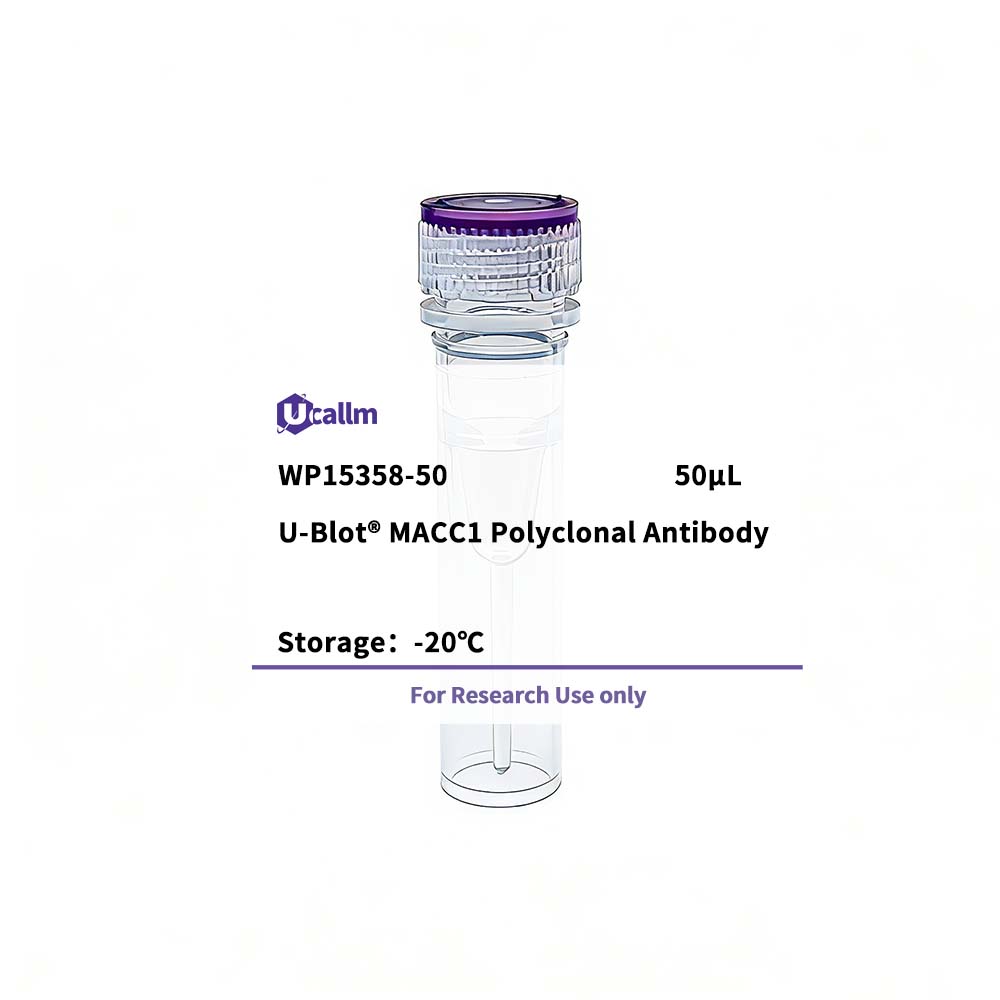
SKU: WP15358 Categories: ,

MACC1 Polyclonal Antibody

Price range: $268.00 through $328.00

SKU: WP15358-100
Enter the quantity you would like, or drag the panel to find the quantity and price that best for you
Bulk QuoteAuthorize OEM & ODM

Product details

Background:

MACC1 is a key regulator of the hepatocyte growth factor (HGF; MIM 142409)-HGF receptor (HGFR, or MET; MIM 164860) pathway, which is involved in cellular growth, epithelial-mesenchymal transition, angiogenesis, cell motility, invasiveness, and metastasis. Expression of MACC1 in colon cancer (MIM 114500) specimens is an independent prognostic indicator for metastasis formation and metastasis-free survival (Stein et al., 2009 [PubMed 19098908]).[supplied by OMIM, Mar 2009],

Specifications

Size50μL/100μL
TargetMACC1
ReactivityHuman, Mouse
ApplicationsWB, ELISA
MW(Calculated)
MW(Observed)97kD
Host SpeciesRabbit
IsotypeIgG
Conjugate/ModificationUnmodified
Recommended Dilution RatioWB 1:500-1:2000; ELISA 1:20000; Not yet tested in other applications.
FormulationLiquid in PBS containing 50% glycerol, 0.5% BSA and 0.02% sodium azide.
PurificationThe antibody was affinity-purified from rabbit antiserum by affinity-chromatography using epitope-specific immunogen.
Storage-15°C to -25°C/1 year(Do not lower than -25°C)
Concentration1 mg/ml
ClonalityPolyclonal
Clone Number
ImmunogenThe antiserum was produced against synthesized peptide derived from the Internal region of human MACC1. AA range:411-460
SpecificityMACC1 Polyclonal Antibody detects endogenous levels of MACC1 protein.
Gene NameMACC1
Protein NameMetastasis-associated in colon cancer protein 1
Other NameMACC1; / Metastasis-associated in colon cancer protein 1; / SH3 domain-containing protein 7a5
SpeciesHuman
Gene ID346389
UniprotQ6ZN28
Species.1
Gene ID.1
Uniprot.1
Species.2
Gene ID.2
Uniprot.2
Cellular LocalizationCytoplasm . Nucleus . Mainly found in the cytoplasm in non-metastasizing tumors.
Tissue ExpressionPreferentially expressed in metastasizing tumors.
Signaling_pathway
Research Areas
FunctionFunction:Acts as a transcription activator for MET and as a key regulator of HGF-MET signaling. Promotes cell motility, proliferation and hepatocyte growth factor (HGF)-dependent scattering in vitro and tumor growth and metastasis in vivo.,similarity:Contains 1 SH3 domain.,subcellular location:Mainly found in the cytoplasm in non-metastasizing tumors.,tissue specificity:Preferentially expressed in metastasizing tumors.,
Please login to post questions
Back to Top
Product has been added to your cart