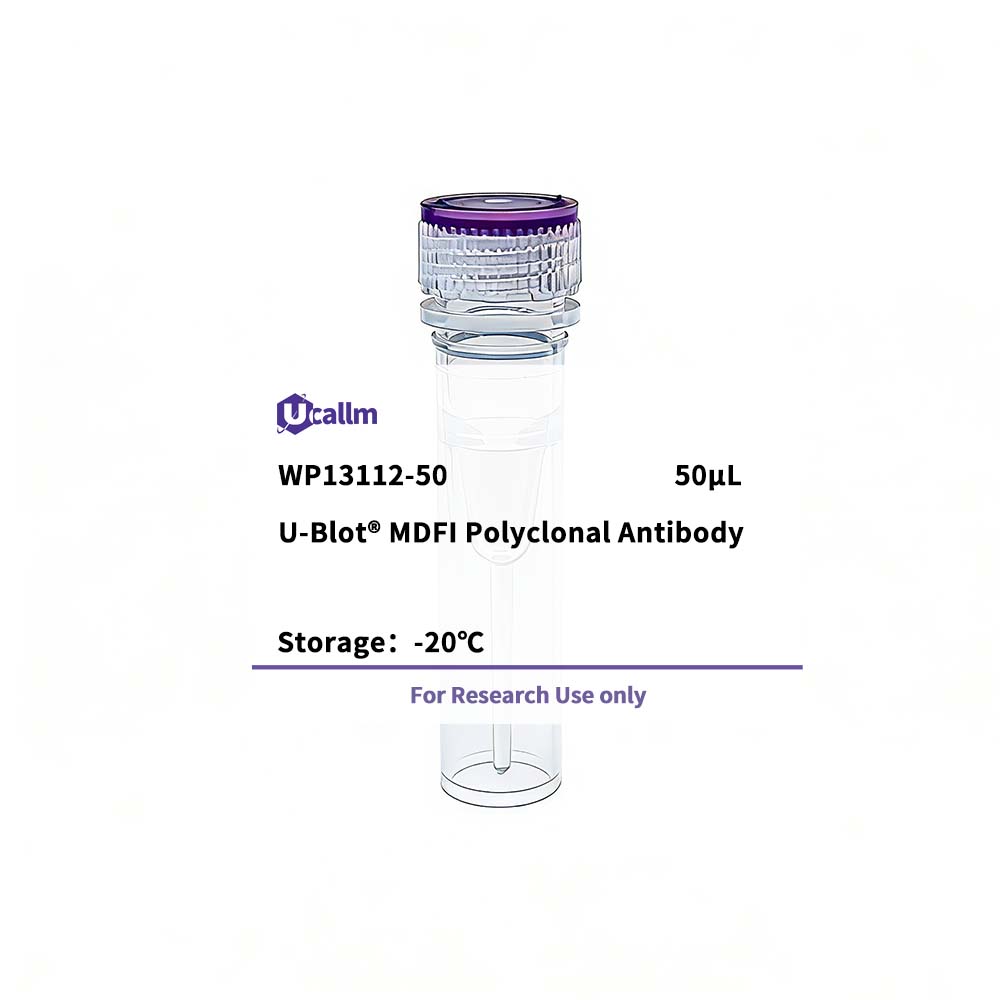
SKU: WP13112 Categories: ,

MDFI Polyclonal Antibody

Price range: $268.00 through $328.00

SKU: WP13112-100
Enter the quantity you would like, or drag the panel to find the quantity and price that best for you
Bulk QuoteAuthorize OEM & ODM

Product details

Background:

This protein is a transcription factor that negatively regulates other myogenic family proteins. Studies of the mouse homolog, I-mf, show that it interferes with myogenic factor function by masking nuclear localization signals and preventing DNA binding. Knockout mouse studies show defects in the formation of vertebrae and ribs that also involve cartilage formation in these structures. [provided by RefSeq, Jul 2008],

Specifications

Size50μL/100μL
TargetMDFI
ReactivityHuman, Mouse
ApplicationsWB, ELISA
MW(Calculated)
MW(Observed)25kD
Host SpeciesRabbit
IsotypeIgG
Conjugate/ModificationUnmodified
Recommended Dilution RatioWB 1:500-1:2000; ELISA 1:10000; Not yet tested in other applications.
FormulationLiquid in PBS containing 50% glycerol, 0.5% BSA and 0.02% sodium azide.
PurificationThe antibody was affinity-purified from rabbit antiserum by affinity-chromatography using epitope-specific immunogen.
Storage-15°C to -25°C/1 year(Do not lower than -25°C)
Concentration1 mg/ml
ClonalityPolyclonal
Clone Number
ImmunogenThe antiserum was produced against synthesized peptide derived from human MDFI. AA range:103-152
SpecificityMDFI Polyclonal Antibody detects endogenous levels of MDFI protein.
Gene NameMDFI
Protein NameMyoD family inhibitor
Other NameMDFI; / MyoD family inhibitor; / Myogenic repressor I-mf
SpeciesHuman
Gene ID4188
UniprotQ99750,
Species.1Mouse
Gene ID.117240
Uniprot.1P70331
Species.2
Gene ID.2
Uniprot.2
Cellular LocalizationNucleus . Cytoplasm .
Tissue ExpressionFetal brain,Muscle,
Signaling_pathway
Research Areas
FunctionFunction:Inhibits the transactivation activity of the Myod family of myogenic factors and represses myogenesis. Acts by associating with Myod family members and retaining them in the cytoplasm by masking their nuclear localization signals. Can also interfere with the DNA-binding activity of Myod family members. Plays an important role in trophoblast and chondrogenic differentiation. Regulates the transcriptional activity of TCF7L1/TCF3 by interacting directly with TCF7L1/TCF3 and preventing it from binding DNA. Binds to the axin complex, resulting in an increase in the level of free beta-catenin. Affects axin regulation of the WNT and JNK signaling pathways.,similarity:Belongs to the MDFI family.,subunit:The C-terminus interacts with AXIN1 and LEF1.,
Please login to post questions
Back to Top
Product has been added to your cart

