SKU: WP10417 Categories: ,

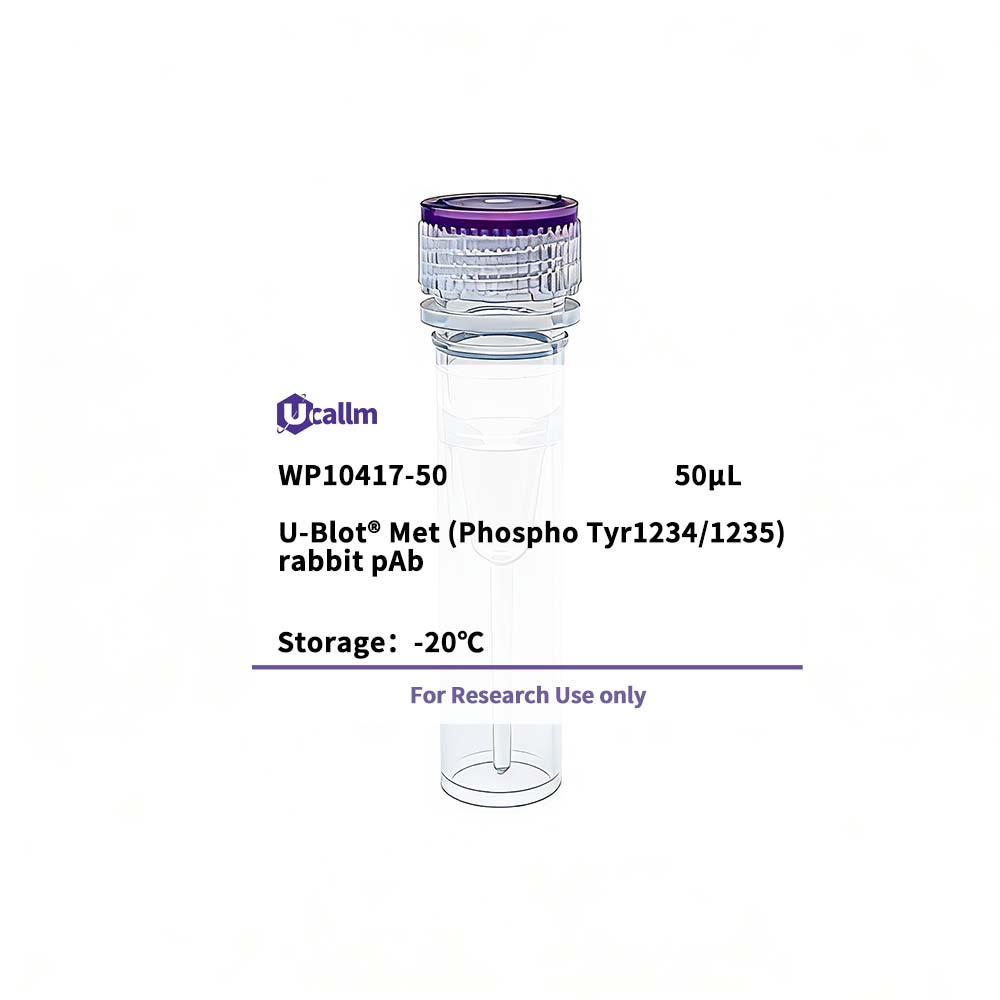
Met (Phospho Tyr1234/1235) rabbit pAb

Price range: $288.00 through $368.00

SKU: WP10417-100
Enter the quantity you would like, or drag the panel to find the quantity and price that best for you
Bulk QuoteAuthorize OEM & ODM

Product details

Background:

This gene encodes a member of the receptor tyrosine kinase family of proteins and the product of the proto-oncogene MET. The encoded preproprotein is proteolytically processed to generate alpha and beta subunits that are linked via disulfide bonds to form the mature receptor. Further processing of the beta subunit results in the formation of the M10 peptide, which has been shown to reduce lung fibrosis. Binding of its ligand, hepatocyte growth factor, induces dimerization and activation of the receptor, which plays a role in cellular survival, embryogenesis, and cellular migration and invasion. Mutations in this gene are associated with papillary renal cell carcinoma, hepatocellular carcinoma, and various head and neck cancers. Amplification and overexpression of this gene are also associated with multiple human cancers. [provided by RefSeq, May 2016],

Specifications

Size50μL/100μL
TargetMet Phospho Tyr1234/1235
ReactivityHuman, Mouse, Rat
ApplicationsWB, ELISA, IHC
MW(Calculated)
MW(Observed)145kD
Host SpeciesRabbit
IsotypeIgG
Conjugate/Modificationphosphate
Recommended Dilution RatioWB 1:500-2000; IHC 1:50-300; ELISA 1:2000-20000 / Note: For IHC, we suggest antigen retrieval with TE buffer pH 9.0 (Cat#WT1004)
FormulationLiquid in PBS containing 50% glycerol, 0.5% BSA and 0.02% sodium azide.
PurificationThe antibody was affinity-purified from rabbit serum by affinity-chromatography using specific immunogen.
Storage-15°C to -25°C/1 year(Do not lower than -25°C)
Concentration1 mg/ml
ClonalityPolyclonal
Clone Number
ImmunogenSynthesized phosho peptide around human Met (Tyr1234 and 1235)
SpecificityThis antibody detects endogenous levels of Met only when phosphorylated at Tyr1234 or Thr1235,and dually phosphorylated at two sites.
Gene NameMET
Protein NameMet (Tyr1234/1235)
Other NameHepatocyte growth factor receptor; / HGF receptor; / HGF/SF receptor; / Proto-oncogene c-Met; / Scatter factor receptor; / SF receptor; / Tyrosine-protein kinase Met
SpeciesHuman
Gene ID4233
UniprotP08581,
Species.1Mouse
Gene ID.1
Uniprot.1P16056,
Species.2Rat
Gene ID.224553
Uniprot.2P97523
Cellular LocalizationMembrane; Single-pass type I membrane protein.; [Isoform 3]: Secreted.
Tissue ExpressionExpressed in normal hepatocytes as well as in epithelial cells lining the stomach, the small and the large intestine. Found also in basal keratinocytes of esophagus and skin. High levels are found in liver, gastrointestinal tract, thyroid and kidney. Also present in the brain. Expressed in metaphyseal bone (at protein level) (PubMed:26637977).
Signaling_pathwayCellular Processes >> Cellular community - eukaryotes >> Focal adhesion;Cellular Processes >> Cellular community - eukaryotes >> Adherens junction;Human Diseases >> Cancer: overview >> Pathways in cancer;Human Diseases >> Cancer: overview >> Transcriptional misregulation in cancer;Human Diseases >> Cancer: overview >> MicroRNAs in cancer;Human Diseases >> Cancer: overview >> Central carbon metabolism in cancer;Human Diseases >> Cancer: specific types >> Hepatocellular carcinoma;Human Diseases >> Cancer: specific types >> Gastric cancer;Human Diseases >> Cancer: specific types >> Melanoma;Human Diseases >> Cancer: specific types >> Renal cell carcinoma;Human Diseases >> Cancer: specific types >> Non-small cell lung cancer;Environmental Information Processing >> Signal transduction >> MAPK signaling pathway;Environmental Information Processing >> Signal transduction >> Ras signaling pathway;Environmental Information Processing >> Signal transduction >> Rap1 signaling pathway;Environmental Information Processing >> Signal transduction >> Calcium signaling pathway;Environmental Information Processing >> Signal transduction >> PI3K-Akt signaling pathway
Research Areas>>EGFR tyrosine kinase inhibitor resistance; / >>MAPK signaling pathway; / >>Ras signaling pathway; / >>Rap1 signaling pathway; / >>Calcium signaling pathway; / >>PI3K-Akt signaling pathway; / >>Axon guidance; / >>Focal adhesion; / >>Adherens junction; / >>Bacterial invasion of epithelial cells; / >>Epithelial cell signaling in Helicobacter pylori infection; / >>Malaria; / >>Pathways in cancer; / >>Transcriptional misregulation in cancer; / >>Proteoglycans in cancer; / >>MicroRNAs in cancer; / >>Chemical carcinogenesis - reactive oxygen species; / >>Renal cell carcinoma; / >>Melanoma; / >>Non-small cell lung cancer; / >>Hepatocellular carcinoma; / >>Gastric cancer; / >>Central carbon metabolism in cancer
FunctionCatalytic activity:ATP + a [protein]-L-tyrosine = ADP + a [protein]-L-tyrosine phosphate.,Disease:Activation of MET after rearrangement with the TPR gene produces an oncogenic protein.,Disease:Defects in MET are a cause of hepatocellular carcinoma (HCC) [MIM:114550].,Disease:Defects in MET are a cause of hereditary papillary renal carcinoma (HPRC) [MIM:605074]; also known as papillary renal cell carcinoma 2 (RCCP2). HPRC is a form of inherited kidney cancer characterized by a predisposition to develop multiple, bilateral papillary renal tumors. The pattern of inheritance is consistent with autosomal dominant transmission with reduced penetrance.,Disease:Defects in MET may be associated with gastric cancer.,Disease:Genetic variations in MET may be associated with susceptibility to autism type 9 (AUTS9) [MIM:611015]. Autism is a neurodevelopmental disorder characterized by disturbance in language, perception and socialization. The disorder is classically defined by a triad of limited or absent verbal communication, a lack of reciprocal social interaction or responsiveness, and restricted, stereotypical, and ritualized patterns of interests and behavior.,Domain:The kinase domain is involved in SPSB1 binding.,Function:Receptor for hepatocyte growth factor and scatter factor. Has a tyrosine-protein kinase activity. Functions in cell proliferation, scattering, morphogenesis and survival.,online information:C-MET entry,similarity:Belongs to the protein kinase superfamily. Tyr protein kinase family.,similarity:Contains 1 protein kinase domain.,similarity:Contains 1 Sema domain.,similarity:Contains 3 IPT/TIG domains.,subunit:Heterodimer formed of an alpha chain (50 kDa) and a beta chain (145 kDa) which are disulfide linked. Binds PLXNB1 and GRB2. Interacts with SPSB1, SPSB2 and SPSB4 (By similarity). Interacts with INPP5D/SHIP1. When phosphorylated at Tyr-1356, interacts with INPPL1/SHIP2. Interacts with RANBP9 and RANBP10, as well as SPSB1, SPSB2, SPSB3 and SPSB4. SPSB1 binding occurs in the presence and in the absence of HGF, however HGF treatment has a positive effect on this interaction. Interacts with MUC20; prevents interaction with GRB2 and suppresses hepatocyte growth factor-induced cell proliferation.,
Please login to post questions
Back to Top
Product has been added to your cart
