


U-Blot® MMP2 Rabbit mAb
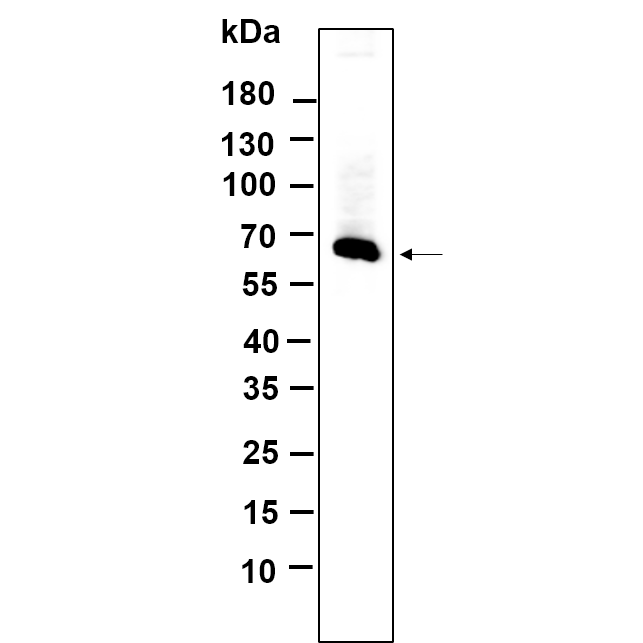
WR4423 Western Blot analysis using U-87 MG lysates,primary antibody was diluted at 1:1000, 4°over night, Dylight 800 secondary antibody(WS0446)was diluted at 1:10000, 37° 1hour.
Price range: $268.00 through $328.00
Product details
Background:matrix metallopeptidase 2(MMP2) Homo sapiens This gene is a member of the matrix metalloproteinase (MMP) gene family, that are zinc-dependent enzymes capable of cleaving components of the extracellular matrix and molecules involved in signal transduction. The protein encoded by this gene is a gelatinase A, type IV collagenase, that contains three fibronectin type II repeats in its catalytic site that allow binding of denatured type IV and V collagen and elastin. Unlike most MMP family members, activation of this protein can occur on the cell membrane. This enzyme can be activated extracellularly by proteases, or, intracellulary by its S-glutathiolation with no requirement for proteolytical removal of the pro-domain. This protein is thought to be involved in multiple pathways including roles in the nervous system, endometrial menstrual breakdown, regulation of vascularization, and metastasis. Mutations in this gene have been associated with Win
Specifications
| Size | 50μL/100μL |
| Target | MMP-2 |
| Reactivity | Human, Mouse, Rat |
| Applications | WB, IF, ELISA |
| MW(Calculated) | 74kD |
| MW(Observed) | 64kD |
| Host Species | Rabbit |
| Isotype | IgG,Kappa |
| Conjugate/Modification | Unmodified |
| Recommended Dilution Ratio | WB 1:2000-1:10000; IF 1:200-1:1000; ELISA 1:5000-1:20000; |
| Formulation | PBS, 50% glycerol, 0.05% Proclin 300, 0.05%BSA |
| Purification | Recombinant Antibody expressed in animal component-free (ACF) media, purified via Protein A affinity chromatography. |
| Storage | -15°C to -25°C/1 year(Do not lower than -25°C) |
| Concentration | |
| Clonality | Monoclonal |
| Clone Number | RM0642R |
| Immunogen | The specific immunogen used to produce this antibody is proprietary information. |
| Specificity | Endogenous |
| Gene Name | MMP2 |
| Protein Name | 72 kDa type IV collagenase |
| Other Name | MMP2; / CLG4A; / 72 kDa type IV collagenase; / 72 kDa gelatinase; / Gelatinase A; / Matrix metalloproteinase-2; / MMP-2; / TBE-1 |
| Species | Human |
| Gene ID | 4313 |
| Uniprot | P08253, |
| Species.1 | Mouse |
| Gene ID.1 | 17390 |
| Uniprot.1 | P33434, |
| Species.2 | Rat |
| Gene ID.2 | 81686 |
| Uniprot.2 | P33436 |
| Cellular Localization | Cytoplasm, Nucleus |
| Tissue Expression | Produced by normal skin fibroblasts. PEX is expressed in a number of tumors including gliomas, breast and prostate. |
| Signaling_pathway | Organismal Systems >> Immune system >> Leukocyte transendothelial migration;Organismal Systems >> Endocrine system >> GnRH signaling pathway;Organismal Systems >> Endocrine system >> Estrogen signaling pathway;Organismal Systems >> Endocrine system >> Relaxin signaling pathway;Human Diseases >> Cancer: overview >> Pathways in cancer;Human Diseases >> Cancer: specific types >> Bladder cancer |
| Research Areas | >>Endocrine resistance; / >>Leukocyte transendothelial migration; / >>GnRH signaling pathway; / >>Estrogen signaling pathway; / >>Relaxin signaling pathway; / >>AGE-RAGE signaling pathway in diabetic complications; / >>Pathways in cancer; / >>Proteoglycans in cancer; / >>Bladder cancer; / >>Diabetic cardiomyopathy; / >>Fluid shear stress and atherosclerosis |
| Function | Catalytic activity:Cleavage of gelatin type I and collagen types IV, V, VII, X. Cleaves the collagen-like sequence Pro-Gln-Gly-|-Ile-Ala-Gly-Gln.,cofactor:Binds 2 zinc ions per subunit.,cofactor:Binds 4 calcium ions per subunit.,Disease:Defects in MMP2 are the cause of Torg-Winchester syndrome [MIM:259600]; also called multicentric osteolysis nodulosis and arthropathy (MONA). Torg-Winchester syndrome is an autosomal recessive osteolysis syndrome. It is severe with generalized osteolysis and osteopenia. Subcutaneous nodules are usually absent. Torg-Winchester syndrome has been associated with a number of additional features including coarse face, corneal opacities, patches of thickened, hyperpigmented skin, hypertrichosis and gum hypertrophy. However, these features are not always present and have occasionally been observed in other osteolysis syndromes.,Domain:The conserved cysteine present in the cysteine-switch motif binds the catalytic zinc ion, thus inhibiting the enzyme. The dissociation of the cysteine from the zinc ion upon the activation-peptide release activates the enzyme.,enzyme regulation:Inhibited by histatin-3 1/24 (histatin-5).,Function:In addition to gelatin and collagens, it cleaves KiSS1 at a Gly-|-Leu bond.,PTM:The propeptide is processed by MMP14 (MT-MMP1) and MMP16 (MT-MMP3).,similarity:Belongs to the peptidase M10A family.,similarity:Contains 3 fibronectin type-II domains.,similarity:Contains 4 hemopexin-like domains.,subunit:Ligand for integrin alpha-V/beta-3.,tissue specificity:Produced by normal skin fibroblasts., |
Please login to post questions
Related products





