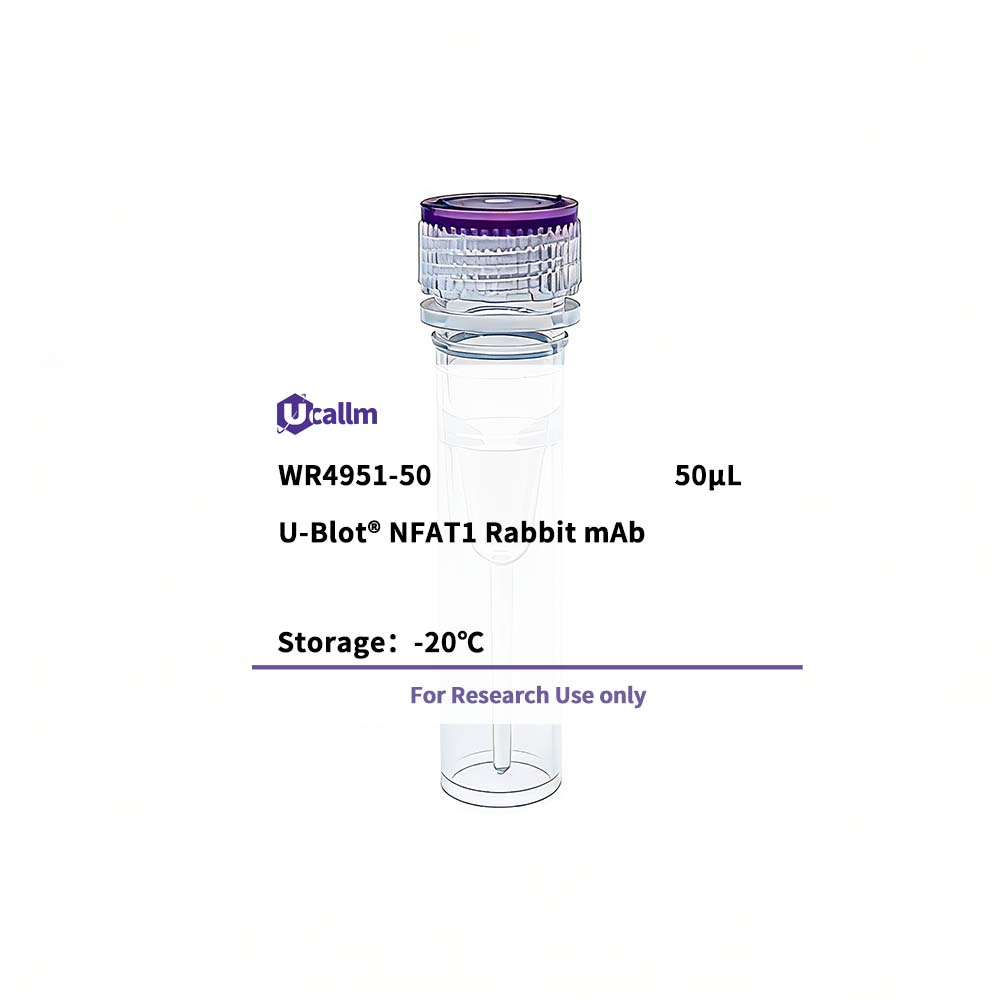
SKU: WR4951 Categories: ,

U-Blot® NFAT1 Rabbit mAb

Price range: $268.00 through $328.00

SKU: WR4951-50
Enter the quantity you would like, or drag the panel to find the quantity and price that best for you
Bulk QuoteAuthorize OEM & ODM

Product details

Background:This gene is a member of the nuclear factor of activated T cells (NFAT) family. The product of this gene is a DNA-binding protein with a REL-homology region (RHR) and an NFAT-homology region (NHR). This protein is present in the cytosol and only translocates to the nucleus upon T cell receptor (TCR) stimulation, where it becomes a member of the nuclear factors of activated T cells transcription complex. This complex plays a central role in inducing gene transcription during the immune response. Alternate transcriptional splice variants encoding different isoforms have been characterized. [provided by RefSeq, Apr 2012],

Specifications

Size50μL/100μL
TargetNFAT1
ReactivityHuman
ApplicationsWB, IHC, IF, ELISA
MW(Calculated)100kD
MW(Observed)140kD
Host SpeciesRabbit
IsotypeIgG,Kappa
Conjugate/ModificationUnmodified
Recommended Dilution RatioIHC 1:100-1:500; WB 1:2000-1:10000; IF 1:200-1:1000; ELISA 1:5000-1:20000; / Note: For IHC, we suggest antigen retrieval with TE buffer pH 9.0 (Cat#WT1004)
FormulationPBS, 50% glycerol, 0.05% Proclin 300, 0.05%BSA
PurificationRecombinant Antibody expressed in animal component-free (ACF) media, purified via Protein A affinity chromatography.
Storage-15°C to -25°C/1 year(Do not lower than -25°C)
Concentration
ClonalityMonoclonal
Clone NumberRM1174R
ImmunogenThe specific immunogen used to produce this antibody is proprietary information.
SpecificityEndogenous
Gene NameNFATC2 NFAT1 NFATP
Protein NameNuclear factor of activated T-cells, cytoplasmic 2 (NF-ATc2) (NFATc2) (NFAT pre-existing subunit) (NF-ATp) (T-cell transcription factor NFAT1)
Other NameNuclear factor of activated T-cells, cytoplasmic 2; / NF-ATc2; / NFATc2; / NFAT pre-existing subunit; / NF-ATp; / T-cell transcription factor NFAT1
SpeciesHuman
Gene ID4773
UniprotQ13469,
Species.1Mouse
Gene ID.118019
Uniprot.1Q60591
Species.2
Gene ID.2
Uniprot.2
Cellular LocalizationCytoplasm. Nucleus. Cytoplasmic for the phosphorylated form and nuclear after activation that is controlled by calcineurin-mediated dephosphorylation. Rapid nuclear exit of NFATC is thought to be one mechanism by which cells distinguish between sustained and transient calcium signals. The subcellular localization of NFATC plays a key role in the regulation of gene transcription.
Tissue ExpressionExpressed in thymus, spleen, heart, testis, brain, placenta, muscle and pancreas. Isoform 1 is highly expressed in the small intestine, heart, testis, prostate, thymus, placenta and thyroid. Isoform 3 is highly expressed in stomach, uterus, placenta, trachea and thyroid.
Signaling_pathwayCellular Processes >> Cell growth and death >> Cellular senescence;Organismal Systems >> Immune system >> Natural killer cell mediated cytotoxicity;Organismal Systems >> Immune system >> T cell receptor signaling pathway;Organismal Systems >> Immune system >> Th1 and Th2 cell differentiation;Organismal Systems >> Immune system >> Th17 cell differentiation;Organismal Systems >> Immune system >> B cell receptor signaling pathway;Organismal Systems >> Endocrine system >> Oxytocin signaling pathway;Organismal Systems >> Development and regeneration >> Osteoclast differentiation;Human Diseases >> Cancer: overview >> PD-L1 expression and PD-1 checkpoint pathway in cancer;Environmental Information Processing >> Signal transduction >> Wnt signaling pathway;Environmental Information Processing >> Signal transduction >> VEGF signaling pathway;Environmental Information Processing >> Signal transduction >> Calcium signaling pathway;Environmental Information Processing >> Signal transduction >> cGMP-PKG signaling pathway
Research Areas>>cGMP-PKG signaling pathway; / >>Cellular senescence; / >>Wnt signaling pathway; / >>Axon guidance; / >>VEGF signaling pathway; / >>Osteoclast differentiation; / >>C-type lectin receptor signaling pathway; / >>Natural killer cell mediated cytotoxicity; / >>Th1 and Th2 cell differentiation; / >>Th17 cell differentiation; / >>T cell receptor signaling pathway; / >>B cell receptor signaling pathway; / >>Oxytocin signaling pathway; / >>Yersinia infection; / >>Hepatitis B; / >>Human cytomegalovirus infection; / >>Human T-cell leukemia virus 1 infection; / >>Kaposi sarcoma-associated herpesvirus infection; / >>Human immunodeficiency virus 1 infection; / >>PD-L1 expression and PD-1 checkpoint pathway in cancer; / >>Lipid and atherosclerosis
FunctionAlternative products:Additional isoforms seem to exist,Domain:Rel Similarity Domain (RSD) allows DNA-binding and cooperative interactions with AP1 factors.,Function:Plays a role in the inducible expression of cytokine genes in T-cells, especially in the induction of the IL-2, IL-3, IL-4, TNF-alpha or GM-CSF.,induction:Inducibly expressed in T-lymphocytes upon activation of the T-cell receptor (TCR) complex. Induced after co-addition of phorbol 12-myristate 13-acetate (PMA) and ionomycin.,PTM:In resting cells, phosphorylated by NFATC-kinase on at least 18 sites in the 99-363 region. Upon cell stimulation, all these sites except Ser-243 are dephosphorylated by calcineurin. Dephosphorylation induces a conformational change that simultaneously exposes an NLS and masks an NES, which results in nuclear localization. Simultaneously, Ser-53 or Ser-56 is phosphorylated; which is required for full transcriptional activity.,similarity:Contains 1 RHD (Rel-like) domain.,subcellular location:Cytoplasmic for the phosphorylated form and nuclear after activation that is controlled by calcineurin-mediated dephosphorylation. Rapid nuclear exit of NFATC is thought to be one mechanism by which cells distinguish between sustained and transient calcium signals. The subcellular localization of NFATC plays a key role in the regulation of gene transcription.,subunit:Member of the multicomponent NFATC transcription complex that consists of at least two components, a pre-existing cytoplasmic component NFATC2 and an inducible nuclear component NFATC1. Other members such as NFATC4, NFATC3 or members of the activating protein-1 family, MAF, GATA4 and Cbp/p300 can also bind the complex. The phosphorylated form specifically interacts with XPO1; which mediates nuclear export. NFATC proteins bind to DNA as monomers. Interacts with NFATC2IP.,tissue specificity:Expressed in thymus, spleen, heart, testis, brain, placenta, muscle and pancreas.,
Please login to post questions
Back to Top
Product has been added to your cart
