SKU: WR4910 Categories: ,

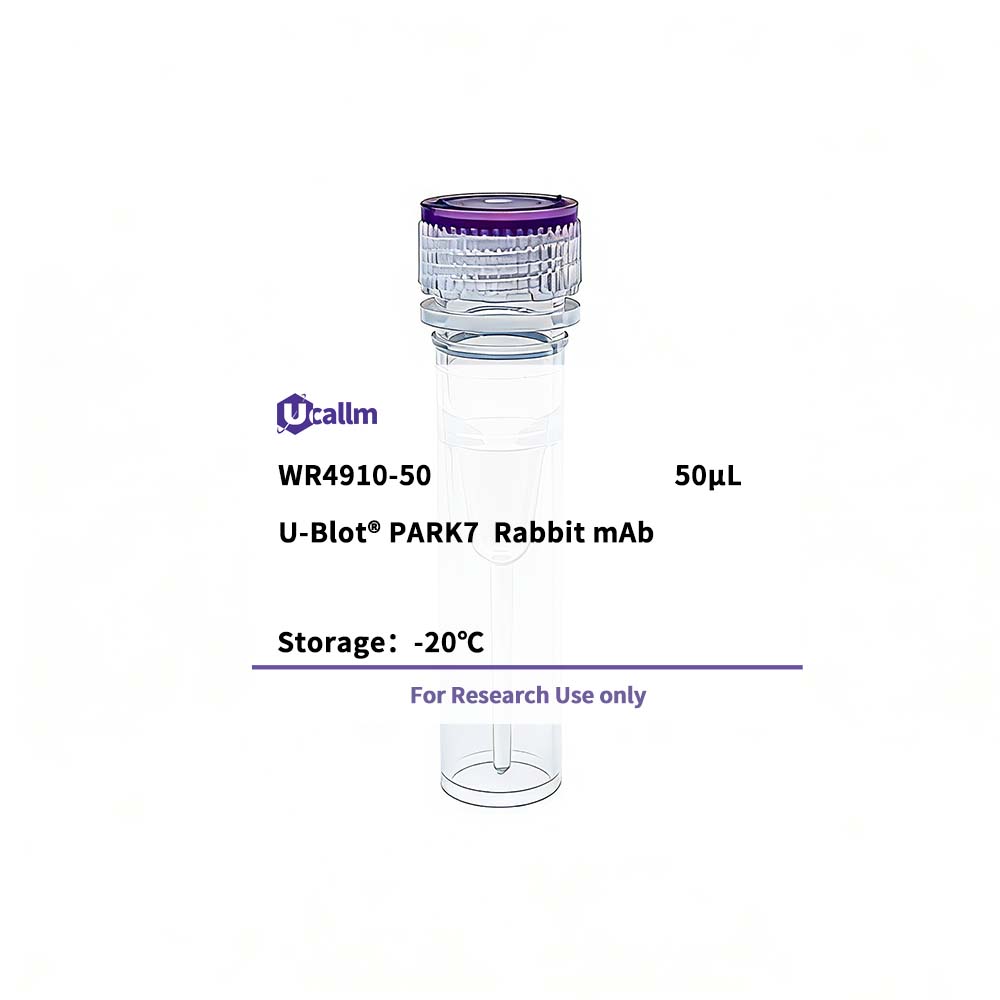
U-Blot® PARK7 Rabbit mAb

Price range: $268.00 through $328.00

SKU: WR4910-50
Enter the quantity you would like, or drag the panel to find the quantity and price that best for you
Bulk QuoteAuthorize OEM & ODM

Product details

Background:The product of this gene belongs to the peptidase C56 family of proteins. It acts as a positive regulator of androgen receptor-dependent transcription. It may also function as a redox-sensitive chaperone, as a sensor for oxidative stress, and it apparently protects neurons against oxidative stress and cell death. Defects in this gene are the cause of autosomal recessive early-onset Parkinson disease 7. Two transcript variants encoding the same protein have been identified for this gene. [provided by RefSeq, Jul 2008],


Specifications

Size50μL/100μL
TargetPARK7
ReactivityHuman, Mouse, Rat
ApplicationsWB, IHC, IF, IP, ELISA
MW(Calculated)20kD
MW(Observed)22kD
Host SpeciesRabbit
IsotypeIgG,Kappa
Conjugate/ModificationUnmodified
Recommended Dilution RatioIHC 1:4000-1:20000; WB 1:2000-1:10000; IF 1:200-1:1000; ELISA 1:5000-1:20000; IP 1:50-1:200; / Note: For IHC, we suggest antigen retrieval with TE buffer pH 9.0 (Cat#WT1004)
FormulationPBS, 50% glycerol, 0.05% Proclin 300, 0.05%BSA
PurificationRecombinant Antibody expressed in animal component-free (ACF) media, purified via Protein A affinity chromatography.
Storage-15°C to -25°C/1 year(Do not lower than -25°C)
Concentration
ClonalityMonoclonal
Clone NumberRM1140R
ImmunogenThe specific immunogen used to produce this antibody is proprietary information.
SpecificityEndogenous
Gene NamePARK7
Protein NameProtein DJ-1
Other NamePARK7; / Protein DJ-1; / Oncogene DJ1; / Parkinson disease protein 7
SpeciesHuman
Gene ID11315
UniprotQ99497,
Species.1Mouse
Gene ID.157320
Uniprot.1Q99LX0,
Species.2Rat
Gene ID.2117287
Uniprot.2O88767
Cellular LocalizationCell membrane; Lipid-anchor . Cytoplasm . Nucleus . Membrane raft . Mitochondrion . Endoplasmic reticulum . Under normal conditions, located predominantly in the cytoplasm and, to a lesser extent, in the nucleus and mitochondrion. Translocates to the mitochondrion and subsequently to the nucleus in response to oxidative stress and exerts an increased cytoprotective effect against oxidative damage (PubMed:18711745). Detected in tau inclusions in brains from neurodegenerative disease patients (PubMed:14705119). Membrane raft localization in astrocytes and neuronal cells requires palmitoylation. .
Tissue ExpressionHighly expressed in pancreas, kidney, skeletal muscle, liver, testis and heart. Detected at slightly lower levels in placenta and brain (at protein level). Detected in astrocytes, Sertoli cells, spermatogonia, spermatids and spermatozoa. Expressed by pancreatic islets at higher levels than surrounding exocrine tissues (PubMed:22611253).
Signaling_pathwayHuman Diseases >> Neurodegenerative disease >> Parkinson disease;Human Diseases >> Neurodegenerative disease >> Pathways of neurodegeneration - multiple diseases
Research Areas>>Parkinson disease; / >>Pathways of neurodegeneration - multiple diseases
FunctionDisease:Defects in PARK7 are the cause of autosomal recessive early-onset Parkinson disease 7 (PARK7) [MIM:606324, 168600]. Parkinson disease (PD) is a complex, multifactorial disorder that typically manifests after the age of 50 years, although early-onset cases (before 50 years) are known. PD generally arises as a sporadic condition but is occasionally inherited as a simple mendelian trait. Although sporadic and familial PD are very similar, inherited forms of the disease usually begin at earlier ages and are associated with atypical clinical features. PD is characterized by bradykinesia, resting tremor, muscular rigidity and postural instability, as well as by a clinically significant response to treatment with levodopa. The pathology involves the loss of dopaminergic neurons in the substantia nigra and the presence of Lewy bodies (intraneuronal accumulations of aggregated proteins), in surviving neurons in various areas of the brain. PARK7 is characterized by onset before 40 years, slow progression and initial good response to levodopa.,Disease:Defects in PARK7 influences susceptibility to amyotrophic lateral sclerosis-parkinsonism/dementia complex type 2 [MIM:105500]; also called amyotrophic lateral sclerosis-parkinsonism/dementia complex of Guam or Guam disease. Amyotrophic lateral sclerosis-parkinsonism/dementia complex type 2 is a neurodengenerative disorder with unusually high incidence among the Chamorro people of the Western Pacific Islands of Guam. Both amyotrophic lateral sclerosis and parkinsonism-dementia are chronic, progressive, and uniformly fatal disorders in this population. Both diseases are known to occur in the same kindred, the same sibship, and even the same individual.,Function:Acts as a positive regulator of androgen receptor-dependent transcription. May function as a redox-sensitive chaperone and as a sensor for oxidative stress. Prevents aggregation of SNCA. Protects neurons against oxidative stress and cell death. Plays a role in fertilization. Has no proteolytic activity. Has cell-growth promoting activity and transforming activity.,induction:By ultraviolet irradiation.,miscellaneous:Cys-106 is easily oxidized to sulfinic acid.,online information:The Singapore human mutation and polymorphism database,PTM:Sumoylated on Lys-130 by PIAS2 or PIAS4; which is enhanced after ultraviolet irradiation and essential for cell-growth promoting activity and transforming activity.,similarity:Belongs to the peptidase C56 family.,subcellular location:Associated with mitochondria in some cells, particularly after oxidative stress. Detected in tau inclusions in brains from neurodegenerative disease patients.,subunit:Homodimer. Binds EFCAB6/DJBP and PIAS2. Part of a ternary complex containing PARK7, EFCAB6/DJBP and AR.,tissue specificity:Highly expressed in pancreas, kidney, skeletal muscle, liver, testis and heart. Detected at slightly lower levels in placenta and brain. Detected in astrocytes, Sertoli cells, spermatogonia, spermatids and spermatozoa.,
Please login to post questions
Back to Top
Product has been added to your cart
