SKU: WR4417 Categories: ,

U-Blot® PYK2 Rabbit mAb

Price range: $268.00 through $328.00

SKU: WR4417-50
Enter the quantity you would like, or drag the panel to find the quantity and price that best for you
Bulk QuoteAuthorize OEM & ODM

Product details

Background:This gene encodes a cytoplasmic protein tyrosine kinase which is involved in calcium-induced regulation of ion channels and activation of the map kinase signaling pathway. The encoded protein may represent an important signaling intermediate between neuropeptide-activated receptors or neurotransmitters that increase calcium flux and the downstream signals that regulate neuronal activity. The encoded protein undergoes rapid tyrosine phosphorylation and activation in response to increases in the intracellular calcium concentration, nicotinic acetylcholine receptor activation, membrane depolarization, or protein kinase C activation. This protein has been shown to bind CRK-associated substrate, nephrocystin, GTPase regulator associated with FAK, and the SH2 domain of GRB2. The encoded protein is a member of the FAK subfamily of protein tyrosine kinases but lacks significant sequence similarity t


Specifications

Size50μL/100μL
TargetPYK2
ReactivityHuman, Mouse, Rat
ApplicationsWB, IHC, IF, ELISA
MW(Calculated)116kD
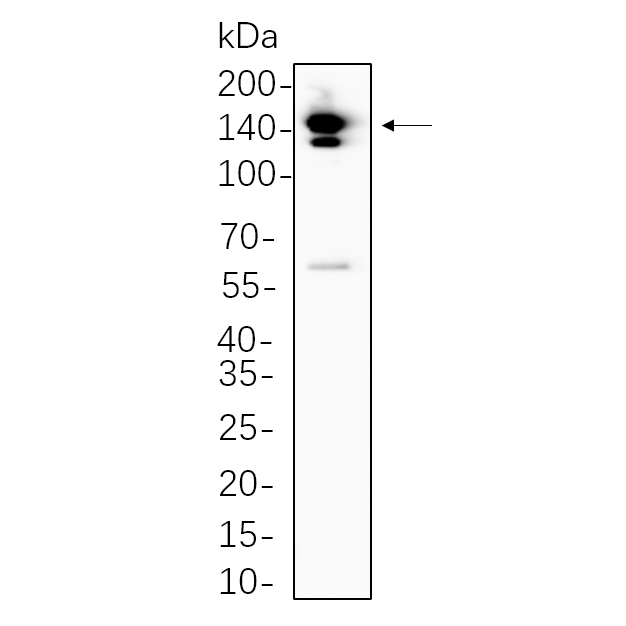
MW(Observed)116kD
Host SpeciesRabbit
IsotypeIgG,Kappa
Conjugate/ModificationUnmodified
Recommended Dilution RatioWB 1:2000-1:10000; IF 1:200-1:1000; ELISA 1:5000-1:20000;
FormulationPBS, 50% glycerol, 0.05% Proclin 300, 0.05%BSA
PurificationRecombinant Antibody expressed in animal component-free (ACF) media, purified via Protein A affinity chromatography.
Storage-15°C to -25°C/1 year(Do not lower than -25°C)
Concentration
ClonalityMonoclonal
Clone NumberRM0144R
ImmunogenThe specific immunogen used to produce this antibody is proprietary information.
SpecificityEndogenous
Gene NamePTK2B
Protein NameProtein-tyrosine kinase 2-beta
Other NamePTK2B; / FAK2; / PYK2; / RAFTK; / Protein-tyrosine kinase 2-beta; / Calcium-dependent tyrosine kinase; / CADTK; / Calcium-regulated non-receptor proline-rich tyrosine kinase; / Cell adhesion kinase beta; / CAK-beta; / CAKB; / Focal adhesion kinase 2; / FADK 2; / Pro
SpeciesHuman
Gene ID4914;4915;4916
UniprotQ14289,
Species.1Mouse
Gene ID.119229
Uniprot.1Q9QVP9,
Species.2Rat
Gene ID.250646
Uniprot.2P70600
Cellular LocalizationCytoplasm. Cytoplasm, perinuclear region. Cell membrane; Peripheral membrane protein; Cytoplasmic side. Cell junction, focal adhesion. Cell projection, lamellipodium. Cytoplasm, cell cortex. Nucleus. Interaction with NPHP1 induces the membrane-association of the kinase. Colocalizes with integrins at the cell periphery.
Tissue ExpressionIsoform TrkA-I is found in most non-neuronal tissues. Isoform TrkA-II is primarily expressed in neuronal cells. TrkA-III is specifically expressed by pluripotent neural stem and neural crest progenitors. {ECO:0000269|PubMed:15488758, ECO:0000269|PubMed:8325889}. Isoform TrkB is expressed in the central and peripheral nervous system. In the central nervous system (CNS), expression is observed in the cerebral cortex, hippocampus, thalamus, choroid plexus, granular layer of the cerebellum, brain stem, and spinal cord. In the peripheral nervous system, it is expressed in many cranial ganglia, the ophthalmic nerve, the vestibular system, multiple facial structures, the submaxillary glands, and dorsal root ganglia. Isoform TrkB-T1 is mainly expressed in the brain but also detected in other tissues including pancreas, kidney and heart. Isoform TrkB-T-Shc is predominantly expressed in the brain. {ECO:0000269|PubMed:11798182, ECO:0000269|PubMed:7936202}.TRKC: Widely expressed but mainly in nervous tissue. Isoform 2 is expressed at higher levels in adult brain than in fetal brain.
Signaling_pathwayCellular Processes >> Cell growth and death >> Apoptosis;Organismal Systems >> Nervous system >> Neurotrophin signaling pathway;Organismal Systems >> Sensory system >> Inflammatory mediator regulation of TRP channels;Human Diseases >> Cancer: overview >> Pathways in cancer;Human Diseases >> Cancer: overview >> Transcriptional misregulation in cancer;Human Diseases >> Cancer: overview >> Central carbon metabolism in cancer;Human Diseases >> Cancer: specific types >> Thyroid cancer;Environmental Information Processing >> Signal transduction >> MAPK signaling pathway;Environmental Information Processing >> Signal transduction >> Ras signaling pathway;Environmental Information Processing >> Signal transduction >> Calcium signaling pathway;Environmental Information Processing >> Signal transduction >> PI3K-Akt signaling pathway
Research Areas>>MAPK signaling pathway; / >>Ras signaling pathway; / >>Calcium signaling pathway; / >>PI3K-Akt signaling pathway; / >>Apoptosis; / >>Neurotrophin signaling pathway; / >>Inflammatory mediator regulation of TRP channels; / >>Pathways in cancer; / >>Transcriptional misregulation in cancer; / >>Thyroid cancer; / >>Central carbon metabolism in cancer
FunctionCatalytic activity:ATP + a [protein]-L-tyrosine = ADP + a [protein]-L-tyrosine phosphate.,Function:Involved in calcium induced regulation of ion channel and activation of the map kinase signaling pathway. May represent an important signaling intermediate between neuropeptide activated receptors or neurotransmitters that increase calcium flux and the downstream signals that regulate neuronal activity. Interacts with the SH2 domain of Grb2. May phosphorylate the voltage-gated potassium channel protein Kv1.2. Its activation is highly correlated with the stimulation of c-Jun N-terminal kinase activity. Involved in osmotic stress-dependent SNCA 'Tyr-125' phosphorylation.,PTM:Phosphorylated on tyrosine residues in response to various stimuli that elevate the intracellular calcium concentration, as well as by PKC activation. Recruitment by nephrocystin to cell matrix adhesions initiates Tyr-402 phosphorylation. In monocytes, adherence to substrata is required for tyrosine phosphorylation and kinase activation. Angiotensin II, thapsigargin and L-alpha-lysophosphatidic acid (LPA) also induce autophosphorylation and increase kinase activity.,similarity:Belongs to the protein kinase superfamily. Tyr protein kinase family.,similarity:Belongs to the protein kinase superfamily. Tyr protein kinase family. FAK subfamily.,similarity:Contains 1 FERM domain.,similarity:Contains 1 protein kinase domain.,subcellular location:Interaction with nephrocystin induces the membrane-association of the kinase.,subunit:Interacts with Crk-associated substrate (Cas), PTPNS1 and SH2D3C (By similarity). Interacts with nephrocystin, ASAP2, OPHN1L, SKAP2 and TGFB1I1.,tissue specificity:Most abundant in the brain, with highest levels in amygdala and hippocampus. Low levels in kidney. Also expressed in spleen and lymphocytes.,
Please login to post questions

Back to Top
Product has been added to your cart