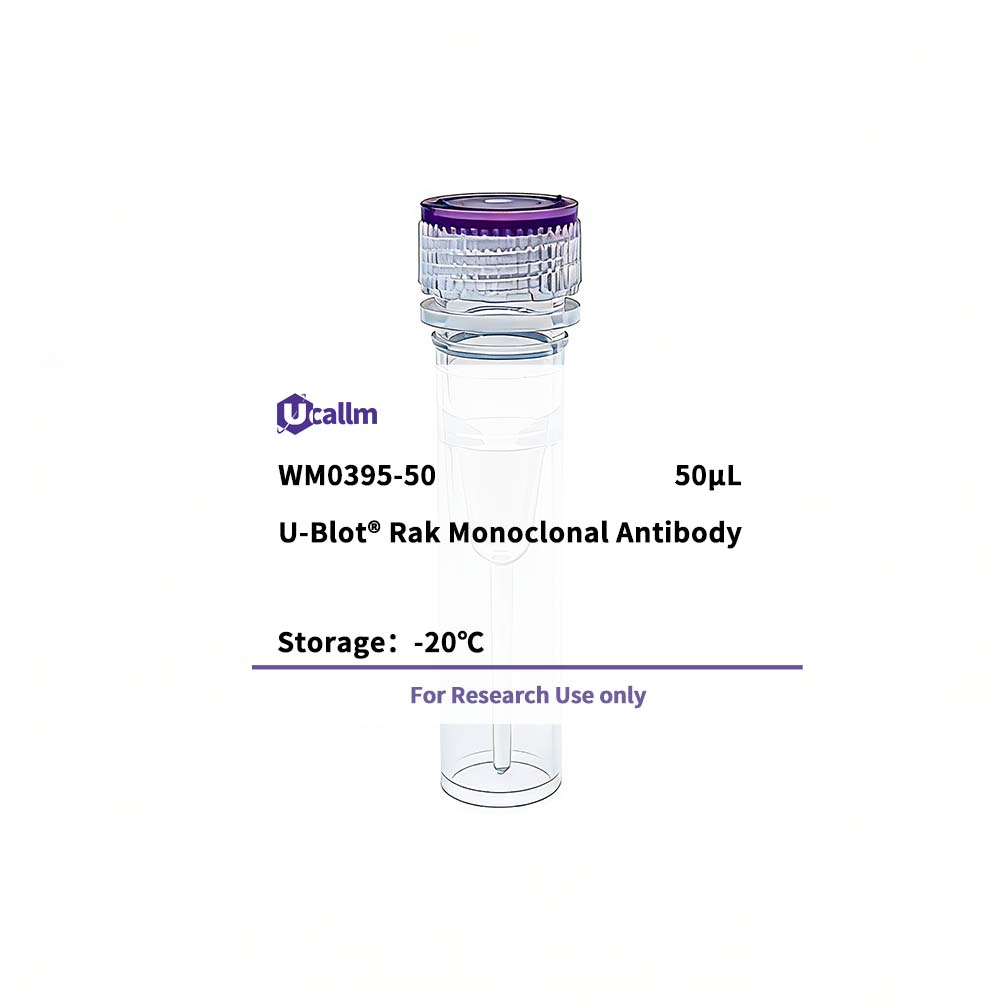
SKU: WM0395 Categories: ,

Rak Monoclonal Antibody

Price range: $268.00 through $328.00

SKU: WM0395-50
Enter the quantity you would like, or drag the panel to find the quantity and price that best for you
Bulk QuoteAuthorize OEM & ODM

Product details

Background:
The protein encoded by this gene belongs to the TYR family of protein kinases. This tyrosine kinase is a nuclear protein and may function during G1 and S phase of the cell cycle and suppress growth. [provided by RefSeq, Jul 2008],

Specifications

Size50μL/100μL
TargetRak
ReactivityHuman
ApplicationsWB, IHC, IF, ELISA
MW(Calculated)58kD
MW(Observed)
Host SpeciesMouse
Isotype
Conjugate/ModificationUnmodified
Recommended Dilution RatioWB 1:500-1:2000; IHC 1:200-1:1000; ELISA 1:10000; IF 1:50-200 / Note: For IHC, we suggest antigen retrieval with TE buffer pH 9.0 (Cat#WT1004)
FormulationLiquid in PBS containing 50% glycerol, 0.5% BSA and 0.02% sodium azide.
PurificationAffinity purification
Storage-15°C to -25°C/1 year(Do not lower than -25°C)
Concentration
ClonalityMonoclonal
Clone Number15B5
ImmunogenPurified recombinant fragment of Rak (aa2-300) expressed in E. Coli.
SpecificityRak Monoclonal Antibody detects endogenous levels of Rak protein.
Gene NameFRK
Protein NameTyrosine-protein kinase FRK
Other NameFRK; / PTK5; / RAK; / Tyrosine-protein kinase FRK; / FYN-related kinase; / Nuclear tyrosine protein kinase RAK; / Protein-tyrosine kinase 5
SpeciesHuman
Gene ID2444
UniprotP42685,
Species.1Mouse
Gene ID.1
Uniprot.1Q922K9
Species.2
Gene ID.2
Uniprot.2
Cellular LocalizationCytoplasm . Nucleus . Predominantly found in the nucleus, with a small fraction found in the cell periphery.
Tissue ExpressionPredominantly expressed in epithelial derived cell lines and tissues, especially normal liver, kidney, breast and colon.
Signaling_pathway
Research Areas
FunctionCatalytic activity:ATP + a [protein]-L-tyrosine = ADP + a [protein]-L-tyrosine phosphate.,similarity:Belongs to the protein kinase superfamily. Tyr protein kinase family. SRC subfamily.,similarity:Contains 1 protein kinase domain.,similarity:Contains 1 SH2 domain.,similarity:Contains 1 SH3 domain.,tissue specificity:Restricted to cells lines derived from tissues of lymphoid, brain, breast, colon and bladder origin.,
Please login to post questions
Back to Top
Product has been added to your cart
