


Recombinant CD269/BCMA Fc-Fused Nanobody (VF0551)
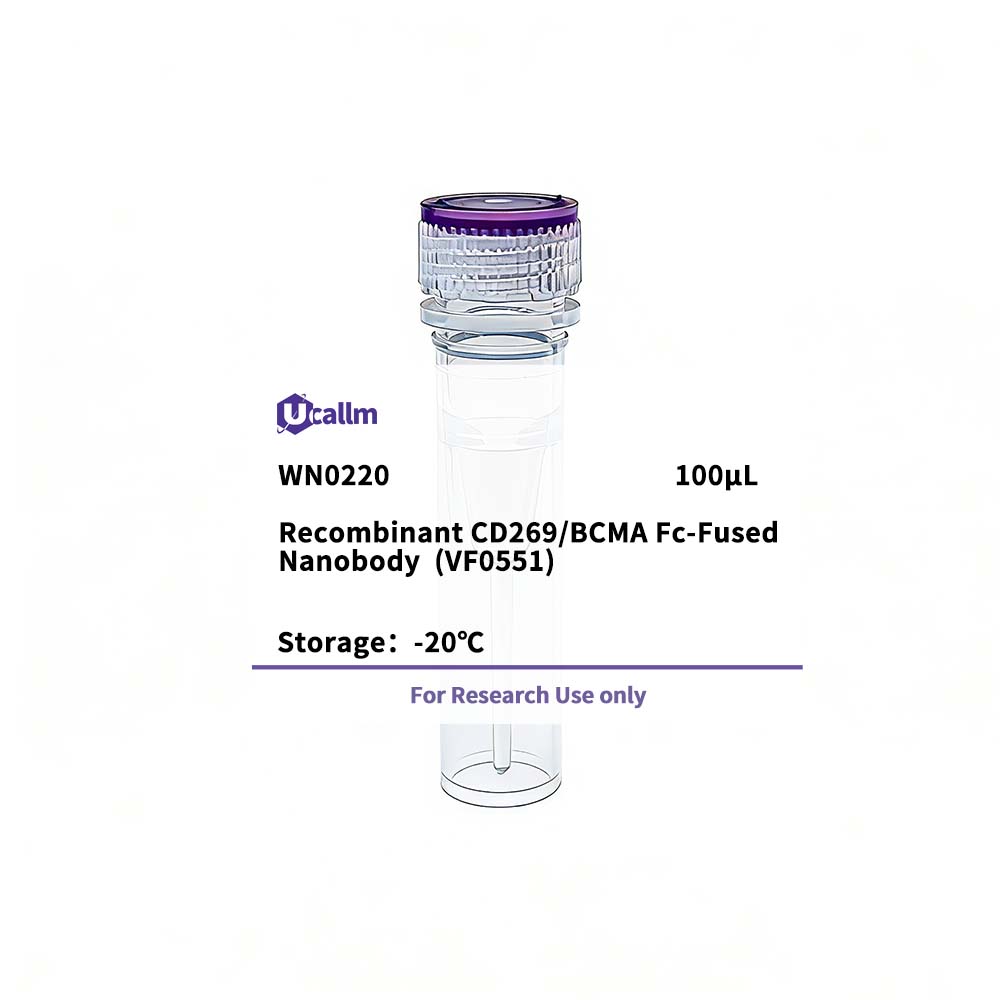
Ucallm_WN0220
$365.00
Product details
Background:The protein encoded byThis gene is a member of the TNF-receptor superfamily.This receptor is preferentially expressed in mature B lymphocytes, and may be important for B cell development and autoimmune response.This receptor has been shown to specifically bind to the tumor necrosis factor (ligand) superfamily, member 13b (TNFSF13B/TALL-1/BAFF), and to lead to NF-kappaB and MAPK8/JNK activation.This receptor also binds to various TRAF family members, and thus may transduce signals for cell survival and proliferation. [provided by RefSeq, Jul 2008]
Specifications
| Size | 100μL |
| Target | CD269/BCMA |
| Reactivity | Human |
| Applications | FC, ELISA |
| MW(Calculated) | |
| MW(Observed) | |
| Host Species | |
| Isotype | IgG2a,Kappa |
| Conjugate/Modification | Unmodified |
| Recommended Dilution Ratio | ELISA 1:5000-100000 |
| Formulation | Phosphate-buffered solution |
| Purification | Recombinant Expression and Affinity purified |
| Storage | -15°C to -25°C/1 year(Avoid freeze / thaw cycles) |
| Concentration | Please check the information on the tube |
| Clonality | |
| Clone Number | VF0422 |
| Immunogen | Purified recombinant Human CD269 |
| Specificity | This recombinant monoclonal antibody can detects endogenous levels of CD269/BCMA protein. |
| Gene Name | TNFRSF17 BCM BCMA |
| Protein Name | Tumor necrosis factor receptor superfamily member 17 (B-cell maturation protein) (CD antigen CD269) |
| Other Name | TNFRSF17; / BCM; / BCMA; / Tumor necrosis factor receptor superfamily member 17; / B-cell maturation protein; / CD269; / CD269 nanobody; / BCMA nanobody |
| Species | Human |
| Gene ID | 608 |
| Uniprot | Q02223 |
| Species.1 | |
| Gene ID.1 | |
| Uniprot.1 | |
| Species.2 | |
| Gene ID.2 | |
| Uniprot.2 | |
| Cellular Localization | Cell membrane; Single-pass type III membrane protein. Endomembrane system; Single-pass type III membrane protein. Perinuclear Golgi-like structures. |
| Tissue Expression | Stored in the alpha-granules of platelets and Weibel-Palade bodies of endothelial cells. Upon cell activation by agonists, P-selectin is transported rapidly to the cell surface. |
| Signaling_pathway | Organismal Systems >> Immune system >> Intestinal immune network for IgA production;Environmental Information Processing >> Signaling molecules and interaction >> Cytokine-cytokine receptor interaction |
| Research Areas | |
| Function | Disease:A chromosomal aberration involving TNFRSF17 is found in a form of T-cell acute lymphoblastic leukemia (T-ALL). Translocation t(4; 16)(q26; p13) with IL2.,Receptor for TNFSF13B/BLyS/BAFF and TNFSF13/APRIL. Promotes B-cell survival and plays a role in the regulation of humoral immunity. Activates NF-kappa-B and JNK.,similarity:Contains 1 TNFR-Cys repeat.,subcellular location:Perinuclear Golgi-like structures.,subunit:Associates with TRAF1, TRAF2, TRAF3, TRAF5 and TRAF6.,tissue specificity:Expressed in mature B-cells, but not in T-cells or monocytes., |
Please login to post questions
Related products




