


Recombinant CD55 Fc-Fused Nanobody (VF0126)
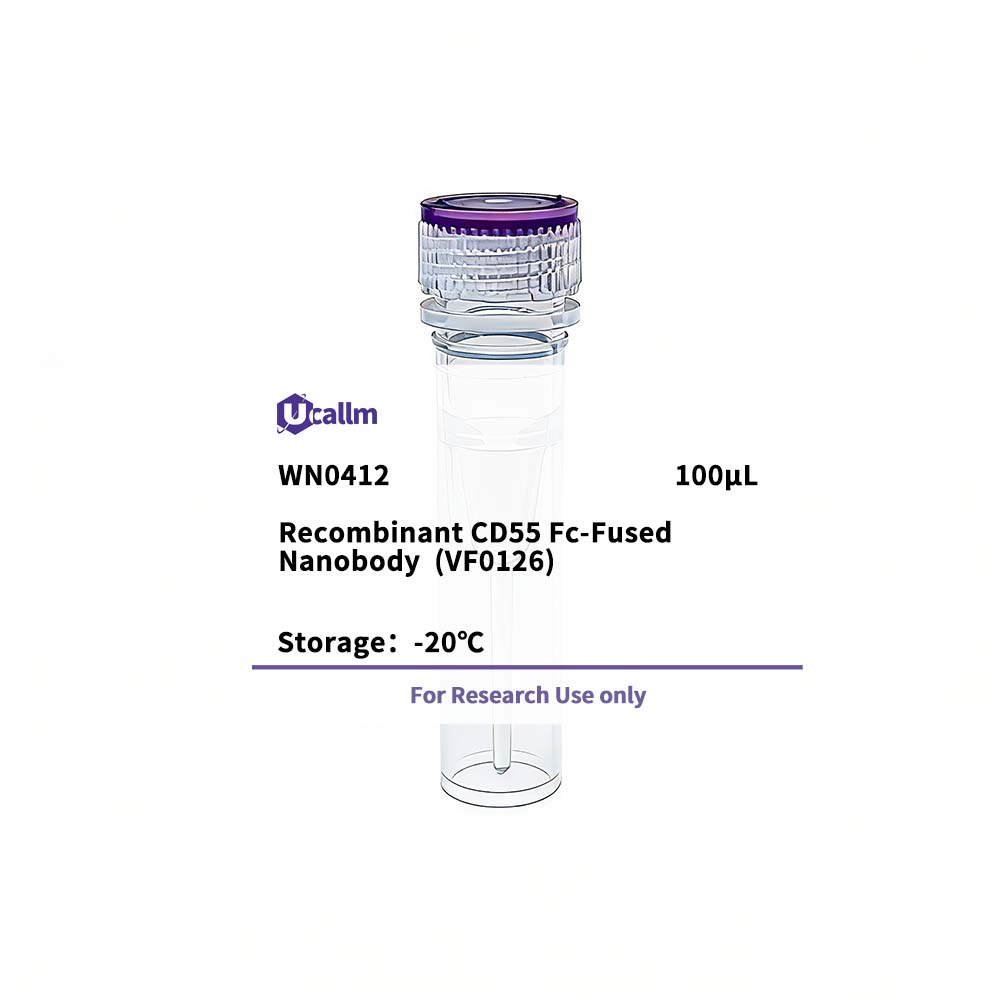
Ucallm_WN0412
$365.00
Product details
Background:This gene encodes a glycoprotein involved in the regulation of the complement cascade. Binding of the encoded protein to complement proteins accelerates their decay, thereby disrupting the cascade and preventing damage to host cells. Antigens present onThis protein constitute the Cromer blood group system (CROM). Alternative splicing results in multiple transcript variants. The predominant transcript variant encodes a membrane-bound protein, but alternatively spliced transcripts may produce soluble proteins. [provided by RefSeq, Jul 2014]
Specifications
| Size | 100μL |
| Target | CD55 |
| Reactivity | Human |
| Applications | ELISA, FC |
| MW(Calculated) | |
| MW(Observed) | |
| Host Species | |
| Isotype | IgG2a,Kappa |
| Conjugate/Modification | Unmodified |
| Recommended Dilution Ratio | ELISA 1:5000-100000 |
| Formulation | Phosphate-buffered solution |
| Purification | Recombinant Expression and Affinity purified |
| Storage | -15°C to -25°C/1 year(Avoid freeze / thaw cycles) |
| Concentration | Please check the information on the tube |
| Clonality | |
| Clone Number | VF0178 |
| Immunogen | Purified recombinant Human CD55 |
| Specificity | This recombinant monoclonal antibody can detects endogenous levels of CD55 protein. |
| Gene Name | CD55 CR DAF |
| Protein Name | Complement decay-accelerating factor (CD antigen CD55) |
| Other Name | CD55; / CR; / DAF; / Complement decay-accelerating factor; / CD55; / CD55 nanobody |
| Species | Human |
| Gene ID | 1604 |
| Uniprot | P08174 |
| Species.1 | |
| Gene ID.1 | |
| Uniprot.1 | |
| Species.2 | |
| Gene ID.2 | |
| Uniprot.2 | |
| Cellular Localization | [Isoform 1]: Cell membrane; Single-pass type I membrane protein.; [Isoform 2]: Cell membrane; Lipid-anchor, GPI-anchor.; [Isoform 3]: Secreted .; [Isoform 4]: Secreted .; [Isoform 5]: Secreted .; [Isoform 6]: Cell membrane; Lipid-anchor, GPI-anchor .; [Isoform 7]: Cell membrane; Lipid-anchor, GPI-anchor . |
| Tissue Expression | Expressed on cortical thymocytes, epidermal Langerhans cells, dendritic cells, on certain T-cell leukemias, and in various other tissues. |
| Signaling_pathway | Organismal Systems >> Immune system >> Hematopoietic cell lineage;Organismal Systems >> Immune system >> Complement and coagulation cascades |
| Research Areas | |
| Function | Domain:The first Sushi domain (SCR1) is not necessary for function. SCR2 and SCR4 provide the proper conformation for the active site on SCR3.,This protein recognizes C4b and C3b fragments that condense with cell-surface hydroxyl or amino groups when nascent C4b and C3b are locally generated during C4 and c3 activation. Interaction of daf with cell-associated C4b and C3b polypeptides interferes with their ability to catalyze the conversion of C2 and factor B to enzymatically active C2a and Bb and thereby prevents the formation of C4b2a and C3bBb, the amplification convertases of the complement cascade.,online information:Blood group antigen gene mutation database,online information:CD55 mutation db,online information:Decay-accelerating factor entry,online information:Icosahedral capsid structure,polymorphism:Responsible for the Cromer blood group system. It consists of at least 8 high-incidence (Cr(a), Tc(a), Dr(a), Es(a), WES(b), UMC, IFC and GUTI) and three low-incidence (Tc(b), Tc(c) and WES(a)) antigens that reside on DAF. In the Cromer phenotypes Dr(a-) and Inab there is reduced or absent expression of DAF, respectively. In the case of the Dr(a-) phenotype, a single nucleotide substitution within exon 5 accounts for two changes: a simple amino acid substitution, Leu-199 that is the basis of the antigenic variation, and an alternative splicing event that underlies the decreased expression of DAF in this phenotype. The Inab phenotype is a very rare one in which the red blood cells lack all Cromer system antigens. The red blood cells of individuals with Inab phenotype have a deficiency of DAF, but these individuals are not known to have any associated hematologic or other abnormalities.,PTM:The Ser/Thr-rich domain is heavily O-glycosylated.,similarity:Belongs to the receptors of complement activation (RCA) family.,similarity:Contains 4 Sushi (CCP/SCR) domains.,subunit:Monomer (major form) and non-disulfide-linked, covalent homodimer (minor form). Binds to coxsackievirus A21, coxsackieviruses B1, B3 and B5, human enterovirus 70, human echoviruses 6, 7, 11, 12, 20 and 21 capsid proteins and acts as a receptor for these viruses.,tissue specificity:Expressed on the plasma membranes of all cell types that are in intimate contact with plasma complement proteins. It is also found on the surfaces of epithelial cells lining extracellular compartments, and variants of the molecule are present in body fluids and in extracellular matrix., |
Please login to post questions
Related products





