


Recombinant CD63 Fc-Fused Nanobody (VF0224)
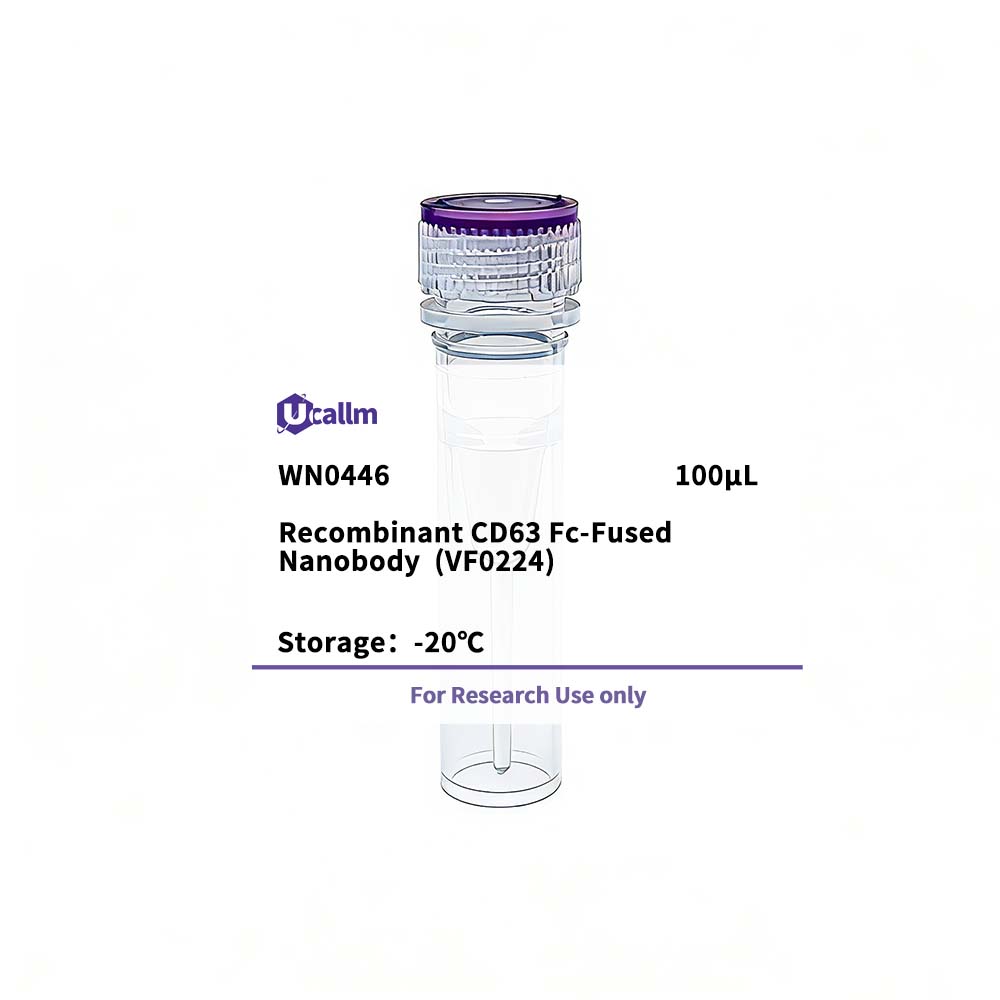
Ucallm_WN0446
$365.00
Product details
Background:The protein encoded byThis gene is a member of the transmembrane 4 superfamily, also known as the tetraspanin family. Most of these members are cell-surface proteins that are characterized by the presence of four hydrophobic domains. The proteins mediate signal transduction events that play a role in the regulation of cell development, activation, growth and motility. The encoded protein is a cell surface glycoprotein that is known to complex with integrins. It may function as a blood platelet activation marker. Deficiency ofThis protein is associated with Hermansky-Pudlak syndrome. AlsoThis gene has been associated with tumor progression. Alternative splicing results in multiple transcript variants encoding different protein isoforms. [provided by RefSeq, Apr 2012]
Specifications
| Size | 100μL |
| Target | CD63 |
| Reactivity | Human |
| Applications | ELISA |
| MW(Calculated) | |
| MW(Observed) | |
| Host Species | |
| Isotype | IgG2a,Kappa |
| Conjugate/Modification | Unmodified |
| Recommended Dilution Ratio | ELISA 1:5000-100000 |
| Formulation | Phosphate-buffered solution |
| Purification | Recombinant Expression and Affinity purified |
| Storage | -15°C to -25°C/1 year(Avoid freeze / thaw cycles) |
| Concentration | Please check the information on the tube |
| Clonality | |
| Clone Number | VF0026 |
| Immunogen | Purified recombinant Human CD63 |
| Specificity | This recombinant monoclonal antibody can detects endogenous levels of CD63 protein. |
| Gene Name | CD63 MLA1 TSPAN30 |
| Protein Name | CD63 antigen (Granulophysin) (Lysosomal-associated membrane protein 3) (LAMP-3) (Lysosome integral membrane protein 1) (Limp1) (Melanoma-associated antigen ME491) (OMA81H) (Ocular melanoma-associated antigen) (Tetraspanin-30) (Tspan-30) (CD antigen CD63) |
| Other Name | CD63; / MLA1; / TSPAN30; / CD63 antigen; / Granulophysin; / Lysosomal-associated membrane protein 3; / LAMP-3; / Melanoma-associated antigen ME491; / OMA81H; / Ocular melanoma-associated antigen; / Tetraspanin-30; / Tspan-30; / CD63; / CD63 nanobody |
| Species | Human |
| Gene ID | 967 |
| Uniprot | P08962 |
| Species.1 | |
| Gene ID.1 | |
| Uniprot.1 | |
| Species.2 | |
| Gene ID.2 | |
| Uniprot.2 | |
| Cellular Localization | Cell membrane; Multi-pass membrane protein . Lysosome membrane; Multi-pass membrane protein . Late endosome membrane; Multi-pass membrane protein . Endosome, multivesicular body . Melanosome . Secreted, extracellular exosome . Cell surface . Also found in Weibel-Palade bodies of endothelial cells (PubMed:10793155). Located in platelet dense granules (PubMed:7682577). Detected in a subset of pre-melanosomes. Detected on intralumenal vesicles (ILVs) within multivesicular bodies (PubMed:21962903). . |
| Tissue Expression | Widely expressed with highest levels in lymphoid tissues. Detected in activated T-cells where expression levels are 3- to 5-fold less than CD28, the stimulatory coreceptor, on the cell surface following activation. |
| Signaling_pathway | Cellular Processes >> Transport and catabolism >> Lysosome |
| Research Areas | |
| Function | This antigen is associated with early stages of melanoma tumor progression. May play a role in growth regulation.,miscellaneous:Lack of expression of CD63 in platelets has been observed in a patient with Hermansky-Pudlak syndrome (HPS). Hermansky-Pudlak syndrome (HPS) is a genetically heterogeneous, rare, autosomal recessive disorder characterized by oculocutaneous albinism, bleeding due to platelet storage pool deficiency, and lysosomal storage defects. This syndrome results from defects of diverse cytoplasmic organelles including melanosomes, platelet dense granules and lysosomes. Ceroid storage in the lungs is associated with pulmonary fibrosis, a common cause of premature death in individuals with HPS.,similarity:Belongs to the tetraspanin (TM4SF) family.,subcellular location:Also found in Weibel-Palade bodies of endothelial cells. Located in platelet dense granules.,tissue specificity:Dysplastic nevi, radial growth phase primary melanomas, hematopoietic cells, tissue macrophages., |
Please login to post questions
Related products





