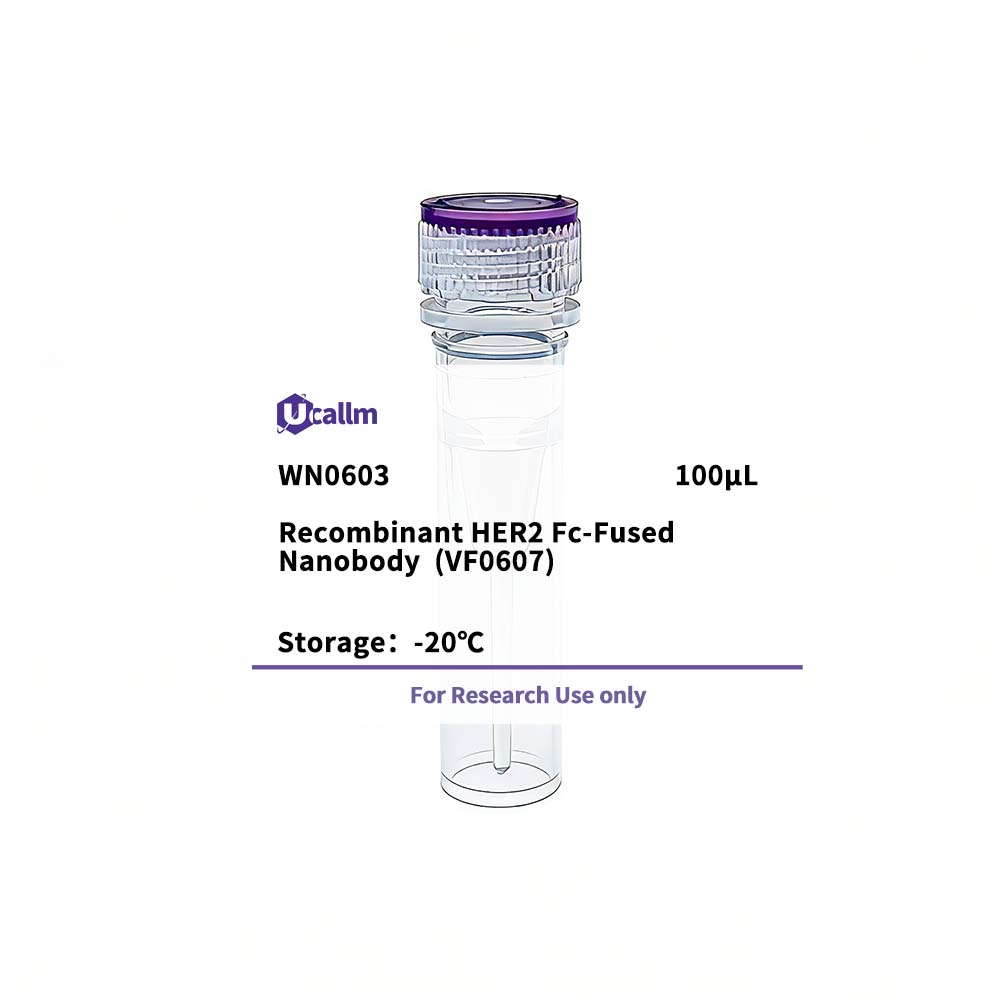
SKU: WN0603 Categories: ,

Recombinant HER2 Fc-Fused Nanobody (VF0607)

$365.00

SKU: WN0603
Enter the quantity you would like, or drag the panel to find the quantity and price that best for you
Bulk QuoteAuthorize OEM & ODM

Product details

Background:This gene encodes a member of the epidermal growth factor (EGF) receptor family of receptor tyrosine kinases. This protein has no ligand binding domain of its own and therefore cannot bind growth factors. However, it does bind tightly to other ligand-bound EGF receptor family members to form a heterodimer, stabilizing ligand binding and enhancing kinase-mediated activation of downstream signalling pathways, such as those involving mitogen-activated protein kinase and phosphatidylinositol-3 kinase. Allelic variations at amino acid positions 654 and 655 of isoform a (positions 624 and 625 of isoform b) have been reported, with the most common allele, Ile654/Ile655, shown here. Amplification and/or overexpression of this gene has been reported in numerous cancers, including breast and ovarian tumors. Alternative splicing results in several additional transcript variants, some encoding d

Specifications

Size100μL
TargetHER2
ReactivityHuman
ApplicationsELISA
MW(Calculated)
MW(Observed)
Host Species
IsotypeIgG2a,Kappa
Conjugate/ModificationUnmodified
Recommended Dilution RatioELISA 1:5000-100000
FormulationPhosphate-buffered solution
PurificationRecombinant Expression and Affinity purified
Storage-15°C to -25°C/1 year(Avoid freeze / thaw cycles)
ConcentrationPlease check the information on the tube
Clonality
Clone NumberVF0325
ImmunogenPurified recombinant Human HER2
SpecificityThis recombinant monoclonal antibody can detects endogenous levels of HER2 protein.
Gene NameERBB2 HER2 MLN19 NEU NGL
Protein NameReceptor tyrosine-protein kinase erbB-2
Other NameERBB2; / HER2; / MLN19; / NEU; / NGL; / Receptor tyrosine-protein kinase erbB-2; / Metastatic lymph node gene 19 protein; / MLN 19; / Proto-oncogene Neu; / Proto-oncogene c-ErbB-2; / Tyrosine kinase-type cell surface receptor HER2; / p185erbB2; / CD340; / HER2 nanobody
SpeciesHuman
Gene ID2064
UniprotP04626,
Species.1Mouse
Gene ID.113866
Uniprot.1P70424
Species.2
Gene ID.2
Uniprot.2
Cellular Localization[Isoform 1]: Cell membrane; Single-pass type I membrane protein. Early endosome . Cytoplasm, perinuclear region. Nucleus. Translocation to the nucleus requires endocytosis, probably endosomal sorting and is mediated by importin beta-1/KPNB1. Also detected in VPS35-positive endosome-to-TGN retrograde vesicles (PubMed:31138794). .; [Isoform 2]: Cytoplasm. Nucleus.; [Isoform 3]: Cytoplasm. Nucleus.
Tissue ExpressionIsoform 1 (epithelial isoform) is expressed by cells of epithelium and highly expressed by carcinomas. Expression is repressed in neuroblastoma cells.
Signaling_pathwayCellular Processes >> Cellular community - eukaryotes >> Focal adhesion;Cellular Processes >> Cellular community - eukaryotes >> Adherens junction;Cellular Processes >> Cellular community - eukaryotes >> Tight junction;Human Diseases >> Cancer: overview >> Pathways in cancer;Human Diseases >> Cancer: overview >> MicroRNAs in cancer;Human Diseases >> Cancer: overview >> Central carbon metabolism in cancer;Human Diseases >> Cancer: specific types >> Pancreatic cancer;Human Diseases >> Cancer: specific types >> Gastric cancer;Human Diseases >> Cancer: specific types >> Bladder cancer;Human Diseases >> Cancer: specific types >> Prostate cancer;Human Diseases >> Cancer: specific types >> Endometrial cancer;Human Diseases >> Cancer: specific types >> Breast cancer;Human Diseases >> Cancer: specific types >> Non-small cell lung cancer;Environmental Information Processing >> Signal transduction >> MAPK signaling pathway;Environmental Information Processing >> Signal transduction >> ErbB signaling pathway;Environmental Information Processing >> Signal transduction >> HIF-1 signaling pathway;Environmental Information Processing >> Signal transduction >> Calcium signaling pathway;Environmental Information Processing >> Signal transduction >> PI3K-Akt signaling pathway
Research Areas
FunctionCatalytic activity:ATP + a [protein]-L-tyrosine = ADP + a [protein]-L-tyrosine phosphate.,Disease:Defects in ERBB2 are associated with familial glioma of brain [MIM:137800]; also called glioblastoma multiforme. Gliomas are central nervous system neoplasms derived from glial cells and comprise astrocytomas, glioblastoma multiforme, oligodendrogliomas, and ependymomas.,Disease:Defects in ERBB2 are associated with gastric cancer [MIM:137215]; also known as hereditary familial diffuse gastric cancer (HDGC).,Disease:Defects in ERBB2 are associated with lung cancer [MIM:211980]; also called adenocarcinoma of lung.,Disease:Defects in ERBB2 are associated with ovarian cancer [MIM:167000]. Ovarian cancer is the leading cause of death from gynecologic malignancy. It is characterized by advanced presentation with loco-regional dissemination in the peritoneal cavity and the rare incidence of visceral metastases. These typical features relate to the biology of the disease, which is a principal determinant of outcome.,Function:Essential component of a neuregulin-receptor complex, although neuregulins do not interact with it alone. GP30 is a potential ligand for this receptor. Not activated by EGF, TGF-alpha and amphiregulin.,online information:ERBB2 entry,polymorphism:There are fours alleles due to the variations in positions 654 and 655. Allele B1 (Ile-654/Ile-655) has a frequency of 0.782; allele B2 (Ile-654/Val-655) has a frequency of 0.206; allele B3 (Val-654/Val-655) has a frequency of 0.012.,PTM:Ligand-binding increases phosphorylation on tyrosine residues.,similarity:Belongs to the protein kinase superfamily. Tyr protein kinase family. EGF receptor subfamily.,similarity:Contains 1 protein kinase domain.,subunit:Heterodimer with each of the other ERBB receptors (Potential). Interacts with PRKCABP and PLXNB1. Part of a complex with EGFR and either PIK3C2A or PIK3C2B. May interact with PIK3C2B when phosphorylated on Tyr-1196. Interacts with MEMO when phosphorylated on Tyr-1248. Interacts with MUC1. Stimulation by heregulin (HRG) in breast cancer cell lines induces binding of MUC1 with gamma-catenin.,
Please login to post questions
Back to Top
Product has been added to your cart


