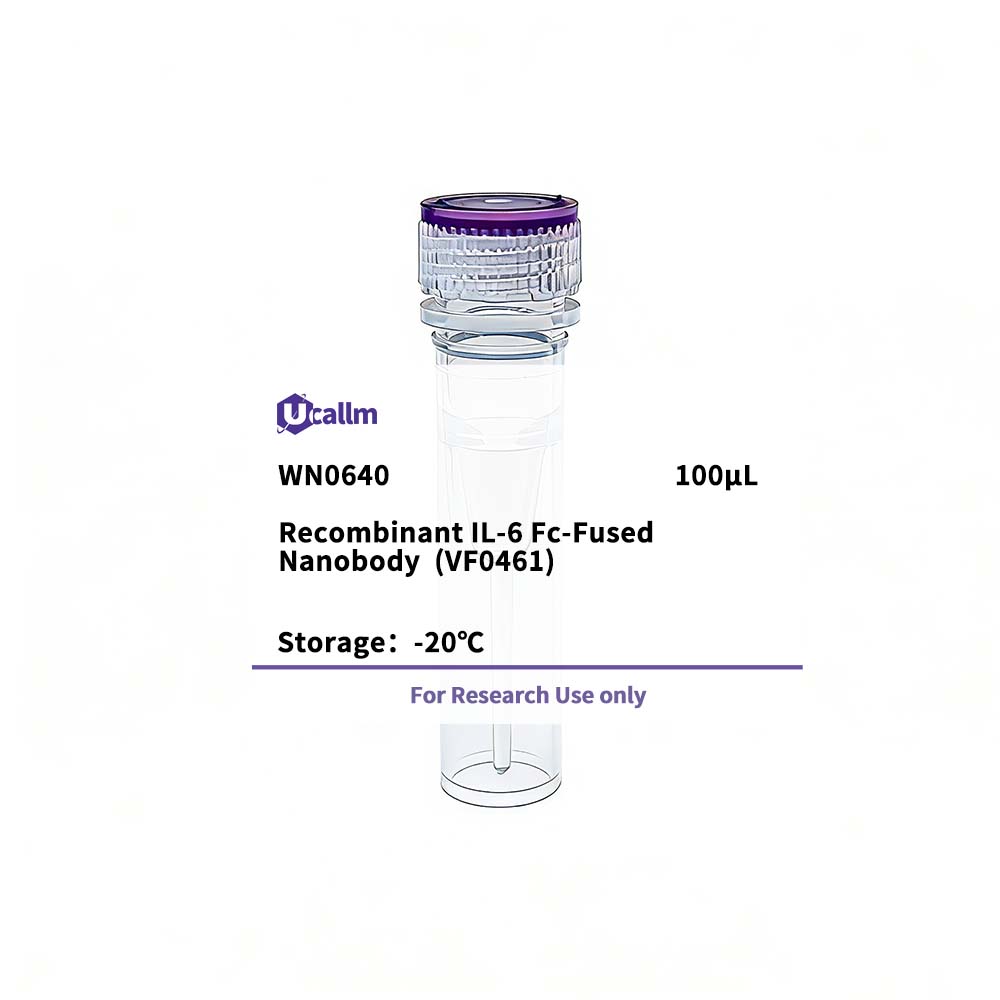
SKU: WN0640 Categories: ,

Recombinant IL-6 Fc-Fused Nanobody (VF0461)

$365.00

SKU: WN0640
Enter the quantity you would like, or drag the panel to find the quantity and price that best for you
Bulk QuoteAuthorize OEM & ODM

Product details

Background:This gene encodes a cytokine that functions in inflammation and the maturation of B cells. In addition, the encoded protein has been shown to be an endogenous pyrogen capable of inducing fever in people with autoimmune diseases or infections. The protein is primarily produced at sites of acute and chronic inflammation, where it is secreted into the serum and induces a transcriptional inflammatory response through interleukin 6 receptor, alpha. The functioning of this gene is implicated in a wide variety of inflammation-associated disease states, including suspectibility to diabetes mellitus and systemic juvenile rheumatoid arthritis. Alternative splicing results in multiple transcript variants. [provided by RefSeq, Dec 2015],

Specifications

Size100μL
TargetIL6
ReactivityHuman
ApplicationsELISA
MW(Calculated)
MW(Observed)
Host Species
IsotypeIgG2a,Kappa
Conjugate/ModificationUnmodified
Recommended Dilution RatioELISA 1:5000-100000
FormulationPhosphate-buffered solution
PurificationRecombinant Expression and Affinity purified
Storage-15°C to -25°C/1 year(Avoid freeze / thaw cycles)
ConcentrationPlease check the information on the tube
Clonality
Clone NumberVF0079
ImmunogenPurified recombinant Human IL6
SpecificityThis recombinant monoclonal antibody can detects endogenous levels of IL6 protein.
Gene NameIL6
Protein NameInterleukin-6
Other NameIL6; / IFNB2; / Interleukin-6; / IL-6; / B-cell stimulatory factor 2; / BSF-2; / CTL differentiation factor; / CDF; / Hybridoma growth factor; / Interferon beta-2; / IFN-beta-2; / IL6 nanobody
SpeciesHuman
Gene ID3569
UniprotP05231
Species.1
Gene ID.1
Uniprot.1
Species.2
Gene ID.2
Uniprot.2
Cellular LocalizationSecreted .
Tissue ExpressionB-cell,Blood
Signaling_pathwayCellular Processes >> Cell growth and death >> Cellular senescence;Organismal Systems >> Immune system >> Hematopoietic cell lineage;Organismal Systems >> Immune system >> Toll-like receptor signaling pathway;Organismal Systems >> Immune system >> NOD-like receptor signaling pathway;Organismal Systems >> Immune system >> Cytosolic DNA-sensing pathway;Organismal Systems >> Immune system >> Th17 cell differentiation;Organismal Systems >> Immune system >> IL-17 signaling pathway;Organismal Systems >> Immune system >> Intestinal immune network for IgA production;Human Diseases >> Cancer: overview >> Pathways in cancer;Human Diseases >> Cancer: overview >> Transcriptional misregulation in cancer;Human Diseases >> Immune disease >> Rheumatoid arthritis;Human Diseases >> Immune disease >> Inflammatory bowel disease;Human Diseases >> Immune disease >> Graft-versus-host disease;Human Diseases >> Neurodegenerative disease >> Alzheimer disease;Human Diseases >> Neurodegenerative disease >> Prion disease;Human Diseases >> Neurodegenerative disease >> Pathways of neurodegeneration - multiple diseases;Environmental Information Processing >> Signal transduction >> JAK-STAT signaling pathway;Environmental Information Processing >> Signal transduction >> TNF signaling pathway;Environmental Information Processing >> Signal transduction >> HIF-1 signaling pathway;Environmental Information Processing >> Signal transduction >> FoxO signaling pathway;Environmental Information Processing >> Signal transduction >> PI3K-Akt signaling pathway;Environmental Information Processing >> Signaling molecules and interaction >> Cytokine-cytokine receptor interaction;Environmental Information Processing >> Signaling molecules and interaction >> Viral protein interaction with cytokine and cytokine receptor
Research Areas
FunctionDisease:At least 1 polymorphism in the IL6 gene renders HIV-infected men susceptible to Kaposi sarcoma [MIM:148000]. Kaposi sarcoma is a sarcoma of spindle cells mixed with angiomatous tissue. A relatively rare malignant skin tumor that results in multifocal purplish coloured papules or plaques that eventually form nodules. Most commonly seen in patients who suffer from AIDS.,Disease:Genetic variations in IL6 are associated with susceptibility to systemic juvenile rheumatoid arthritis [MIM:604302]. Systemic juvenile rheumatoid arthritis is juvenile chronic arthritis associated with severe, debilitating, extraarticular features, and occasionally fatal complications. Despite medical treatment, many children still experience early joint destruction, necessitating surgical replacement.,Function:IL-6 is a cytokine with a wide variety of biological functions: it plays an essential role in the final differentiation of B-cells into Ig-secreting cells, it induces myeloma and plasmacytoma growth, it induces nerve cells differentiation, in hepatocytes it induces acute phase reactants.,online information:Interleukin-6 entry,online information:The Singapore human mutation and polymorphism database,polymorphism:Genetic variations in IL6 may be correlated with bone mineral density (BMD). Low BMD is a risk factor for osteoporotic fracture. Osteoporosis is characterized by reduced bone mineral density, disrutption of bone microarchitecture, and the alteration of the amount and variety of non-collagenous proteins in bone. Osteoporotic bones are more at risk of fracture.,PTM:N- and O-glycosylated.,similarity:Belongs to the IL-6 superfamily.,
Please login to post questions
Back to Top
Product has been added to your cart