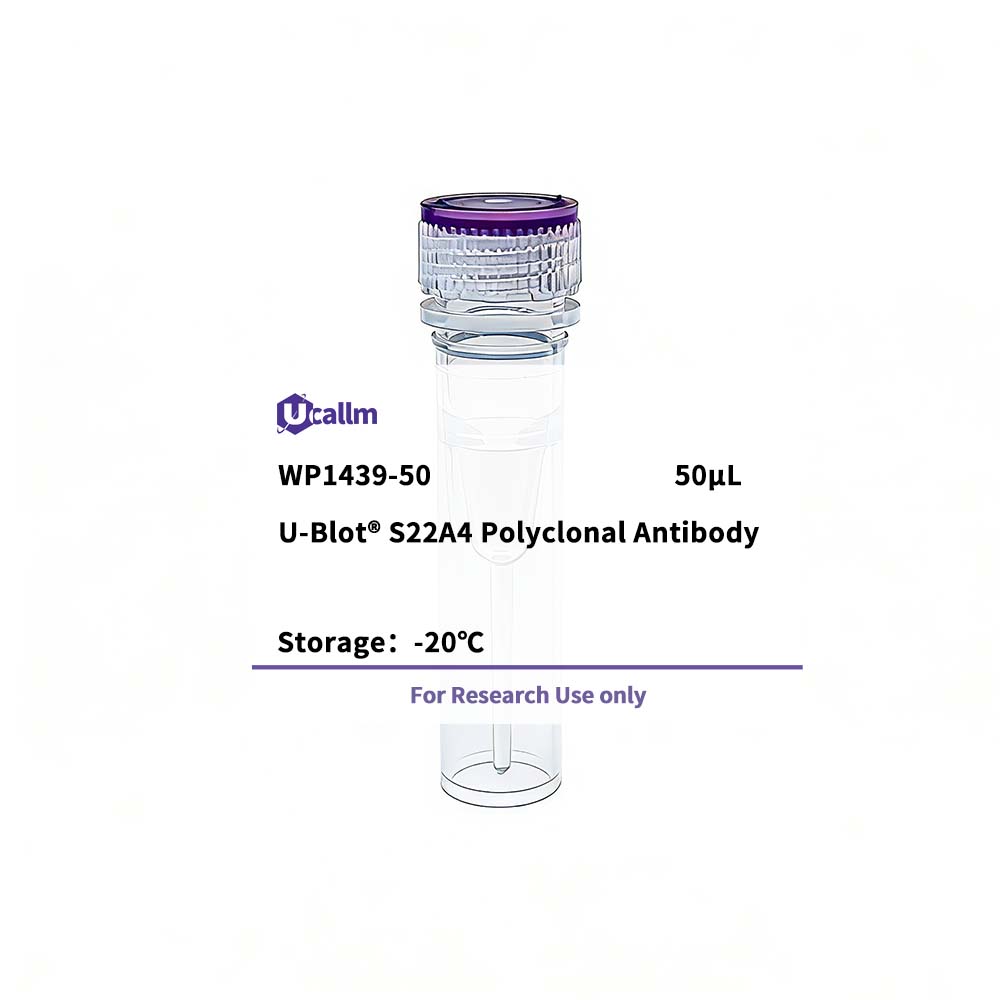
SKU: WP1439 Categories: ,

S22A4 Polyclonal Antibody

Price range: $268.00 through $328.00

SKU: WP1439-100
Enter the quantity you would like, or drag the panel to find the quantity and price that best for you
Bulk QuoteAuthorize OEM & ODM

Product details

Background:

Polyspecific organic cation transporters in the liver, kidney, intestine, and other organs are critical for elimination of many endogenous small organic cations as well as a wide array of drugs and environmental toxins. The encoded protein is an organic cation transporter and plasma integral membrane protein containing eleven putative transmembrane domains as well as a nucleotide-binding site motif. Transport by this protein is at least partially ATP-dependent. [provided by RefSeq, Jul 2008],


Specifications

Size50μL/100μL
TargetS22A4
ReactivityHuman, Mouse, Rat
ApplicationsWB, ELISA
MW(Calculated)62kD
MW(Observed)75kD
Host SpeciesRabbit
IsotypeIgG
Conjugate/ModificationUnmodified
Recommended Dilution RatioWB 1:500-2000; ELISA 1:5000-20000
FormulationLiquid in PBS containing 50% glycerol,0.5% BSA and 0.02% sodium azide.
PurificationThe antibody was affinity-purified from rabbit antiserum by affinity-chromatography using epitope-specific immunogen.
Storage-15°C to -25°C/1 year(Do not lower than -25°C)
Concentration1 mg/ml
ClonalityPolyclonal
Clone Number
ImmunogenSynthesized peptide derived from human protein . at AA range: 240-320
SpecificityS22A4 Polyclonal Antibody detects endogenous levels of protein.
Gene NameSLC22A4 ETT OCTN1 UT2H
Protein NameSolute carrier family 22 member 4 (Ergothioneine transporter) (ET transporter) (Organic cation/carnitine transporter 1)
Other Name
SpeciesHuman
Gene ID6583
UniprotQ9H015,
Species.1Mouse
Gene ID.1
Uniprot.1Q9Z306,
Species.2Rat
Gene ID.2
Uniprot.2Q9R141
Cellular LocalizationMembrane; Multi-pass membrane protein.
Tissue ExpressionWidely expressed. Highly expressed in whole blood, bone marrow, trachea and fetal liver. Weakly expressed in kidney, skeletal muscle, prostate, lung, pancreas, placenta, heart, uterus, spleen and spinal cord. Highly expressed in intestinal cell types affected by Crohn disease, including epithelial cells. Expressed in CD68 macrophage and CD43 T-cells but not in CD20 B-cells. Predominantly expressed in CD14 cells in peripheral blood mononuclear cells.
Signaling_pathway
Research Areas>>Choline metabolism in cancer
FunctionCaution:PubMed:9426230 reported that this protein does not transport carnitine, however, experiments were done with the Phe-503 variant, which affects the ability to transport carnitine. PubMed:15459889 showed that, although weakly, it can also transport carnitine at some level. Its function in carnitine transport is therefore unclear.,Disease:Defects in SLC22A4 may be a cause of rheumatoid arthritis (RA).,Disease:Defects in SLC22A4 may be a cause of susceptibility to Crohn disease (CD) [MIM:266600]. CD is a form of remitting inflammatory bowel disease (IBD). CD may involve any part of the gastrointestinal tract, but most frequently the terminal ileum and colon. Bowel inflammation is transmural and discontinuous. CD is commonly classified as an autoimmune disease.,Function:Sodium-ion dependent, low affinity carnitine transporter. Probably transports one sodium ion with one molecule of carnitine. Also transports organic cations such as tetraethylammonium (TEA) without the involvement of sodium. Relative uptake activity ratio of carnitine to TEA is 1.78. A key substrate of this transporter seems to be ergothioneine (ET).,induction:Overexpressed upon TNF-alpha treatment.,similarity:Belongs to the major facilitator superfamily. Organic cation transporter family.,subunit:Interacts with PDZK1.,tissue specificity:Widely expressed. Highly expressed in whole blood, bone marrow, trachea and fetal liver. Weakly expressed in kidney, skeletal muscle, prostate, lung, pancreas, placenta, heart, uterus, spleen and spinal cord. Highly expressed in intestinal cell types affected by Crohn disease, including epithelial cells. Expressed in CD68 macrophage and CD43 T-cells but not in CD20 B-cells. Predominantly expressed in CD14 cells in peripheral blood mononuclear cells.,
Please login to post questions
Back to Top
Product has been added to your cart

