

S26A9 rabbit pAb
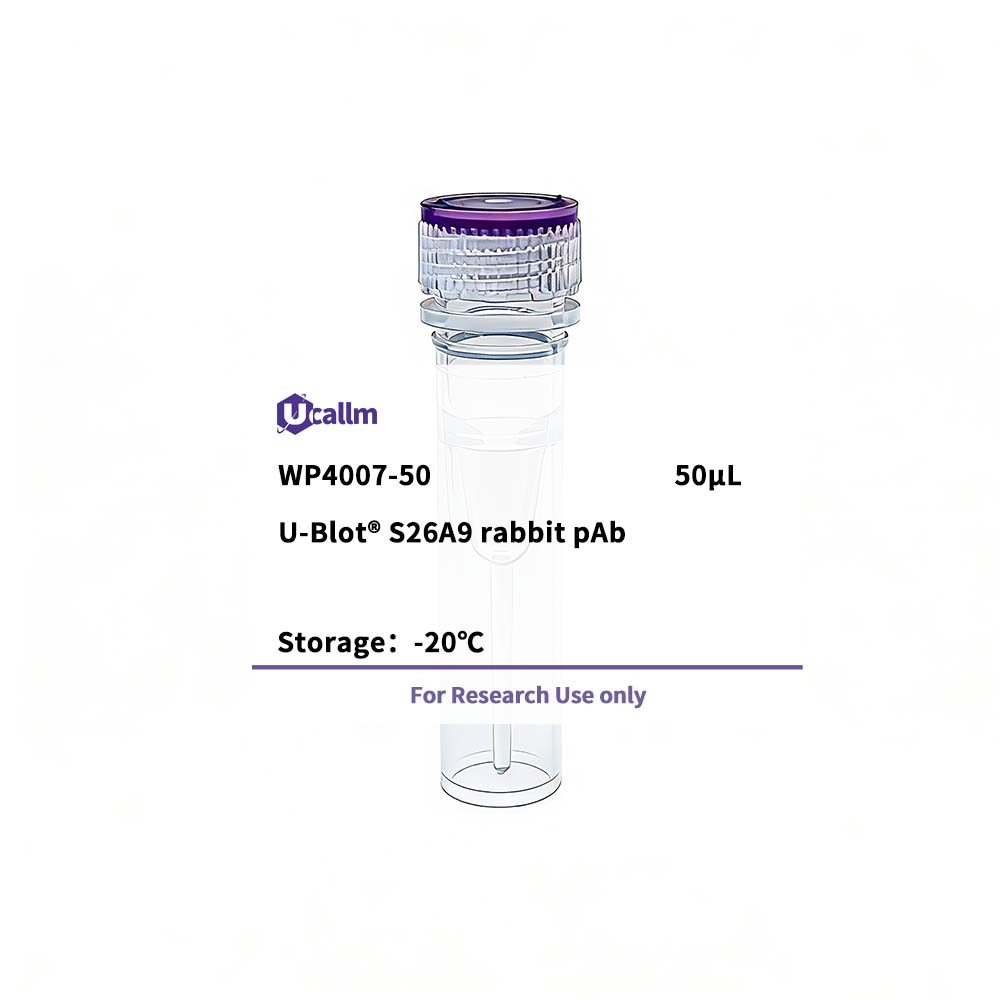
Ucallm_WP4007-50
Price range: $268.00 through $328.00
Product details
Background:
This gene is one member of a family of sulfate/anion transporter genes. Family members are well conserved in their genomic (number and size of exons) and protein (aa length among species) structures yet have markedly different tissue expression patterns. The product of this gene is a highly selective chloride ion channel regulated by WNK kinases. Alternative splicing results in multiple transcript variants encoding differing isoforms.[provided by RefSeq, Dec 2008],
Specifications
| Size | 50μL/100μL |
| Target | S26A9 |
| Reactivity | Human, Mouse |
| Applications | WB |
| MW(Calculated) | 87kD |
| MW(Observed) | |
| Host Species | Rabbit |
| Isotype | IgG |
| Conjugate/Modification | Unmodified |
| Recommended Dilution Ratio | WB 1:500-2000 |
| Formulation | Liquid in PBS containing 50% glycerol, 0.5% BSA and 0.02% sodium azide. |
| Purification | The antibody was affinity-purified from rabbit antiserum by affinity-chromatography using epitope-specific immunogen. |
| Storage | -15°C to -25°C/1 year(Do not lower than -25°C) |
| Concentration | 1 mg/ml |
| Clonality | Polyclonal |
| Clone Number | |
| Immunogen | Synthesized peptide derived from human S26A9 AA range: 689-739 |
| Specificity | This antibody detects endogenous levels of S26A9 at Human/Mouse |
| Gene Name | SLC26A9 |
| Protein Name | S26A9 |
| Other Name | |
| Species | Human |
| Gene ID | 115019 |
| Uniprot | Q7LBE3, |
| Species.1 | Mouse |
| Gene ID.1 | 320718 |
| Uniprot.1 | Q8BU91 |
| Species.2 | |
| Gene ID.2 | |
| Uniprot.2 | |
| Cellular Localization | Cell membrane; Multi-pass membrane protein . |
| Tissue Expression | Predominantly expressed in lung at the luminal side of the bronchiolar and alveolar epithelium of lung. To a lower extent, also expressed in pancreas and prostate. |
| Signaling_pathway | |
| Research Areas | >>Mineral absorption; / >>Chemical carcinogenesis - reactive oxygen species |
| Function | Function:DIDS- and thiosulfate- sensitive anion exchanger mediating chloride, sulfate and oxalate transport. Mediates chloride/bicarbonate exchange or chloride-independent bicarbonate extrusion thus assuring bicarbonate secretion. Inhibited by ammonium and thiosulfate.,sequence Caution:Translated as stop.,similarity:Belongs to the SLC26A/SulP transporter (TC 2.A.53) family.,similarity:Contains 1 STAS domain.,tissue specificity:Predominantly expressed in lung at the luminal side of the bronchiolar and alveolar epithelium of lung. To a lower extent, also espressed in pancreas and prostate., |
Please login to post questions
Related products





