

Product details
Background:
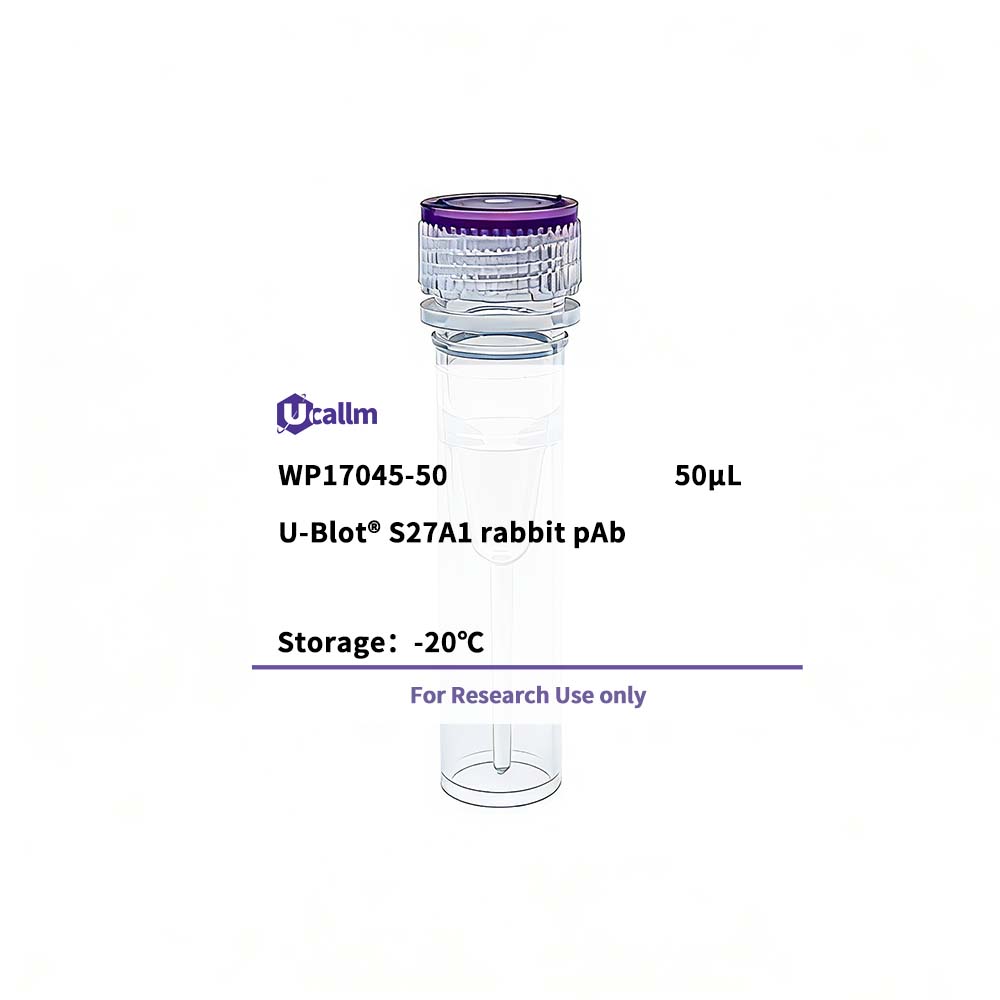
Price range: $268.00 through $328.00
Background:
| Size | 50μL/100μL |
| Target | S27A1 |
| Reactivity | Human, Mouse, Rat |
| Applications | WB |
| MW(Calculated) | 71kD |
| MW(Observed) | |
| Host Species | Rabbit |
| Isotype | IgG |
| Conjugate/Modification | Unmodified |
| Recommended Dilution Ratio | WB 1:500-2000 |
| Formulation | Liquid in PBS containing 50% glycerol, 0.5% BSA and 0.02% sodium azide. |
| Purification | The antibody was affinity-purified from rabbit antiserum by affinity-chromatography using epitope-specific immunogen. |
| Storage | -15°C to -25°C/1 year(Do not lower than -25°C) |
| Concentration | 1 mg/ml |
| Clonality | Polyclonal |
| Clone Number | |
| Immunogen | Synthesized peptide derived from human S27A1 AA range: 115-165 |
| Specificity | This antibody detects endogenous levels of S27A1 at Human/Mouse/Rat |
| Gene Name | SLC27A1 ACSVL5 FATP1 |
| Protein Name | S27A1 |
| Other Name | |
| Species | Human |
| Gene ID | 376497 |
| Uniprot | Q6PCB7, |
| Species.1 | Mouse |
| Gene ID.1 | 26457 |
| Uniprot.1 | Q60714, |
| Species.2 | Rat |
| Gene ID.2 | |
| Uniprot.2 | P97849 |
| Cellular Localization | Cell membrane; Single-pass membrane protein . Endomembrane system; Single-pass membrane protein . Cytoplasm . Plasma membrane and intracellular membranes, at least in adipocytes. In adipocytes, but not myocytes, insulin via the mTORC1 signaling pathway induces a rapid translocation of SLC27A1 from intracellular compartments to the plasma membrane, paralleled by increased LCFA uptake. Insulin-dependent translocation from the cytoplasm to the cell membrane is regulated by EPRS1. Predominantly cytoplasmic in myocytes. . |
| Tissue Expression | Highest levels of expression are detected in muscle and adipose tissue small, intermediate levels in small intestine, and barely detectable in liver. Expressed in brain gray matter (PubMed:21395585). |
| Signaling_pathway | Organismal Systems >> Endocrine system >> PPAR signaling pathway |
| Research Areas | >>PPAR signaling pathway; / >>Insulin resistance; / >>Fat digestion and absorption |
| Function | Function:Involved in translocation of long-chain fatty acids (LFCA) across the plasma membrane. The LFCA import appears to be hormone-regulated in a tissue-specific manner. In adipocytes, but not myocytes, insulin induces a rapid translocation of Fatp1 from intracellular compartments to the plasma membrane, paralleled by increased LFCA uptake. May act directly as a bona fide transporter, or alternatively, in a cytoplasmic or membrane-associated multimeric protein complex to trap and draw fatty acids towards accumulation. Plays a pivotal role in regulating available LFCA substrates from exogenous sources in tissues undergoing high levels of beta-oxidation or triglyceride synthesis. May be involved in regulation of cholesterol metabolism. Has acyl-CoA ligase activity for long-chain and very-long-chain fatty acids.,miscellaneous:FATP1-mediated fatty acid uptake is associated to paramaters related to insulin resistance, which is associated with disturbed fatty acid metabolism and homeostasis, such as obesity.,similarity:Belongs to the ATP-dependent AMP-binding enzyme family.,subcellular location:Plasma membrane and intracellular membranes, at least in adipocytes. Predominantly cytoplasmic in myocytes.,subunit:Self-associates. May function as an homodimer.,tissue specificity:Highest levels of expression are detected in muscle and adipose tissue small, intermediate levels in small intestine, and barely detectable in liver., |





