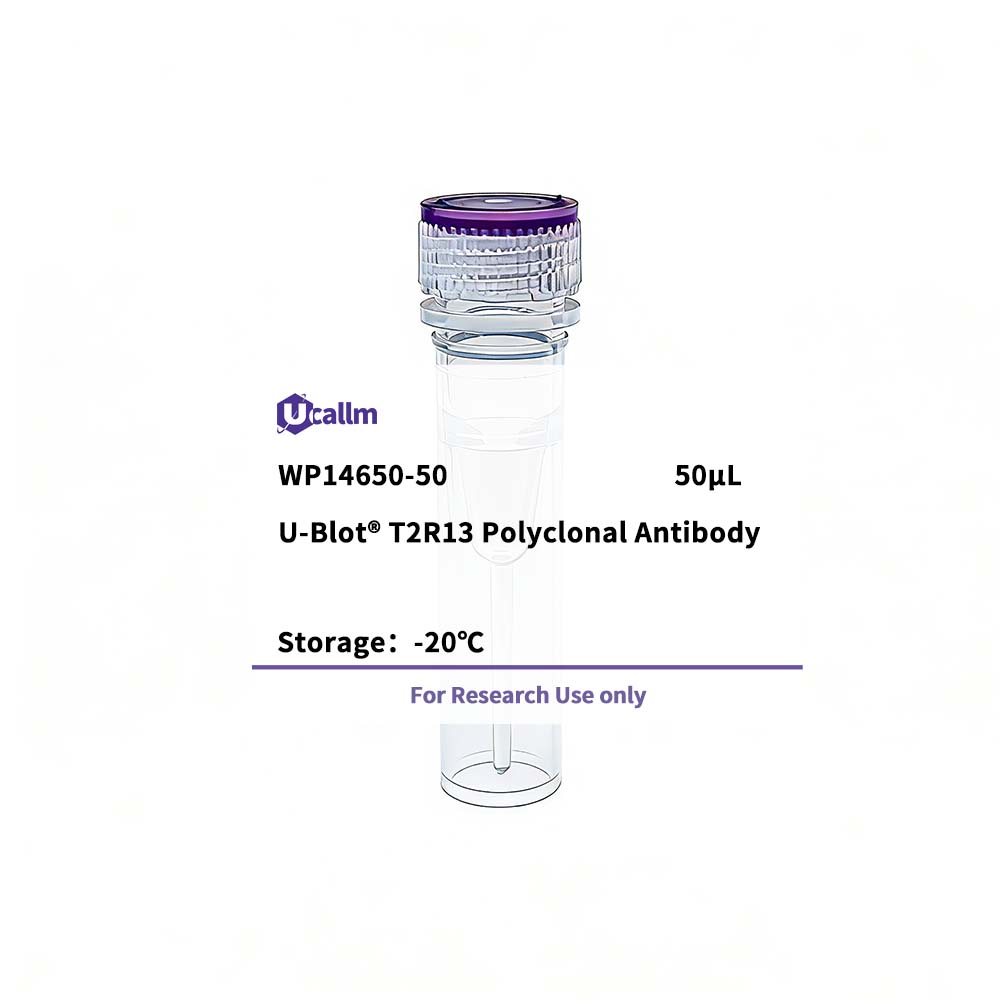
SKU: WP14650 Categories: ,

T2R13 Polyclonal Antibody

Price range: $268.00 through $328.00

SKU: WP14650-100
Enter the quantity you would like, or drag the panel to find the quantity and price that best for you
Bulk QuoteAuthorize OEM & ODM

Product details

Background:

This gene product belongs to the family of candidate taste receptors that are members of the G-protein-coupled receptor superfamily. These proteins are specifically expressed in the taste receptor cells of the tongue and palate epithelia. They are organized in the genome in clusters and are genetically linked to loci that influence bitter perception in mice and humans. In functional expression studies, they respond to bitter tastants. This gene maps to the taste receptor gene cluster on chromosome 12p13. [provided by RefSeq, Jul 2008],

Specifications

Size50μL/100μL
TargetT2R13
ReactivityHuman, Mouse, Rat
ApplicationsWB, IF, ELISA, IHC
MW(Calculated)
MW(Observed)35kD
Host SpeciesRabbit
IsotypeIgG
Conjugate/ModificationUnmodified
Recommended Dilution RatioWB 1:500-2000; IHC 1:50-300; IF 1:200-1:1000; ELISA 1:2000-20000 / Note: For IHC, we suggest antigen retrieval with TE buffer pH 9.0 (Cat#WT1004)
FormulationLiquid in PBS containing 50% glycerol, 0.5% BSA and 0.02% sodium azide.
PurificationThe antibody was affinity-purified from rabbit antiserum by affinity-chromatography using epitope-specific immunogen.
Storage-15°C to -25°C/1 year(Do not lower than -25°C)
Concentration1 mg/ml
ClonalityPolyclonal
Clone Number
ImmunogenThe antiserum was produced against synthesized peptide derived from human TAS2R13. AA range:123-172
SpecificityT2R13 Polyclonal Antibody detects endogenous levels of T2R13 protein.
Gene NameTAS2R13
Protein NameTaste receptor type 2 member 13
Other NameTAS2R13; / Taste receptor type 2 member 13; / T2R13; / Taste receptor family B member 3; / TRB3
SpeciesHuman
Gene ID50838
UniprotQ9NYV9,
Species.1Mouse
Gene ID.1
Uniprot.1Q7M720
Species.2
Gene ID.2
Uniprot.2
Cellular LocalizationMembrane; Multi-pass membrane protein.
Tissue ExpressionExpressed in subsets of taste receptor cells of the tongue and palate epithelium and exclusively in gustducin-positive cells.
Signaling_pathway
Research Areas>>Taste transduction
FunctionFunction:Receptor that may play a role in the perception of bitterness and is gustducin-linked. May play a role in sensing the chemical composition of the gastrointestinal content. The activity of this receptor may stimulate alpha gustducin, mediate PLC-beta-2 activation and lead to the gating of TRPM5.,miscellaneous:Most taste cells may be activated by a limited number of bitter compounds; individual taste cells can discriminate among bitter stimuli.,similarity:Belongs to the G-protein coupled receptor T2R family.,tissue specificity:Expressed in subsets of taste receptor cells of the tongue and palate epithelium and exclusively in gustducin-positive cells.,
Please login to post questions
Back to Top
Product has been added to your cart
