SKU: WR4365 Categories: ,

U-Blot® TATA Box Binding Protein Rabbit mAb

Price range: $268.00 through $328.00

SKU: WR4365-50
Enter the quantity you would like, or drag the panel to find the quantity and price that best for you
Bulk QuoteAuthorize OEM & ODM

Product details

Background:Initiation of transcription by RNA polymerase II requires the activities of more than 70 polypeptides. The protein that coordinates these activities is transcription factor IID (TFIID), which binds to the core promoter to position the polymerase properly, serves as the scaffold for assembly of the remainder of the transcription complex, and acts as a channel for regulatory signals. TFIID is composed of the TATA-binding protein (TBP) and a group of evolutionarily conserved proteins known as TBP-associated factors or TAFs. TAFs may participate in basal transcription, serve as coactivators, function in promoter recognition or modify general transcription factors (GTFs) to facilitate complex assembly and transcription initiation. This gene encodes TBP, the TATA-binding protein. A distinctive feature of TBP is a long string of glutamines in the N-terminus. This region of the protein modulates the DNA bin


Specifications

Size50μL/100μL
TargetTBP/TATA Binding Protein
ReactivityHuman, Mouse, Rat
ApplicationsWB, IHC, IF, IP, ELISA
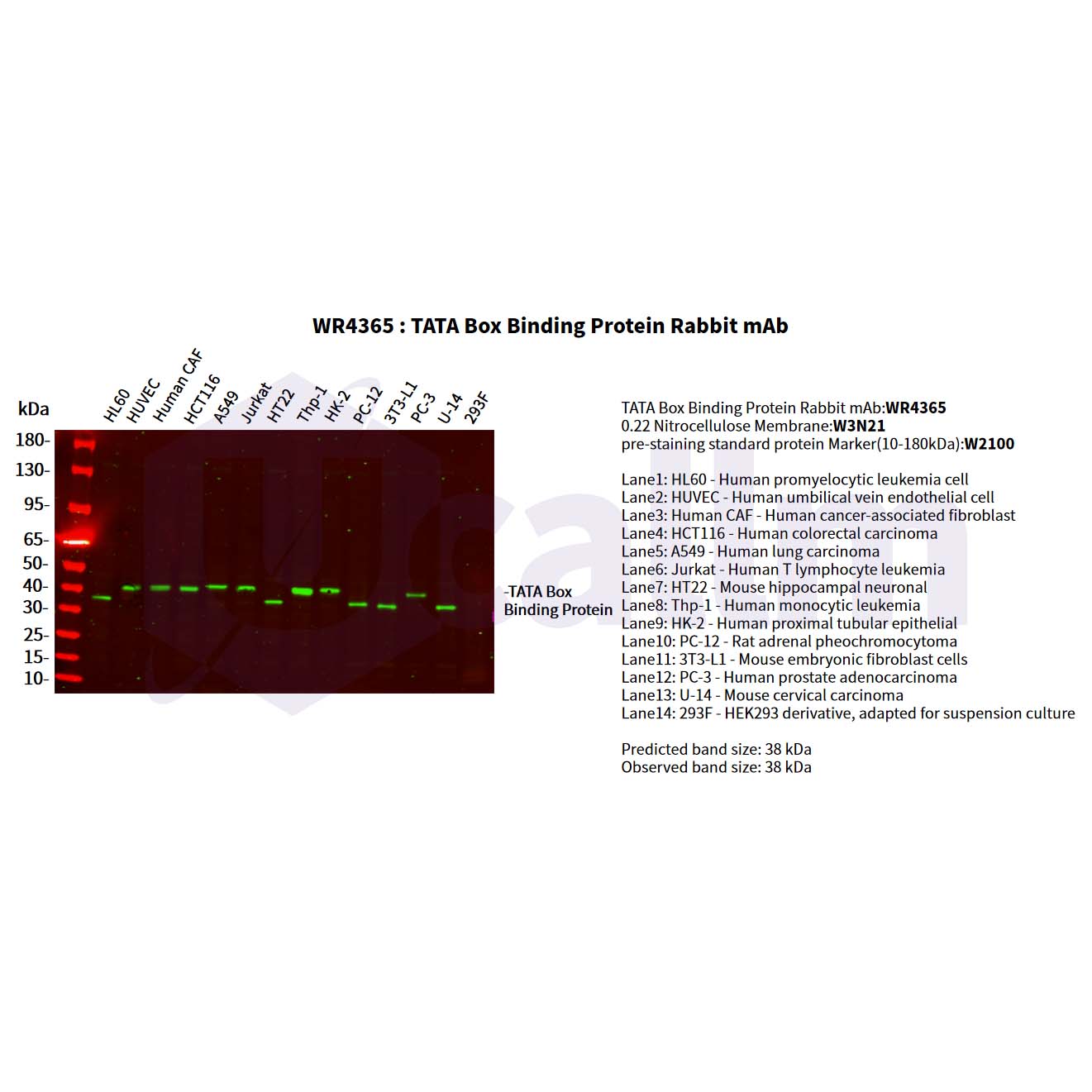
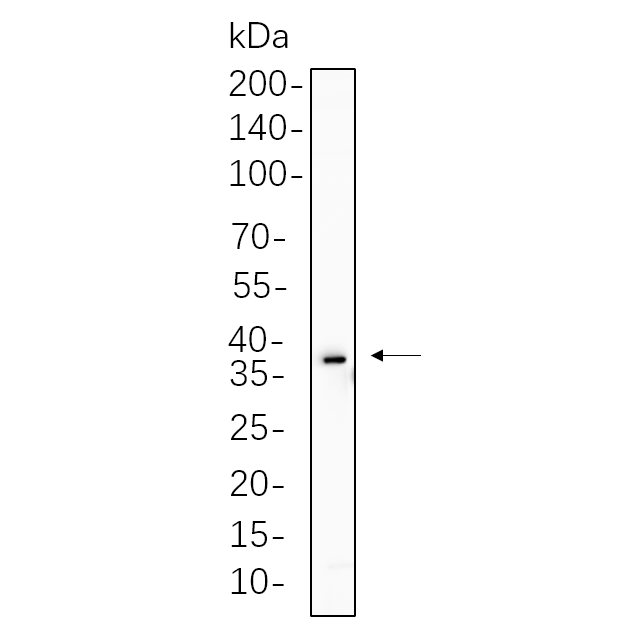
MW(Calculated)38kD
MW(Observed)38kD
Host SpeciesRabbit
IsotypeIgG,Kappa
Conjugate/ModificationUnmodified
Recommended Dilution RatioWB 1:2000-1:10000; IF 1:200-1:1000; ELISA 1:5000-1:20000; IP 1:50-1:200;
FormulationPBS, 50% glycerol, 0.05% Proclin 300, 0.05%BSA
PurificationRecombinant Antibody expressed in animal component-free (ACF) media, purified via Protein A affinity chromatography.
Storage-15°C to -25°C/1 year(Do not lower than -25°C)
Concentration
ClonalityMonoclonal
Clone NumberRM0539R
ImmunogenThe specific immunogen used to produce this antibody is proprietary information.
SpecificityEndogenous
Gene NameTBP
Protein NameTATA-box-binding protein (TATA sequence-binding protein) (TATA-binding factor) (TATA-box factor) (Transcription initiation factor TFIID TBP subunit)
Other NameTBP; / GTF2D1; / TF2D; / TFIID; / TATA-box-binding protein; / TATA sequence-binding protein; / TATA-binding factor; / TATA-box factor; / Transcription initiation factor TFIID TBP subunit
SpeciesHuman
Gene ID10736
UniprotP20226,
Species.1Mouse
Gene ID.121374
Uniprot.1P29037
Species.2
Gene ID.2
Uniprot.2
Cellular LocalizationNucleus
Tissue ExpressionStrongly expressed in skeletal muscle. Expressed in Wilms' tumor and in the cap mesenchyme of fetal kidney (at protein level).
Signaling_pathway
Research Areas
FunctionDisease:Defects in TBP are the cause of spinocerebellar ataxia type 17 (SCA17) [MIM:607136]. Spinocerebellar ataxia is a clinically and genetically heterogeneous group of cerebellar disorders. Patients show progressive incoordination of gait and often poor coordination of hands, speech and eye movements, due to degeneration of the cerebellum with variable involvement of the brainstem and spinal cord. SCA17 is an autosomal dominant cerebellar ataxia (ADCA) characterized by widespread cerebral and cerebellar atrophy, dementia and extrapyramidal signs. The molecular defect in SCA17 is the expansion of a CAG repeat in the coding region of TBP. Longer expansions result in earlier onset and more severe clinical manifestations of the disease.,Function:General transcription factor that functions at the core of the DNA-binding multiprotein factor TFIID. Binding of TFIID to the TATA box is the initial transcriptional step of the pre-initiation complex (PIC), playing a role in the activation of eukaryotic genes transcribed by RNA polymerase II.,polymorphism:The poly-Gln region of TBP is highly polymorphic (25 to 42 repeats) in normal individuals and is expanded to about 47-63 repeats in spinocerebellar ataxia 17 (SCA17) patients.,similarity:Belongs to the TBP family.,subunit:Belongs to the TFIID complex together with the TBP-associated factors (TAFs). Component of the transcription factor SL1/TIFIB complex, composed of TBP and at least TAF1A, TAF1B TAF1C, and TAF3. Binds DNA as monomer. Interacts with TAFs, TFIIB, NCOA6, DRAP1, DR1 and ELF3. Interacts with SPIB, SNAPC1, SNAPC2 and SNAPC4. Interacts with HIV-1 Tat. Interacts with UTF1 which acts as a coactivator of ATF2 transcriptional activity. Interacts with GPBP1 (By similarity). Interacts with BRF2.,tissue specificity:Widely expressed, with levels highest in the testis and ovary.,
Please login to post questions

Back to Top
Product has been added to your cart
