

TRAF4 Polyclonal Antibody
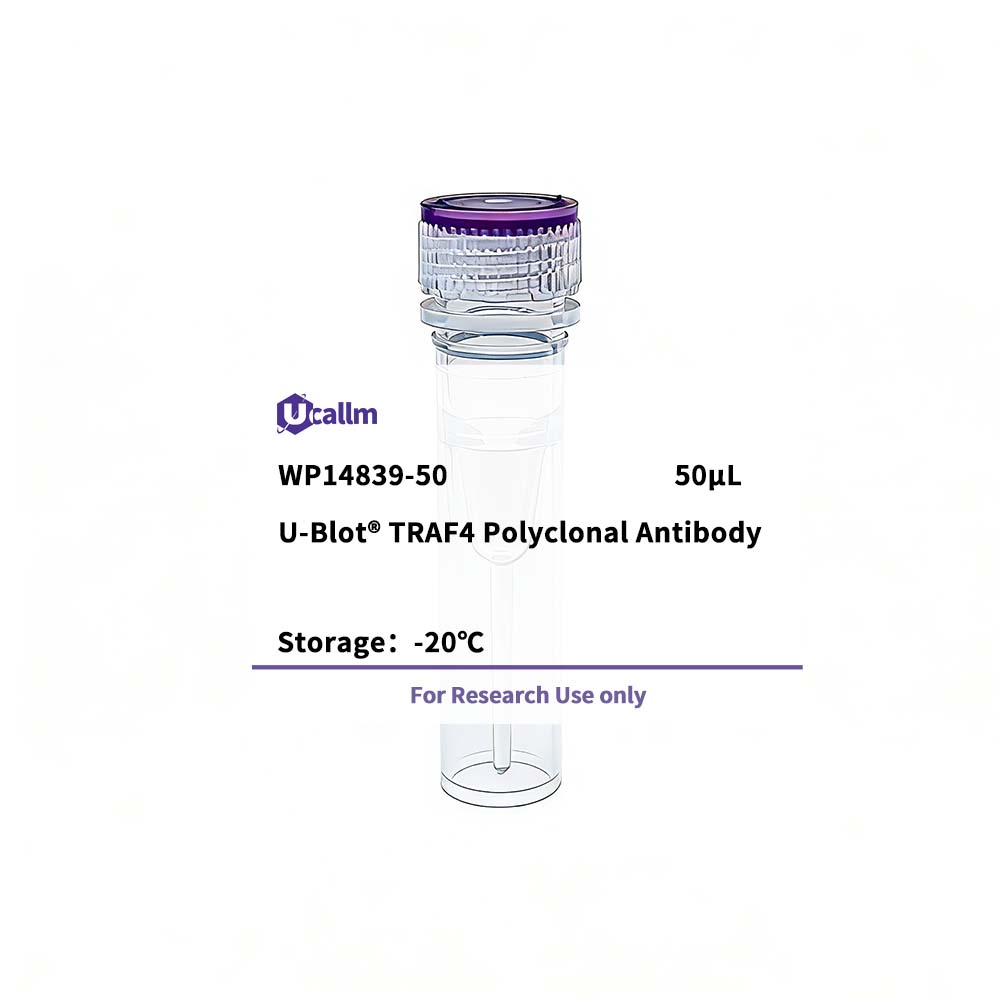
Ucallm_WP14839-50
Price range: $268.00 through $328.00
Product details
Background:
TNF receptor associated factor 4(TRAF4) Homo sapiens This gene encodes a member of the TNF receptor associated factor (TRAF) family. TRAF proteins are associated with, and mediate signal transduction from members of the TNF receptor superfamily. The encoded protein has been shown to interact with neurotrophin receptor, p75 (NTR/NTSR1), and negatively regulate NTR induced cell death and NF-kappa B activation. This protein has been found to bind to p47phox, a cytosolic regulatory factor included in a multi-protein complex known as NAD(P)H oxidase. This protein thus, is thought to be involved in the oxidative activation of MAPK8/JNK. Alternatively spliced transcript variants have been observed but the full-length nature of only one has been determined. [provided by RefSeq, Jul 2008],
Specifications
| Size | 50μL/100μL |
| Target | TRAF4 |
| Reactivity | Human, Mouse, Rat |
| Applications | WB, ELISA |
| MW(Calculated) | |
| MW(Observed) | 53kD |
| Host Species | Rabbit |
| Isotype | IgG |
| Conjugate/Modification | Unmodified |
| Recommended Dilution Ratio | WB 1:500-1:2000; ELISA 1:10000; Not yet tested in other applications. |
| Formulation | Liquid in PBS containing 50% glycerol, 0.5% BSA and 0.02% sodium azide. |
| Purification | The antibody was affinity-purified from rabbit antiserum by affinity-chromatography using epitope-specific immunogen. |
| Storage | -15°C to -25°C/1 year(Do not lower than -25°C) |
| Concentration | 1 mg/ml |
| Clonality | Polyclonal |
| Clone Number | |
| Immunogen | The antiserum was produced against synthesized peptide derived from human TRAF4. AA range:261-310 |
| Specificity | TRAF4 Polyclonal Antibody detects endogenous levels of TRAF4 protein. |
| Gene Name | TRAF4 |
| Protein Name | TNF receptor-associated factor 4 |
| Other Name | TRAF4; / CART1; / MLN62; / RNF83; / TNF receptor-associated factor 4; / Cysteine-rich domain associated with RING and Traf domains protein 1; / Metastatic lymph node gene 62 protein; / MLN 62; / RING finger protein 83 |
| Species | Human |
| Gene ID | 9618 |
| Uniprot | Q9BUZ4, |
| Species.1 | Mouse |
| Gene ID.1 | 22032 |
| Uniprot.1 | Q61382 |
| Species.2 | |
| Gene ID.2 | |
| Uniprot.2 | |
| Cellular Localization | Cytoplasm . Nucleus . Cytoplasm, perinuclear region. Cell junction, tight junction. Cell membrane; Peripheral membrane protein; Cytoplasmic side. Cytoplasm, cytoskeleton . |
| Tissue Expression | Expressed in epithelial cells of thymus, dendritic cells of lymph node, and in the basal cell layer of epithelia such as epidermis, nasopharynx, respiratory tract, salivary gland, and esophagus. |
| Signaling_pathway | Organismal Systems >> Immune system >> IL-17 signaling pathway;Human Diseases >> Cancer: overview >> Pathways in cancer;Human Diseases >> Cancer: specific types >> Small cell lung cancer |
| Research Areas | >>IL-17 signaling pathway; / >>Pathways in cancer; / >>Small cell lung cancer |
| Function | Domain:The coiled coil domain mediates homo- and hetero-oligomerization.,Domain:The MATH/TRAF domain binds to receptor cytoplasmic domains.,Function:Adapter protein and signal transducer that links members of the tumor necrosis factor receptor family to different signaling pathways by association with the receptor cytoplasmic domain and kinases. Seems to mediate activation of NF-kappa-B and JNK and seems to be involved in apoptosis. May play a role in the development of respiratory tract.,similarity:Contains 1 MATH domain.,similarity:Contains 1 RING-type zinc finger.,similarity:Contains 3 TRAF-type zinc fingers.,subunit:Homotrimer (Probable). Associates with LTBR/TNFRSF3 and NGFR/TNFRSF16. Interacts with TGFB1I1.,tissue specificity:Expressed in epithelial cells of thymus, dendritic cells of lymph node, and in the basal cell layer of epithelia such as epidermis, nasopharynx, respiratory tract, salivary gland, and esophagus., |
Please login to post questions
Related products





