SKU: WP14848 Categories: ,

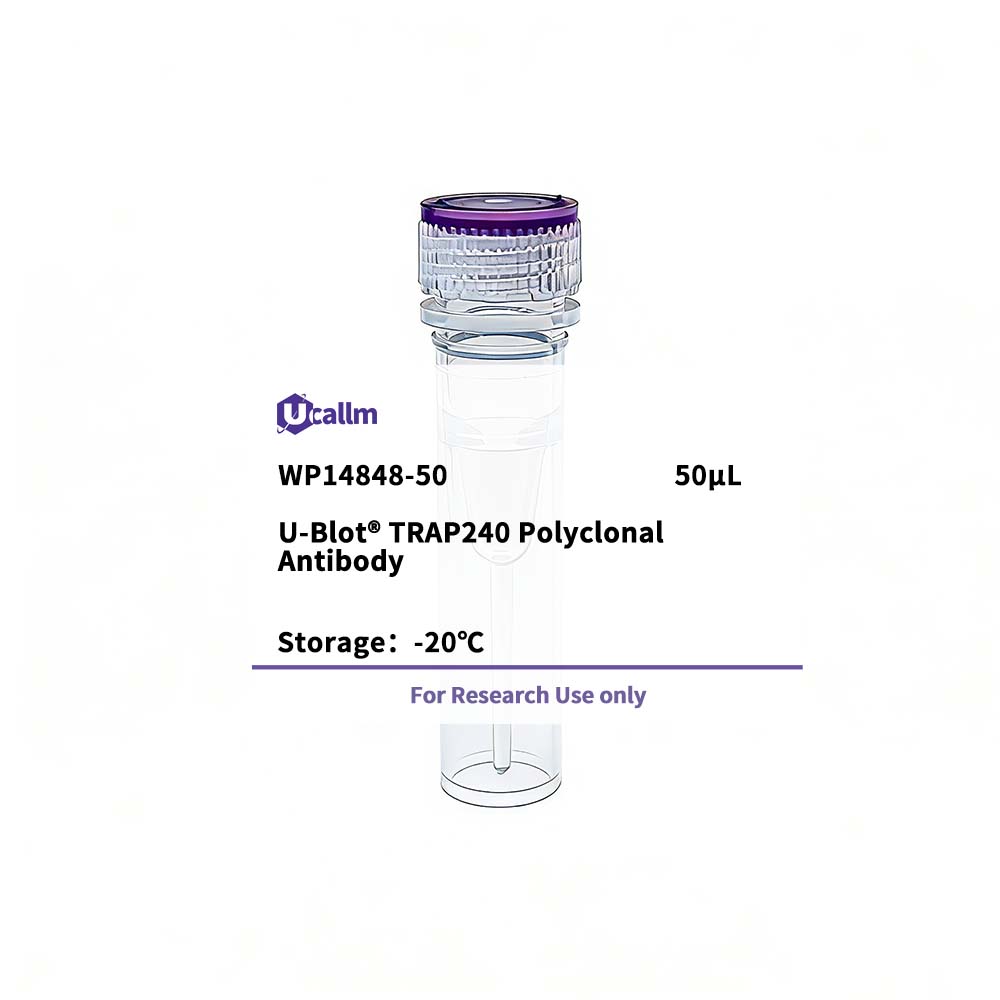
TRAP240 Polyclonal Antibody

Price range: $268.00 through $328.00

SKU: WP14848-100
Enter the quantity you would like, or drag the panel to find the quantity and price that best for you
Bulk QuoteAuthorize OEM & ODM

Product details

Background:

The protein encoded by this gene is a subunit of the Mediator complex, a large complex of proteins that functions as a transcriptional coactivator for most RNA polymerase II-transcribed genes. The encoded protein is involved in early development of the heart and brain. Defects in this gene are a cause of transposition of the great arteries, dextro-looped (DTGA).[provided by RefSeq, Jul 2010],

Specifications

Size50μL/100μL
TargetTRAP240
ReactivityHuman, Mouse
ApplicationsWB, IHC, IF, ELISA
MW(Calculated)
MW(Observed)250kD
Host SpeciesRabbit
IsotypeIgG
Conjugate/ModificationUnmodified
Recommended Dilution RatioWB 1:500-1:2000; IHC 1:100-1:300; ELISA 1:10000; IF 1:50-200 / Note: For IHC, we suggest antigen retrieval with TE buffer pH 9.0 (Cat#WT1004)
FormulationLiquid in PBS containing 50% glycerol, 0.5% BSA and 0.02% sodium azide.
PurificationThe antibody was affinity-purified from rabbit antiserum by affinity-chromatography using epitope-specific immunogen.
Storage-15°C to -25°C/1 year(Do not lower than -25°C)
Concentration1 mg/ml
ClonalityPolyclonal
Clone Number
ImmunogenThe antiserum was produced against synthesized peptide derived from human MED13L. AA range:449-498
SpecificityTRAP240 Polyclonal Antibody detects endogenous levels of TRAP240 protein.
Gene NameMED13L
Protein NameMediator of RNA polymerase II transcription subunit 13-like
Other NameMED13L; / KIAA1025; / Mediator of RNA polymerase II transcription subunit 13-like; / Mediator complex subunit 13-like; / Thyroid hormone receptor-associated protein 2; / Thyroid hormone receptor-associated protein complex 240 kDa component-like
SpeciesHuman
Gene ID23389
UniprotQ71F56,
Species.1Mouse
Gene ID.176199
Uniprot.1Q6JPI3
Species.2
Gene ID.2
Uniprot.2
Cellular LocalizationNucleus .
Tissue ExpressionHighly expressed in brain (cerebellum), heart (aorta), skeletal muscle, kidney, placenta and peripheral blood leukocytes. Highly expressed in fetal brain.
Signaling_pathwayOrganismal Systems >> Endocrine system >> Thyroid hormone signaling pathway
Research Areas>>Thyroid hormone signaling pathway
FunctionDisease:A chromosomal aberration involving MED13L is found in a patient with transposition of the great arteries, dextro-looped and mental retardation. Translocation t(12; 17)(q24.1; q21).,Disease:Defects in MED13L are a cause of transposition of the great arteries, dextro-looped (DTGA) [MIM:608808]. DTGA consists of complete inversion of the great vessels, so that the aorta incorrectly arises from the right ventricle and the pulmonary artery incorrectly arises from the left ventricle. This creates completely separate pulmonary and systemic circulatory systems, an arrangement that is incompatible with life. Patients often have atrial and/or ventricular septal defects or other types of shunting that allow some mixing between the circulations in order to support life minimally, but surgical intervention is always required.,Function:Component of the Mediator complex, a coactivator involved in the regulated transcription of nearly all RNA polymerase II-dependent genes. Mediator functions as a bridge to convey information from gene-specific regulatory proteins to the basal RNA polymerase II transcription machinery. Mediator is recruited to promoters by direct interactions with regulatory proteins and serves as a scaffold for the assembly of a functional preinitiation complex with RNA polymerase II and the general transcription factors. This subunit may specifically regulate transcription of targets of the Wnt signaling pathway and SHH signaling pathway.,PTM:Phosphorylated upon DNA damage, probably by ATM or ATR.,similarity:Belongs to the Mediator complex subunit 13 family.,subunit:Component of the Mediator complex, which is composed of MED1, MED4, MED6, MED7, MED8, MED9, MED10, MED11, MED12, MED13, MED13L, MED14, MED15, MED16, MED17, MED18, MED19, MED20, MED21, MED22, MED23, MED24, MED25, MED26, MED27, MED29, MED30, MED31, CCNC, CDK8 and CDC2L6/CDK11. The MED12, MED13, CCNC and CDK8 subunits form a distinct module termed the CDK8 module. Mediator containing the CDK8 module is less active than Mediator lacking this module in supporting transcriptional activation. Individual preparations of the Mediator complex lacking one or more distinct subunits have been variously termed ARC, CRSP, DRIP, PC2, SMCC and TRAP.,tissue specificity:Highly expressed in brain (cerebellum), heart (aorta), skeletal muscle, kidney, placenta and peripheral blood leukocytes. Highly expressed in fetal brain.,
Please login to post questions
Back to Top
Product has been added to your cart

