SKU: WR4917 Categories: ,

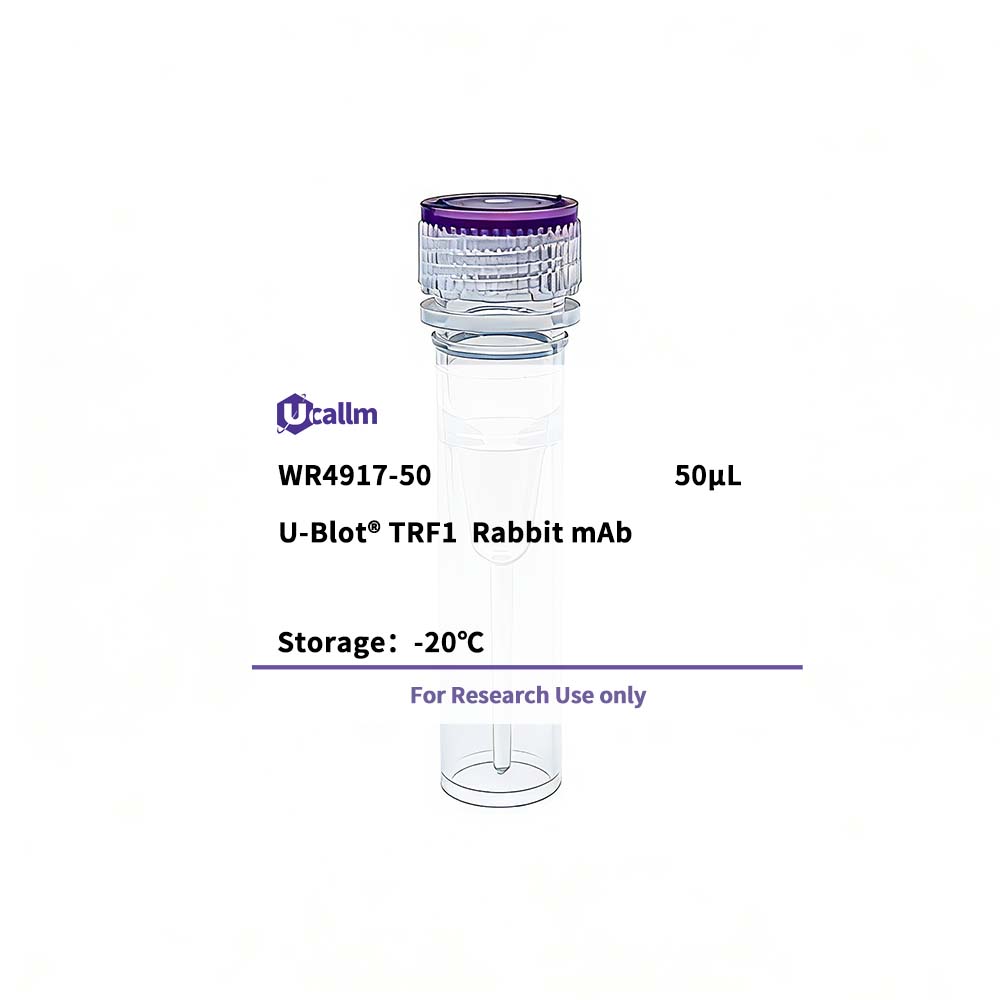
U-Blot® TRF1 Rabbit mAb

Price range: $268.00 through $328.00

SKU: WR4917-50
Enter the quantity you would like, or drag the panel to find the quantity and price that best for you
Bulk QuoteAuthorize OEM & ODM

Product details

Background:This gene encodes a telomere specific protein which is a component of the telomere nucleoprotein complex. This protein is present at telomeres throughout the cell cycle and functions as an inhibitor of telomerase, acting in cis to limit the elongation of individual chromosome ends. The protein structure contains a C-terminal Myb motif, a dimerization domain near its N-terminus and an acidic N-terminus. Two transcripts of this gene are alternatively spliced products. [provided by RefSeq, Jul 2008],

Specifications

Size50μL/100μL
TargetTERF1
ReactivityHuman, Mouse
ApplicationsWB, IF, ELISA
MW(Calculated)50kD
MW(Observed)60kD
Host SpeciesRabbit
IsotypeIgG,Kappa
Conjugate/ModificationUnmodified
Recommended Dilution RatioWB 1:1000-1:5000; IF 1:200-1:1000; ELISA 1:5000-1:20000;
FormulationPBS, 50% glycerol, 0.05% Proclin 300, 0.05%BSA
PurificationRecombinant Antibody expressed in animal component-free (ACF) media, purified via Protein A affinity chromatography.
Storage-15°C to -25°C/1 year(Do not lower than -25°C)
Concentration
ClonalityMonoclonal
Clone NumberRM1147R
ImmunogenThe specific immunogen used to produce this antibody is proprietary information.
SpecificityEndogenous
Gene NameTERF1
Protein NameTelomeric repeat-binding factor 1
Other NameTERF1; / PIN2; / TRBF1; / TRF; / TRF1; / Telomeric repeat-binding factor 1; / NIMA-interacting protein 2; / TTAGGG repeat-binding factor 1; / Telomeric protein Pin2/TRF1
SpeciesHuman
Gene ID7013
UniprotP54274,
Species.1Mouse
Gene ID.121749
Uniprot.1P70371
Species.2
Gene ID.2
Uniprot.2
Cellular LocalizationNucleus. Cytoplasm, cytoskeleton, spindle. Chromosome, telomere. Colocalizes with telomeric DNA in interphase and prophase cells. Telomeric localization decreases in metaphase, anaphase and telophase. Associates with the mitotic spindle.
Tissue ExpressionHighly expressed and ubiquitous. Isoform Pin2 predominates.
Signaling_pathway
Research Areas
FunctionDomain:The acidic N-terminal domain binds to the ankyrin repeats of TNKS1 and TNKS2. The C-terminal domain binds microtubules.,Function:Binds the telomeric double-stranded TTAGGG repeat and negatively regulates telomere length. Involved in the regulation of the mitotic spindle. Component of the shelterin complex (telosome) that is involved in the regulation of telomere length and protection. Shelterin associates with arrays of double-stranded TTAGGG repeats added by telomerase and protects chromosome ends; without its protective activity, telomeres are no longer hidden from the DNA damage surveillance and chromosome ends are inappropriately processed by DNA repair pathways.,induction:Pin2 expression is tightly regulated during the cell cycle; levels are low in G1 and S phase and increase during G2 phase and mitosis.,PTM:ADP-ribosylation by TNKS1 or TNKS2 diminishes its ability to bind to telomeric DNA.,PTM:Phosphorylated preferentially on Ser-219 in an ATM-dependent manner in response to ionizing DNA damage.,similarity:Contains 1 HTH myb-type DNA-binding domain.,subcellular location:Colocalizes with telomeric DNA in interphase and metaphase cells and is located at chromosome ends during metaphase. Associates with the mitotic spindle.,subunit:Homodimer; can contain both isoforms. Found in a complex with POT1; TINF2 and TNKS1. Interacts with ATM, TINF2, TNKS1, TNKS2, PINX1, NEK2 and MAPRE1. Component of the shelterin complex (telosome) composed of TERF1, TERF2, TINF2, TERF2IP ACD and POT1.,tissue specificity:Highly expressed and ubiquitous. Isoform Pin2 predominates.,
Please login to post questions
Back to Top
Product has been added to your cart
