


TRPV6 Polyclonal Antibody
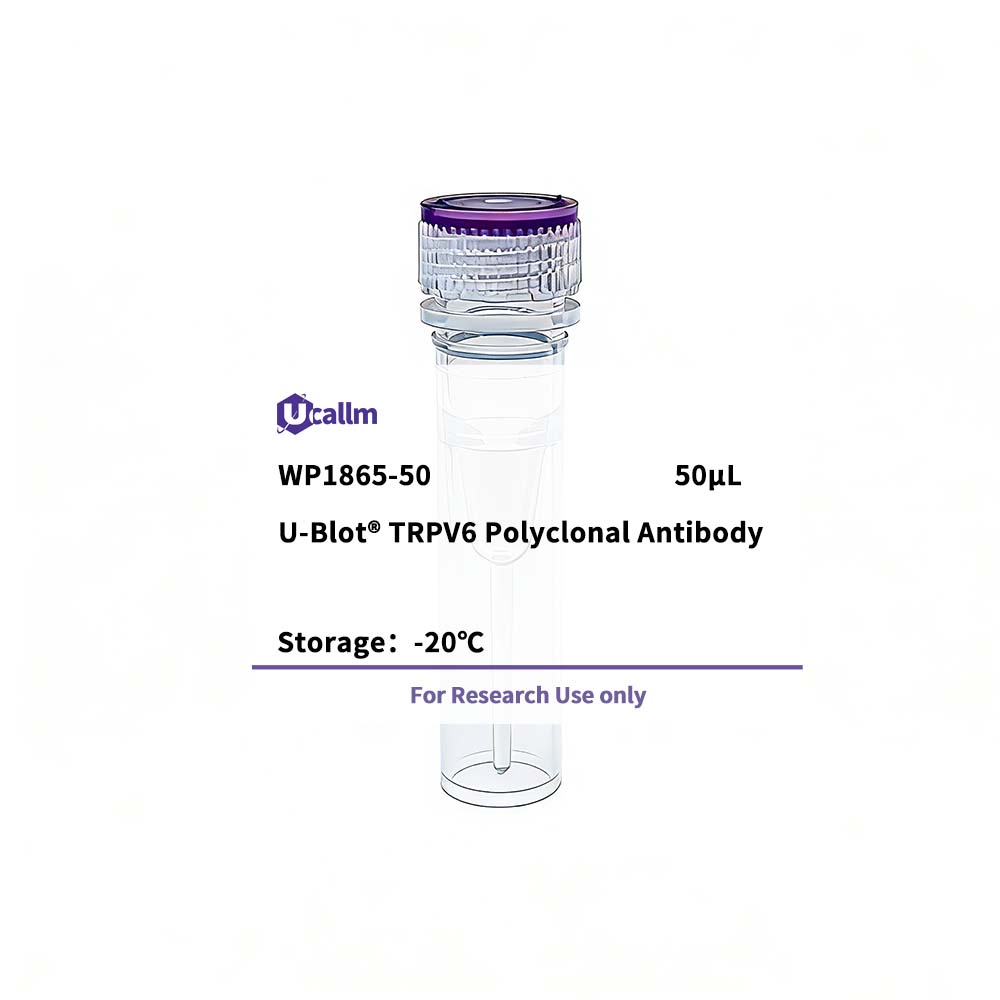
Ucallm_WP1865-50
Price range: $268.00 through $328.00
Product details
Background:
transient receptor potential cation channel subfamily V member 6(TRPV6) Homo sapiens This gene encodes a member of a family of multipass membrane proteins that functions as calcium channels. The encoded protein contains N-terminal ankyrin repeats, which are required for channel assembly and regulation. Translation initiation for this protein occurs at a non-AUG start codon that is decoded as methionine. This gene is situated next to a closely related gene for transient receptor potential cation channel subfamily V member 5 (TRPV5). This locus has experienced positive selection in non-African populations, resulting in several non-synonymous codon differences among individuals of different genetic backgrounds. [provided by RefSeq, Feb 2015],
Specifications
| Size | 50μL/100μL |
| Target | TRPV6 |
| Reactivity | Human, Mouse, Rat |
| Applications | WB, ELISA |
| MW(Calculated) | |
| MW(Observed) | 79kD |
| Host Species | Rabbit |
| Isotype | IgG |
| Conjugate/Modification | Unmodified |
| Recommended Dilution Ratio | WB 1:500-2000; ELISA 1:5000-20000 |
| Formulation | Liquid in PBS containing 50% glycerol,0.5% BSA and 0.02% sodium azide. |
| Purification | The antibody was affinity-purified from rabbit antiserum by affinity-chromatography using epitope-specific immunogen. |
| Storage | -15°C to -25°C/1 year(Do not lower than -25°C) |
| Concentration | 1 mg/ml |
| Clonality | Polyclonal |
| Clone Number | |
| Immunogen | Synthesized peptide derived from part region of human protein |
| Specificity | TRPV6 Polyclonal Antibody detects endogenous levels of protein. |
| Gene Name | TRPV6 ECAC2 |
| Protein Name | Transient receptor potential cation channel subfamily V member 6 (TrpV6) (CaT-like) (CaT-L) (Calcium transport protein 1) (CaT1) (Epithelial calcium channel 2) (ECaC2) |
| Other Name | |
| Species | Human |
| Gene ID | 55503 |
| Uniprot | Q9H1D0, |
| Species.1 | Mouse |
| Gene ID.1 | |
| Uniprot.1 | Q91WD2, |
| Species.2 | Rat |
| Gene ID.2 | |
| Uniprot.2 | Q9R186 |
| Cellular Localization | Cell membrane; Multi-pass membrane protein . |
| Tissue Expression | Expressed at high levels in the gastrointestinal tract, including esophagus, stomach, duodenum, jejunum, ileum and colon, and in pancreas, placenta, prostate and salivary gland. Expressed at moderate levels in liver, kidney and testis. Expressed in trophoblasts of placenta villus trees (at protein level)(PubMed:23612980). Expressed in locally advanced prostate cancer, metastatic and androgen-insensitive prostatic lesions but not detected in healthy prostate tissue and benign prostatic hyperplasia. |
| Signaling_pathway | |
| Research Areas | >>Salivary secretion; / >>Mineral absorption |
| Function | Function:Calcium selective cation channel probably involved in Ca(2+) uptake in various tissues, including Ca(2+) reabsorption in intestine. The channel is activated by low internal calcium level, probably including intracellular calcium store depletion, and the current exhibits an inward rectification. Inactivation includes both, a rapid Ca(2+)-dependent and a slower Ca(2+)-calmodulin-dependent mechanism, the latter may be regulated by phosphorylation. In vitro, is slowly inhibited by Mg(2+) in a voltage-independent manner. Heteromeric assembly with TRPV5 seems to modify channel properties. TRPV5-TRPV6 heteromultimeric concatemers exhibit voltage-dependent gating.,online information:TRPV6 entry,PTM:Glycosylated.,PTM:Phosphorylation by PRKCA at the calmodulin binding site delays channel inactivation.,similarity:Belongs to the transient receptor family. TrpV subfamily.,similarity:Contains 5 ANK repeats.,subunit:Homotetramer and probably heterotetramer with TRPV5. Interacts with TRPV5. Interacts with S100A10 and probably with the ANAX2-S100A10 heterotetramer. The interaction with S100A10 is required for the trafficking to the plasma membrane. Interacts with BSPRY (By similarity). Interacts with calmodulin.,tissue specificity:Expressed at high levels in the gastrointestinal tract, including esophagus, stomach, duodenum, jejunum, ileum and colon, and in pancreas, placenta, prostate and salivary gland. Expressed at moderate levels in liver, kidney and testis. Expressed in locally advanced prostate cancer, metastatic and androgen-insensitive prostatic lesions but not detected in healthy prostate tissue and benign prostatic hyperplasia., |
Please login to post questions
Related products



