


TS1R1 Polyclonal Antibody
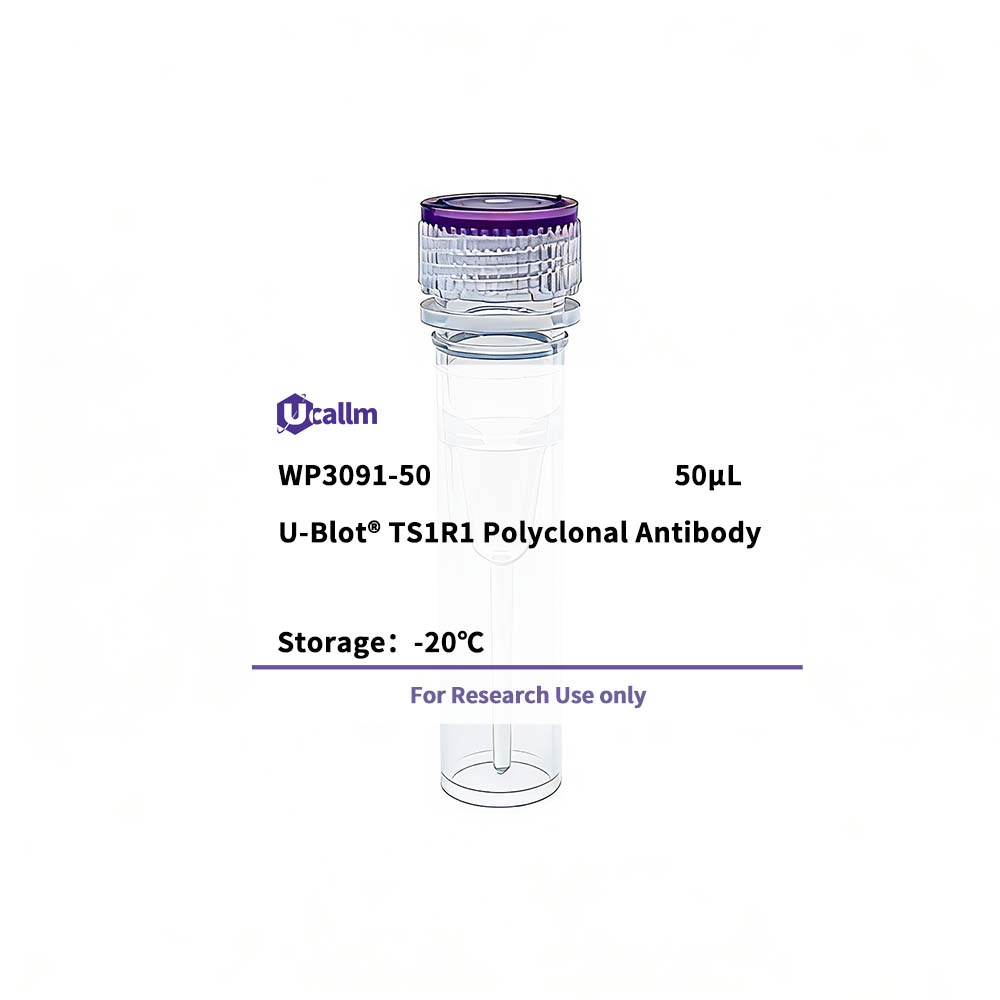
Ucallm_WP3091-50
Price range: $268.00 through $328.00
Product details
Background:
The protein encoded by this gene is a G protein-coupled receptor and is a component of the heterodimeric amino acid taste receptor T1R1+3. The T1R1+3 receptor responds to L-amino acids but not to D-enantiomers or other compounds. Most amino acids that are perceived as sweet activate T1R1+3, and this activation is strictly dependent on an intact T1R1+3 heterodimer. Multiple transcript variants encoding different isoforms have been found for this gene. [provided by RefSeq, Jun 2010],
Specifications
| Size | 50μL/100μL |
| Target | TS1R1 |
| Reactivity | Human, Mouse, Rat |
| Applications | WB, ELISA |
| MW(Calculated) | |
| MW(Observed) | 92kD |
| Host Species | Rabbit |
| Isotype | IgG |
| Conjugate/Modification | Unmodified |
| Recommended Dilution Ratio | WB 1:500-2000; ELISA 1:5000-20000 |
| Formulation | Liquid in PBS containing 50% glycerol,0.5% BSA and 0.02% sodium azide. |
| Purification | The antibody was affinity-purified from rabbit antiserum by affinity-chromatography using epitope-specific immunogen. |
| Storage | -15°C to -25°C/1 year(Do not lower than -25°C) |
| Concentration | 1 mg/ml |
| Clonality | Polyclonal |
| Clone Number | |
| Immunogen | Synthesized peptide derived from human protein . at AA range: 280-360 |
| Specificity | TS1R1 Polyclonal Antibody detects endogenous levels of protein. |
| Gene Name | TAS1R1 GPR70 T1R1 TR1 GM148 |
| Protein Name | Taste receptor type 1 member 1 (G-protein coupled receptor 70) |
| Other Name | |
| Species | Human |
| Gene ID | 80835 |
| Uniprot | Q7RTX1, |
| Species.1 | Mouse |
| Gene ID.1 | |
| Uniprot.1 | Q99PG6, |
| Species.2 | Rat |
| Gene ID.2 | |
| Uniprot.2 | Q9Z0R8 |
| Cellular Localization | Cell membrane; Multi-pass membrane protein. |
| Tissue Expression | |
| Signaling_pathway | |
| Research Areas | >>Taste transduction |
| Function | Function:Putative taste receptor. TAS1R1/TAS1R3 responds to the umami taste stimulus (the taste of monosodium glutamate). Sequence differences within and between species can significantly influence the selectivity and specificity of taste responses.,online information:The taste experience -Issue 55 of February 2005,similarity:Belongs to the G-protein coupled receptor 3 family. TAS1R subfamily.,subunit:Forms heterodimers with TAS1R3., |
Please login to post questions
Related products





