

Product details
Background:
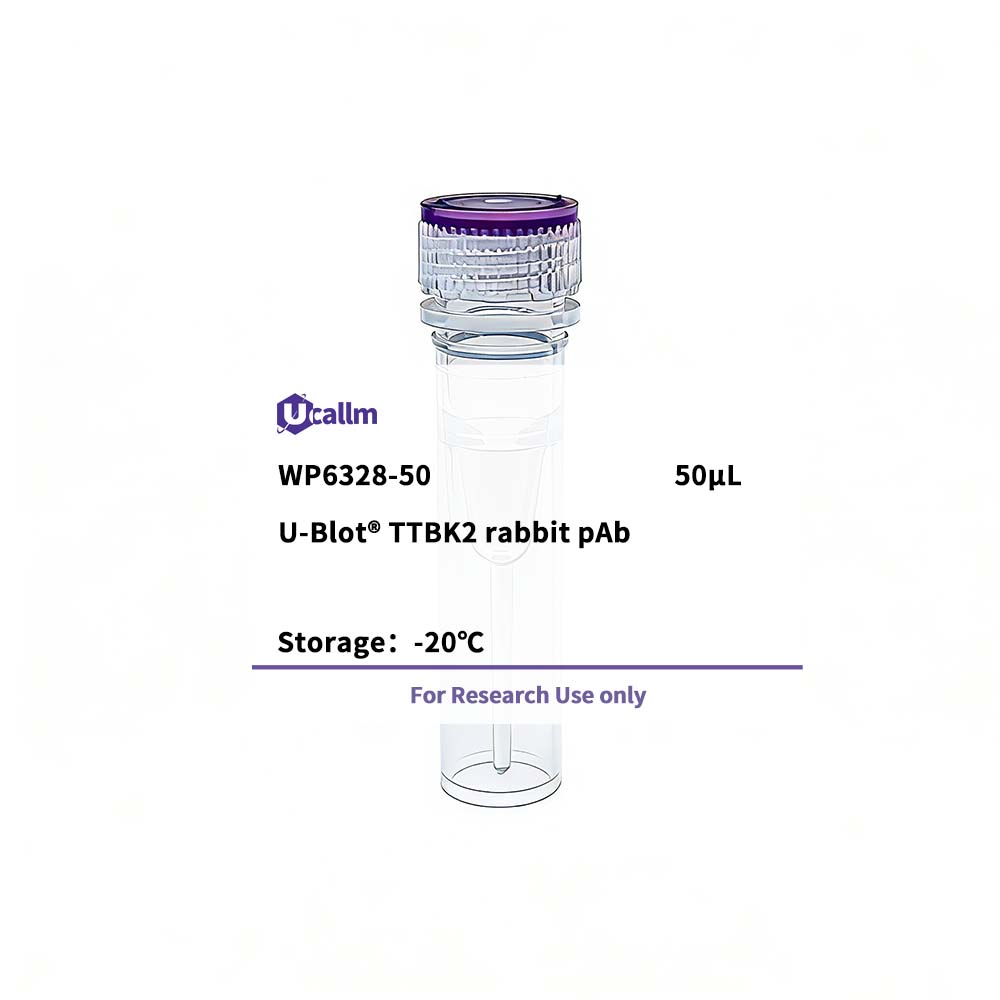
Price range: $268.00 through $328.00
Background:
| Size | 50μL/100μL |
| Target | TTBK2 |
| Reactivity | Human, Mouse |
| Applications | WB |
| MW(Calculated) | 137kD |
| MW(Observed) | |
| Host Species | Rabbit |
| Isotype | IgG |
| Conjugate/Modification | Unmodified |
| Recommended Dilution Ratio | WB 1:500-2000 |
| Formulation | Liquid in PBS containing 50% glycerol, 0.5% BSA and 0.02% sodium azide. |
| Purification | The antibody was affinity-purified from rabbit antiserum by affinity-chromatography using epitope-specific immunogen. |
| Storage | -15°C to -25°C/1 year(Do not lower than -25°C) |
| Concentration | 1 mg/ml |
| Clonality | Polyclonal |
| Clone Number | |
| Immunogen | Synthesized peptide derived from human TTBK2 |
| Specificity | This antibody detects endogenous levels of TTBK2 at Human, Mouse |
| Gene Name | TTBK2 KIAA0847 |
| Protein Name | Tau-tubulin kinase 2 (EC 2.7.11.1) |
| Other Name | |
| Species | Human |
| Gene ID | 146057 |
| Uniprot | Q6IQ55, |
| Species.1 | Mouse |
| Gene ID.1 | 140810 |
| Uniprot.1 | Q3UVR3 |
| Species.2 | |
| Gene ID.2 | |
| Uniprot.2 | |
| Cellular Localization | Cell projection, cilium . Cytoplasm, cytoskeleton, cilium basal body . Cytoplasm, cytoskeleton, microtubule organizing center, centrosome, centriole. Cytoplasm, cytosol. Nucleus. Localizes to the transition zone in primary cilia in response to cell cycle signals that promote ciliogenesis (By similarity). May also be present in cytosol and, at lower level in the nucleus. . |
| Tissue Expression | |
| Signaling_pathway | |
| Research Areas | |
| Function | Serine/threonine kinase that acts as a key regulator of ciliogenesis: controls the initiation of ciliogenesis by binding to the distal end of the basal body and promoting the removal of CCP110, which caps the mother centriole, leading to the recruitment of IFT proteins, which build the ciliary axoneme. Has some substrate preference for proteins that are already phosphorylated on a Tyr residue at the +2 position relative to the phosphorylation site. Able to phosphorylate tau on serines in vitro . Phosphorylates MPHOSPH9 which promotes its ubiquitination and proteasomal degradation, loss of MPHOSPH9 facilitates the removal of the CP110-CEP97 complex (a negative regulator of ciliogenesis) from the mother centrioles, promoting the initiation of ciliogenesis . |





