SKU: WR5240 Categories: ,

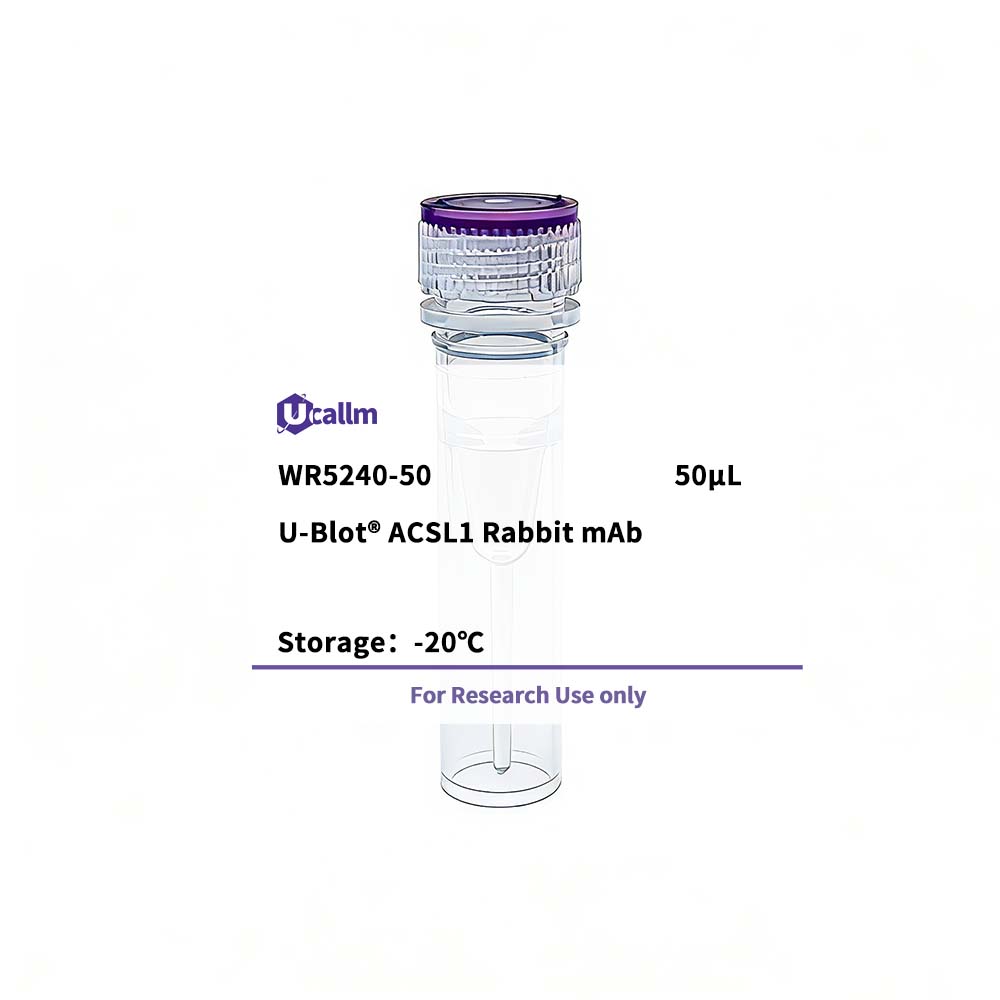
U-Blot® ACSL1 Rabbit mAb

Price range: $268.00 through $328.00

SKU: WR5240-100
Enter the quantity you would like, or drag the panel to find the quantity and price that best for you
Bulk QuoteAuthorize OEM & ODM

Product details

Background:The protein encoded by this gene is an isozyme of the long-chain fatty-acid-coenzyme A ligase family. Although differing in substrate specificity, subcellular localization, and tissue distribution, all isozymes of this family convert free long-chain fatty acids into fatty acyl-CoA esters, and thereby play a key role in lipid biosynthesis and fatty acid degradation. Several transcript variants encoding different isoforms have been found for this gene. [provided by RefSeq, Nov 2013],


Specifications

Size50μL/100μL
TargetACSL1
ReactivityHuman
ApplicationsWB, IHC, IF, ELISA
MW(Calculated)78kD
MW(Observed)78kD
Host SpeciesRabbit
IsotypeIgG,Kappa
Conjugate/ModificationUnmodified
Recommended Dilution RatioIHC 1:200-1:1000; WB 1:2000-1:10000; IF 1:200-1:1000; ELISA 1:5000-1:20000; / Note: For IHC, we suggest antigen retrieval with TE buffer pH 9.0 (Cat#WT1004)
FormulationPBS, 50% glycerol, 0.05% Proclin 300, 0.05%BSA
PurificationRecombinant Antibody expressed in animal component-free (ACF) media, purified via Protein A affinity chromatography.
Storage-15°C to -25°C/1 year(Do not lower than -25°C)
Concentration
ClonalityMonoclonal
Clone NumberRM1477R
ImmunogenThe specific immunogen used to produce this antibody is proprietary information.
SpecificityEndogenous
Gene NameACSL1 FACL1 FACL2 LACS LACS1 LACS2
Protein NameLong-chain-fatty-acid--CoA ligase 1 (Acyl-CoA synthetase 1) (ACS1) (Long-chain acyl-CoA synthetase 1) (LACS 1) (Long-chain acyl-CoA synthetase 2) (LACS 2) (Long-chain fatty acid-CoA ligase 2) (Palmitoyl-CoA ligase 1) (Palmitoyl-CoA ligase 2)
Other Name
SpeciesHuman
Gene ID2180
UniprotP33121,
Species.1Mouse
Gene ID.1
Uniprot.1P41216,
Species.2Rat
Gene ID.2
Uniprot.2P18163
Cellular LocalizationMitochondrion outer membrane; Single-pass type III membrane protein . Peroxisome membrane; Single-pass type III membrane protein . Microsome membrane; Single-pass type III membrane protein . Endoplasmic reticulum membrane; Single-pass type III membrane protein .
Tissue ExpressionHighly expressed in liver, heart, skeletal muscle, kidney and erythroid cells, and to a lesser extent in brain, lung, placenta and pancreas.
Signaling_pathwayCellular Processes >> Transport and catabolism >> Peroxisome;Cellular Processes >> Cell growth and death >> Ferroptosis;Organismal Systems >> Endocrine system >> Adipocytokine signaling pathway;Organismal Systems >> Endocrine system >> PPAR signaling pathway
Research Areas>>Fatty acid biosynthesis; / >>Fatty acid degradation; / >>Metabolic pathways; / >>Fatty acid metabolism; / >>PPAR signaling pathway; / >>Peroxisome; / >>Ferroptosis; / >>Thermogenesis; / >>Adipocytokine signaling pathway
FunctionCatalytic activity:ATP + a long-chain carboxylic acid + CoA = AMP + diphosphate + an acyl-CoA.,cofactor:Magnesium.,developmental stage:Expressed during the early stages of erythroid development while expression is very low in reticulocytes and young erythrocytes.,Function:Activation of long-chain fatty acids for both synthesis of cellular lipids, and degradation via beta-oxidation. Preferentially uses palmitoleate, oleate and linoleate.,similarity:Belongs to the ATP-dependent AMP-binding enzyme family.,tissue specificity:Highly expressed in liver, heart, skeletal muscle, kidney and erythroid cells, and to a lesser extent in brain, lung, placenta and pancreas.,
Please login to post questions
Back to Top
Product has been added to your cart

