SKU: WR5303 Categories: ,

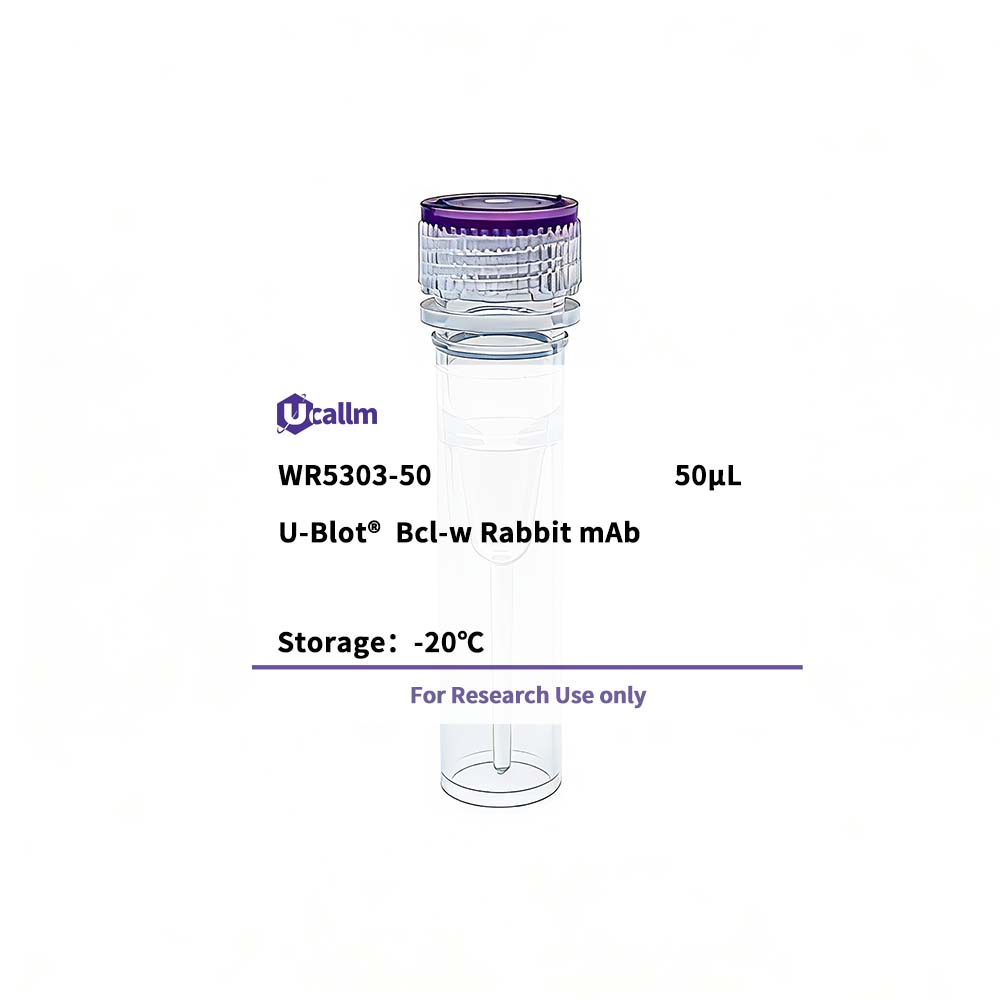
U-Blot® Bcl-w Rabbit mAb

Price range: $268.00 through $328.00

SKU: WR5303-50
Enter the quantity you would like, or drag the panel to find the quantity and price that best for you
Bulk QuoteAuthorize OEM & ODM

Product details

Background:This gene encodes a member of the BCL-2 protein family. The proteins of this family form hetero- or homodimers and act as anti- and pro-apoptotic regulators. Expression of this gene in cells has been shown to contribute to reduced cell apoptosis under cytotoxic conditions. Studies of the related gene in mice indicated a role in the survival of NGF- and BDNF-dependent neurons. Mutation and knockout studies of the mouse gene demonstrated an essential role in adult spermatogenesis. Alternative splicing results in multiple transcript variants. Read-through transcription also exists between this gene and the neighboring downstream PABPN1 (poly(A) binding protein, nuclear 1) gene. [provided by RefSeq, Dec 2010],


Specifications

Size50μL/100μL
TargetBcl-w
ReactivityHuman, Mouse, Rat
ApplicationsWB, IHC, IF, ELISA
MW(Calculated)21kD
MW(Observed)18kD
Host SpeciesRabbit
IsotypeIgG,Kappa
Conjugate/ModificationUnmodified
Recommended Dilution RatioIHC 1:200-1:500; WB 1:500-1:2000; IF 1:200-1:1000; ELISA 1:5000-1:20000; / Note: For IHC, we suggest antigen retrieval with TE buffer pH 9.0 (Cat#WT1004)
FormulationPBS, 50% glycerol, 0.05% Proclin 300, 0.05%BSA
PurificationRecombinant Antibody expressed in animal component-free (ACF) media, purified via Protein A affinity chromatography.
Storage-15°C to -25°C/1 year(Do not lower than -25°C)
Concentration
ClonalityMonoclonal
Clone NumberRM1525R
ImmunogenThe specific immunogen used to produce this antibody is proprietary information.
SpecificityEndogenous
Gene NameBCL2L2
Protein NameBcl-2-like protein 2
Other NameBCL2L2; / BCLW; / KIAA0271; / Bcl-2-like protein 2; / Bcl2-L-2; / Apoptosis regulator Bcl-W
SpeciesHuman
Gene ID599
UniprotQ92843,
Species.1Mouse
Gene ID.112050
Uniprot.1P70345
Species.2
Gene ID.2
Uniprot.2
Cellular LocalizationMitochondrion membrane; Peripheral membrane protein . Loosely associated with the mitochondrial membrane in healthy cells. During apoptosis, tightly bound to the membrane.
Tissue ExpressionExpressed (at protein level) in a wide range of tissues with highest levels in brain, spinal cord, testis, pancreas, heart, spleen and mammary glands. Moderate levels found in thymus, ovary and small intestine. Not detected in salivary gland, muscle or liver. Also expressed in cell lines of myeloid, fibroblast and epithelial origin. Not detected in most lymphoid cell lines.
Signaling_pathwayHuman Diseases >> Cancer: overview >> MicroRNAs in cancer
Research Areas>>MicroRNAs in cancer
FunctionDomain:The BH1 and BH2 motifs form a hydrophobic groove which acts as a docking site for the BH3 domain of some pro-apoptotic proteins. The C-terminal residues of BCL2L2 fold into the BH3-binding cleft and modulate pro-survival activity by regulating ligand access. When BH3 domain-containing proteins bind, they displace the C-terminus, allowing its insertion into the membrane and neutralizing the pro-survival activity of BCL2L2.,Domain:The BH4 motif seems to be involved in the anti-apoptotic function.,Function:Promotes cell survival. Blocks dexamethasone-induced apoptosis. Mediates survival of postmitotic Sertoli cells by suppressing death-promoting activity of BAX.,similarity:Belongs to the Bcl-2 family.,subcellular location:Loosely associated with the mitochondrial membrane in healthy cells. During apoptosis, tightly bound to the membrane.,tissue specificity:Expressed (at protein level) in a wide range of tissues with highest levels in brain, spinal cord, testis, pancreas, heart, spleen and mammary glands. Moderate levels found in thymus, ovary and small intestine. Not detected in salivary gland, muscle or liver. Also expressed in cell lines of myeloid, fibroblast and epithelial origin. Not detected in most lymphoid cell lines.,
Please login to post questions
Back to Top
Product has been added to your cart
