

U-Blot® Dvl-2 Rabbit mAb
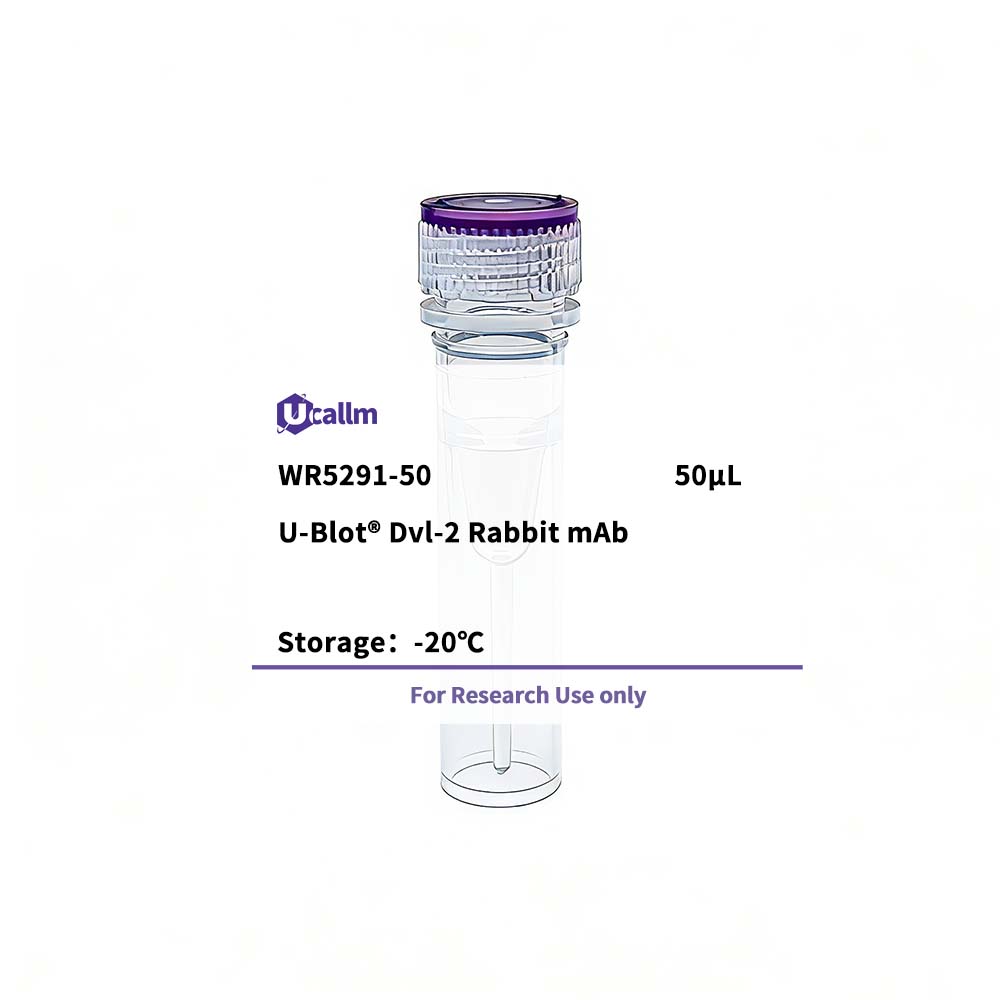
Ucallm_WR5291-50
Price range: $268.00 through $328.00
Product details
Background:This gene encodes a member of the dishevelled (dsh) protein family. The vertebrate dsh proteins have approximately 40% amino acid sequence similarity with Drosophila dsh. This gene encodes a 90-kD protein that undergoes posttranslational phosphorylation to form a 95-kD cytoplasmic protein, which may play a role in the signal transduction pathway mediated by multiple Wnt proteins. The mechanisms of dishevelled function in Wnt signaling are likely to be conserved among metazoans. [provided by RefSeq, Jul 2008],
Specifications
| Size | 50μL/100μL |
| Target | Dvl-2 |
| Reactivity | Human, Mouse, Rat |
| Applications | WB, IHC, IF, IP, ELISA |
| MW(Calculated) | 79kD |
| MW(Observed) | 90kD |
| Host Species | Rabbit |
| Isotype | IgG,Kappa |
| Conjugate/Modification | Unmodified |
| Recommended Dilution Ratio | IHC 1:200-1:1000; WB 1:2000-1:10000; IF 1:200-1:1000; ELISA 1:5000-1:20000; IP 1:50-1:200; / Note: For IHC, we suggest antigen retrieval with TE buffer pH 9.0 (Cat#WT1004) |
| Formulation | PBS, 50% glycerol, 0.05% Proclin 300, 0.05%BSA |
| Purification | Recombinant Antibody expressed in animal component-free (ACF) media, purified via Protein A affinity chromatography. |
| Storage | -15°C to -25°C/1 year(Do not lower than -25°C) |
| Concentration | |
| Clonality | Monoclonal |
| Clone Number | RM1583R |
| Immunogen | The specific immunogen used to produce this antibody is proprietary information. |
| Specificity | Endogenous |
| Gene Name | DVL2 |
| Protein Name | Segment polarity protein dishevelled homolog DVL-2 |
| Other Name | DVL2; / Segment polarity protein dishevelled homolog DVL-2; / Dishevelled-2; / DSH homolog 2 |
| Species | Human |
| Gene ID | 1856 |
| Uniprot | O14641, |
| Species.1 | Mouse |
| Gene ID.1 | 13543 |
| Uniprot.1 | Q60838 |
| Species.2 | |
| Gene ID.2 | |
| Uniprot.2 | |
| Cellular Localization | Cell membrane; Peripheral membrane protein; Cytoplasmic side . Cytoplasm, cytosol . Cytoplasmic vesicle . Nucleus . Localizes at the cell membrane upon interaction with frizzled family members and promotes their internalization. Localizes to cytoplasmic puncta (By similarity). Interaction with FOXK1 and FOXK2 induces nuclear translocation (PubMed:25805136). . |
| Tissue Expression | Colon, |
| Signaling_pathway | Cellular Processes >> Cellular community - eukaryotes >> Signaling pathways regulating pluripotency of stem cells;Human Diseases >> Cancer: overview >> Pathways in cancer;Human Diseases >> Cancer: specific types >> Hepatocellular carcinoma;Human Diseases >> Cancer: specific types >> Gastric cancer;Human Diseases >> Cancer: specific types >> Basal cell carcinoma;Human Diseases >> Cancer: specific types >> Breast cancer;Human Diseases >> Neurodegenerative disease >> Alzheimer disease;Human Diseases >> Neurodegenerative disease >> Pathways of neurodegeneration - multiple diseases;Environmental Information Processing >> Signal transduction >> Wnt signaling pathway;Environmental Information Processing >> Signal transduction >> Notch signaling pathway;Environmental Information Processing >> Signal transduction >> Hippo signaling pathway;Environmental Information Processing >> Signal transduction >> mTOR signaling pathway |
| Research Areas | >>mTOR signaling pathway; / >>Wnt signaling pathway; / >>Notch signaling pathway; / >>Hippo signaling pathway; / >>Signaling pathways regulating pluripotency of stem cells; / >>Melanogenesis; / >>Cushing syndrome; / >>Alzheimer disease; / >>Pathways of neurodegeneration - multiple diseases; / >>Human papillomavirus infection; / >>Pathways in cancer; / >>Basal cell carcinoma; / >>Breast cancer; / >>Hepatocellular carcinoma; / >>Gastric cancer |
| Function | Function:May play a role in the signal transduction pathway mediated by multiple Wnt genes.,PTM:Phosphorylated.,similarity:Belongs to the DSH family.,similarity:Contains 1 DEP domain.,similarity:Contains 1 DIX domain.,similarity:Contains 1 PDZ (DHR) domain.,subunit:Interacts through its PDZ domain with the C-terminal regions of VANGL1 and VANGL2 (By similarity). Interacts with DIXDC1 and Rac., |
Please login to post questions
Related products





