

U-Blot® ELAVL1 Rabbit mAb
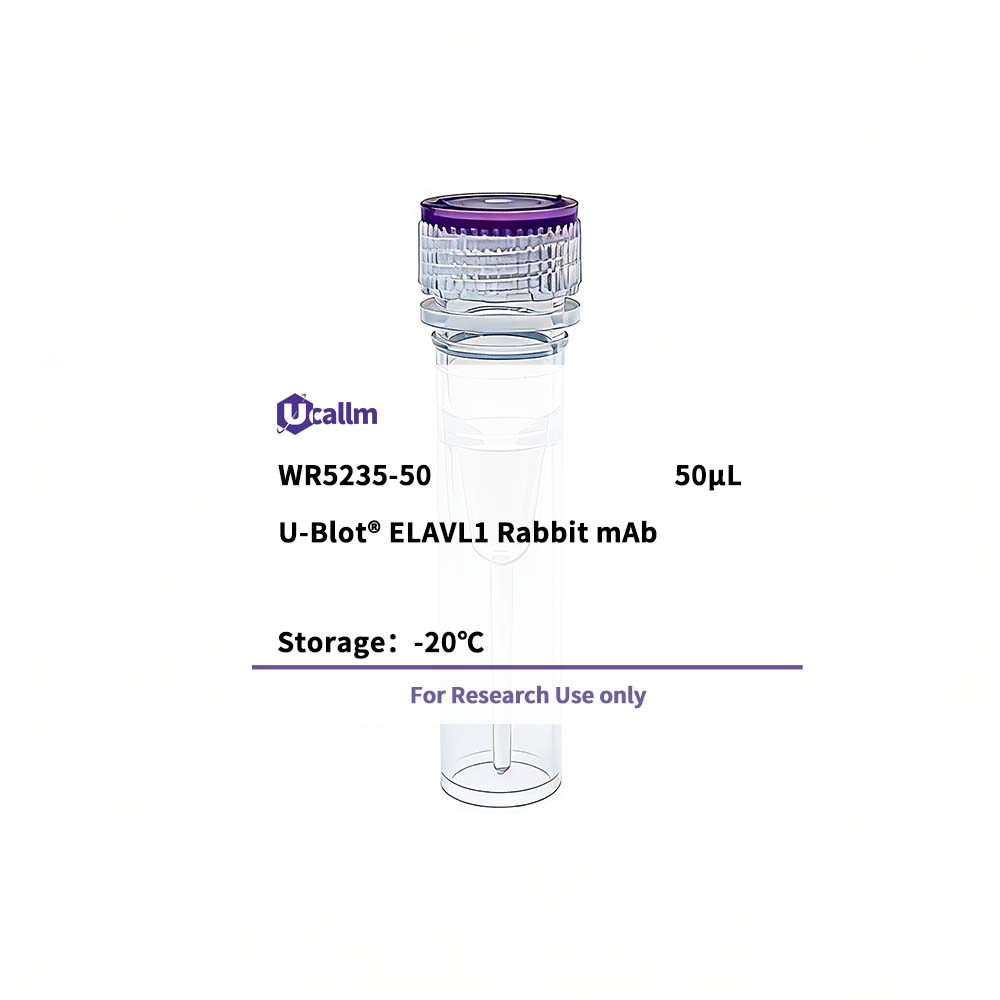
Ucallm_WR5235-50
Price range: $268.00 through $328.00
Product details
Background:ELAV like RNA binding protein 1(ELAVL1) Homo sapiens The protein encoded by this gene is a member of the ELAVL family of RNA-binding proteins that contain several RNA recognition motifs, and selectively bind AU-rich elements (AREs) found in the 3' untranslated regions of mRNAs. AREs signal degradation of mRNAs as a means to regulate gene expression, thus by binding AREs, the ELAVL family of proteins play a role in stabilizing ARE-containing mRNAs. This gene has been implicated in a variety of biological processes and has been linked to a number of diseases, including cancer. It is highly expressed in many cancers, and could be potentially useful in cancer diagnosis, prognosis, and therapy. [provided by RefSeq, Sep 2012],
Specifications
| Size | 50μL/100μL |
| Target | ELAVL1 |
| Reactivity | Human, Mouse, Rat |
| Applications | WB, IHC, IF, IP, ELISA |
| MW(Calculated) | 36kD |
| MW(Observed) | 36kD |
| Host Species | Rabbit |
| Isotype | IgG,Kappa |
| Conjugate/Modification | Unmodified |
| Recommended Dilution Ratio | IHC 1:200-1:1000; WB 1:2000-1:10000; IF 1:200-1:1000; ELISA 1:5000-1:20000; IP 1:50-1:200; / Note: For IHC, we suggest antigen retrieval with TE buffer pH 9.0 (Cat#WT1004) |
| Formulation | PBS, 50% glycerol, 0.05% Proclin 300, 0.05%BSA |
| Purification | Recombinant Antibody expressed in animal component-free (ACF) media, purified via Protein A affinity chromatography. |
| Storage | -15°C to -25°C/1 year(Do not lower than -25°C) |
| Concentration | |
| Clonality | Monoclonal |
| Clone Number | RM1472R |
| Immunogen | The specific immunogen used to produce this antibody is proprietary information. |
| Specificity | Endogenous |
| Gene Name | ELAVL1 HUR |
| Protein Name | ELAV-like protein 1 (Hu-antigen R) (HuR) |
| Other Name | |
| Species | Human |
| Gene ID | 1994 |
| Uniprot | Q15717, |
| Species.1 | Mouse |
| Gene ID.1 | |
| Uniprot.1 | P70372 |
| Species.2 | |
| Gene ID.2 | |
| Uniprot.2 | |
| Cellular Localization | Cytoplasm . Nucleus . Cytoplasm, Stress granule . Cytoplasm, P-body . Translocates into the cytoplasm following phosphorylation by MAPKAPK2 (PubMed:14517288). Likewise, phosphorylation by PRKCD promotes translocation from the nucleus into the cytoplasm, where it is associated with free and cytoskeleton-bound polysomes (PubMed:18285462).Localizes to the stress granules in the presence of PLEKHN1 (By similarity). . |
| Tissue Expression | Ubiquitous. Detected in brain, liver, thymus and muscle. |
| Signaling_pathway | Organismal Systems >> Immune system >> IL-17 signaling pathway;Environmental Information Processing >> Signal transduction >> AMPK signaling pathway |
| Research Areas | >>AMPK signaling pathway; / >>IL-17 signaling pathway |
| Function | Function:Binds avidly to the AU-rich element in FOS and IL3/interleukin-3 mRNAs. In the case of the FOS AU-rich element, HUR binds to a core element of 27 nucleotides that contain AUUUA, AUUUUA, and AUUUUUA motifs.,PTM:Methylated at Arg-217 by CARM1 in macrophages in response to LPS challenge.,similarity:Belongs to the RRM elav family.,similarity:Contains 3 RRM (RNA recognition motif) domains.,subunit:Interacts with ANP32A.,tissue specificity:Ubiquitous., |
Please login to post questions
Related products





