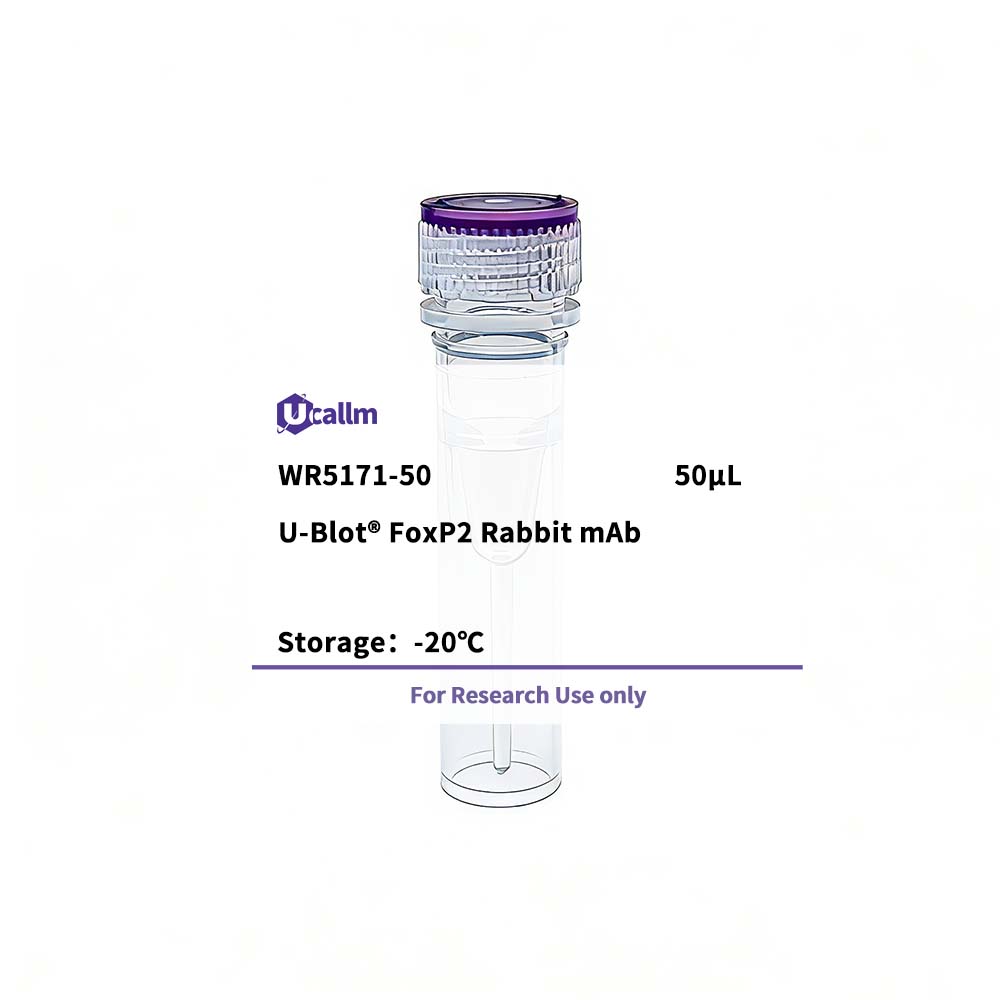
SKU: WR5171 Categories: ,

U-Blot® FoxP2 Rabbit mAb

Price range: $268.00 through $328.00

SKU: WR5171-100
Enter the quantity you would like, or drag the panel to find the quantity and price that best for you
Bulk QuoteAuthorize OEM & ODM

Product details

Background:This gene encodes a member of the forkhead/winged-helix (FOX) family of transcription factors. It is expressed in fetal and adult brain as well as in several other organs such as the lung and gut. The protein product contains a FOX DNA-binding domain and a large polyglutamine tract and is an evolutionarily conserved transcription factor, which may bind directly to approximately 300 to 400 gene promoters in the human genome to regulate the expression of a variety of genes. This gene is required for proper development of speech and language regions of the brain during embryogenesis, and may be involved in a variety of biological pathways and cascades that may ultimately influence language development. Mutations in this gene cause speech-language disorder 1 (SPCH1), also known as autosomal dominant speech and language disorder with orofacial dyspraxia. Multiple alternative transcripts encoding different isofor


Specifications

Size50μL/100μL
TargetFoxP2
ReactivityHuman, Mouse, Rat
ApplicationsWB, IF, IP, ELISA
MW(Calculated)80kD
MW(Observed)95kD
Host SpeciesRabbit
IsotypeIgG,Kappa
Conjugate/ModificationUnmodified
Recommended Dilution RatioWB 1:1000-1:5000; IF 1:200-1:1000; ELISA 1:5000-1:20000; IP 1:50-1:200;
FormulationPBS, 50% glycerol, 0.05% Proclin 300, 0.05%BSA
PurificationRecombinant Antibody expressed in animal component-free (ACF) media, purified via Protein A affinity chromatography.
Storage-15°C to -25°C/1 year(Do not lower than -25°C)
Concentration
ClonalityMonoclonal
Clone NumberRM1405R
ImmunogenThe specific immunogen used to produce this antibody is proprietary information.
SpecificityEndogenous
Gene NameFOXP2
Protein NameForkhead box protein P2
Other NameFOXP2; / CAGH44; / TNRC10; / Forkhead box protein P2; / CAG repeat protein 44; / Trinucleotide repeat-containing gene 10 protein
SpeciesHuman
Gene ID93986
UniprotO15409,
Species.1Mouse
Gene ID.1
Uniprot.1P58463
Species.2
Gene ID.2
Uniprot.2
Cellular LocalizationNucleus .
Tissue ExpressionIsoform 1 and isoform 6 are expressed in adult and fetal brain, caudate nucleus and lung.
Signaling_pathway
Research Areas
Functiondevelopmental stage:Expressed in the brain at 15 and 22 weeks of gestation, with a pattern of strong cortical, basal ganglia, thalamic and cerebellar expression. Highly expressed in the head and tail of nucleus caudatus and putamen. Restricted expression within the globus pallidus, with high levels in the pars interna, which provides the principal source of output from the basal ganglia to the nucleus centrum medianum thalami (CM) and the major motor relay nuclei of the thalamus. In the thalamus, present in the CM and nucleus medialis dorsalis thalami. Lower levels are observed in the nuclei anterior thalami, dorsal and ventral, and the nucleus parafascicularis thalami. Expressed in the ventrobasal complex comprising the nucleus ventralis posterior lateralis/medialis. The ventral tier of the thalamus exhibits strong expression, including nuclei ventralis anterior, lateralis and posterior lateralis pars oralis. Also expressed in the nucleus subthalamicus bilaterally and in the nucleus ruber.,Disease:A chromosomal aberration disrupting FOXP2 is a cause of severe speech and language impairment. Translocation t(5; 7)(q22; q31.2).,Disease:Defects in FOXP2 are the cause of speech-language disorder 1 (SPCH1) [MIM:602081]; also known as autosomal dominant speech and language disorder with orofacial dyspraxia. Affected individuals have a severe impairment in the selection and sequencing of fine orofacial movements, which are necessary for articulation. They also show deficits in several facets of language processing (such as the ability to break up words into their constituent phonemes) and grammatical skills.,Domain:The leucine-zipper is required for dimerization and transcriptional repression.,Function:Transcriptional repressor that may play a role in the specification and differentiation of lung epithelium. May also play a role in developing neural, gastrointestinal and cardiovascular tissues. Can act with CTBP1 to synergistically repress transcription but CTPBP1 is not essential. Involved in neural mechanisms mediating the development of speech and language.,online information:FOXP2 entry,online information:Talking heads - Issue 51 of October 2004,similarity:Contains 1 C2H2-type zinc finger.,similarity:Contains 1 fork-head DNA-binding domain.,subunit:Forms homodimers and heterodimers with FOXP1 and FOXP4. Dimerization is required for DNA-binding. Interacts with CTBP1.,tissue specificity:Isoform 1 and isoform 6 are expressed in adult and fetal brain, caudate nucleus and lung.,
Please login to post questions
Back to Top
Product has been added to your cart

