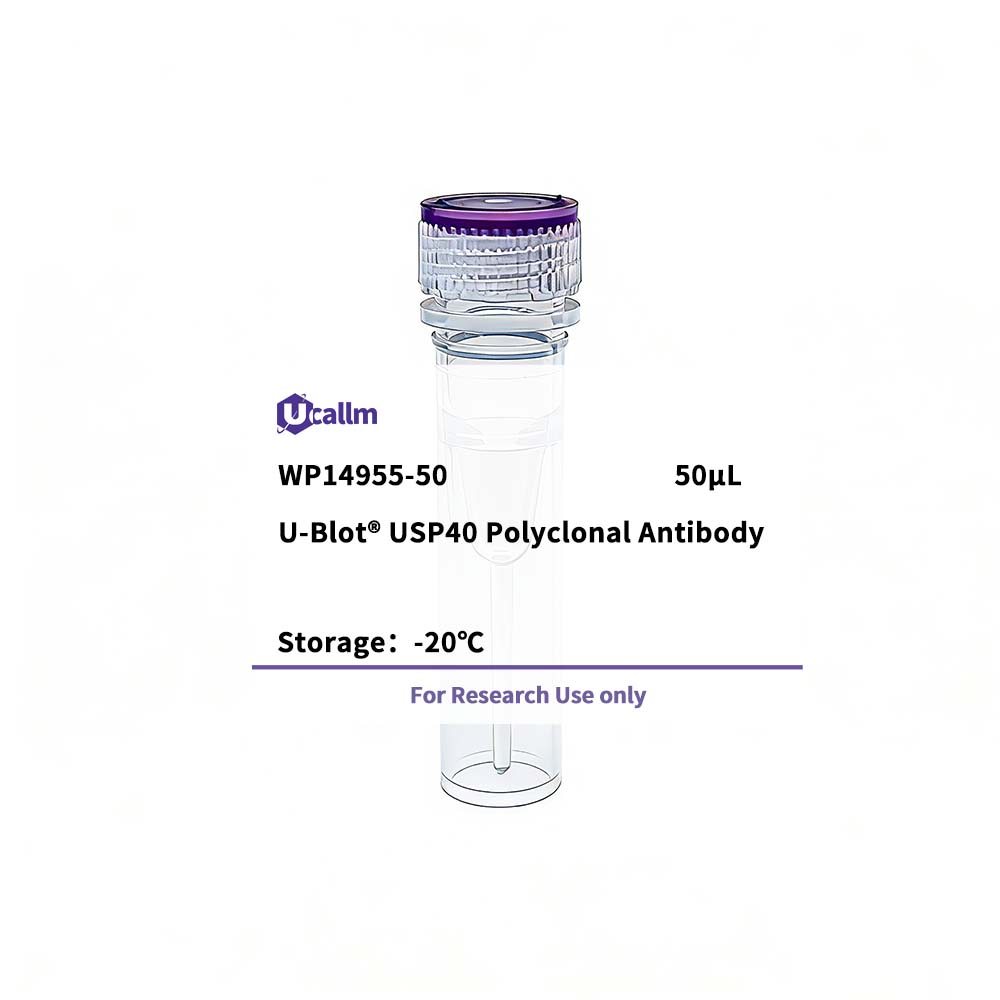
SKU: WP14955 Categories: ,

USP40 Polyclonal Antibody

Price range: $268.00 through $328.00

SKU: WP14955-100
Enter the quantity you would like, or drag the panel to find the quantity and price that best for you
Bulk QuoteAuthorize OEM & ODM

Product details

Background:

Modification of cellular proteins by ubiquitin is an essential regulatory mechanism controlled by the coordinated action of multiple ubiquitin-conjugating and deubiquitinating enzymes. USP40 belongs to a large family of cysteine proteases that function as deubiquitinating enzymes (Quesada et al., 2004 [PubMed 14715245]).[supplied by OMIM, Mar 2008],


Specifications

Size50μL/100μL
TargetUSP40
ReactivityHuman, Mouse
ApplicationsWB, IHC, IF, ELISA
MW(Calculated)
MW(Observed)140kD
Host SpeciesRabbit
IsotypeIgG
Conjugate/ModificationUnmodified
Recommended Dilution RatioWB 1:500-1:2000; IHC 1:100-1:300; ELISA 1:20000; IF 1:50-200 / Note: For IHC, we suggest antigen retrieval with TE buffer pH 9.0 (Cat#WT1004)
FormulationLiquid in PBS containing 50% glycerol, 0.5% BSA and 0.02% sodium azide.
PurificationThe antibody was affinity-purified from rabbit antiserum by affinity-chromatography using epitope-specific immunogen.
Storage-15°C to -25°C/1 year(Do not lower than -25°C)
Concentration1 mg/ml
ClonalityPolyclonal
Clone Number
ImmunogenThe antiserum was produced against synthesized peptide derived from human USP40. AA range:1011-1060
SpecificityUSP40 Polyclonal Antibody detects endogenous levels of USP40 protein.
Gene NameUSP40
Protein NameUbiquitin carboxyl-terminal hydrolase 40
Other NameUSP40; / Ubiquitin carboxyl-terminal hydrolase 40; / Deubiquitinating enzyme 40; / Ubiquitin thioesterase 40; / Ubiquitin-specific-processing protease 40
SpeciesHuman
Gene ID55230
UniprotQ9NVE5,
Species.1Mouse
Gene ID.1
Uniprot.1Q8BWR4
Species.2
Gene ID.2
Uniprot.2
Cellular Localizationnucleus,cytoplasm,
Tissue ExpressionBroadly expressed.
Signaling_pathway
Research Areas
FunctionCatalytic activity:Ubiquitin C-terminal thioester + H(2)O = ubiquitin + a thiol.,Function:May be catalytically inactive.,similarity:Belongs to the peptidase C19 family.,tissue specificity:Broadly expressed.,
Please login to post questions
Back to Top
Product has been added to your cart
