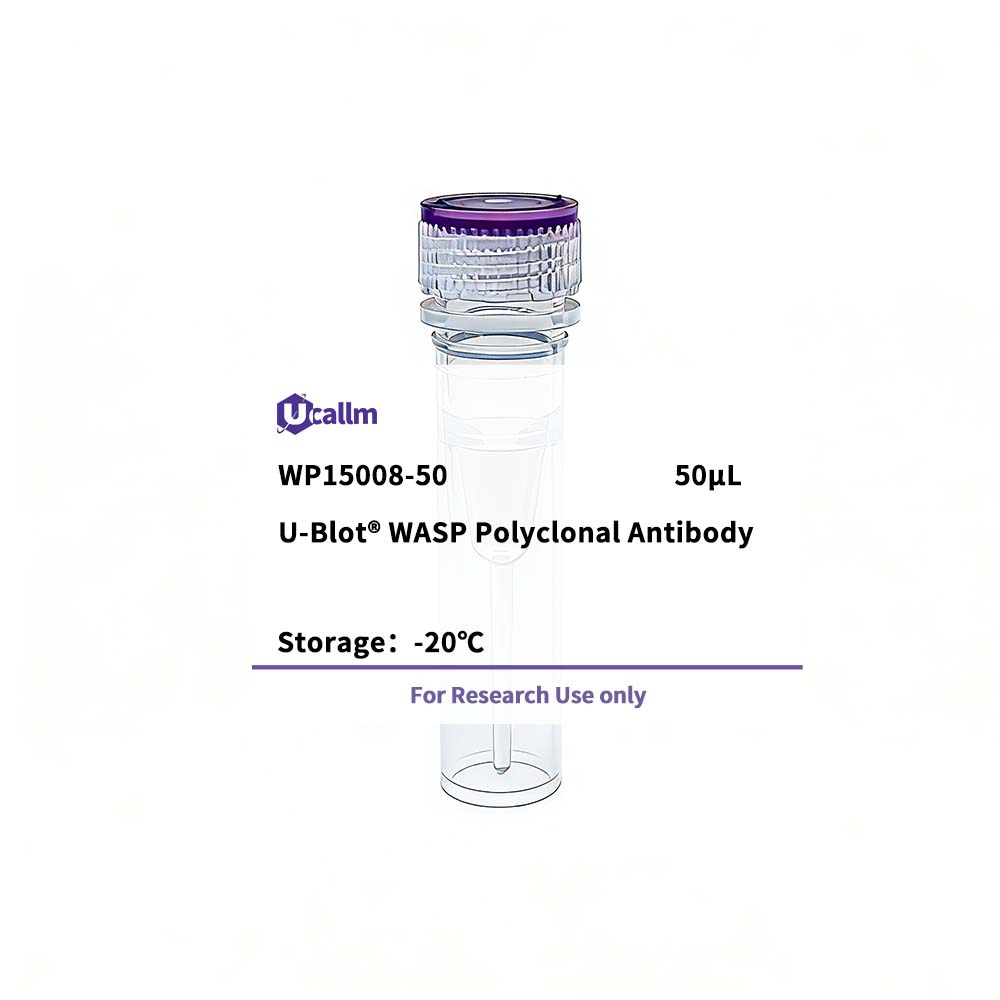
SKU: WP15008 Categories: ,

WASP Polyclonal Antibody

Price range: $268.00 through $328.00

SKU: WP15008-100
Enter the quantity you would like, or drag the panel to find the quantity and price that best for you
Bulk QuoteAuthorize OEM & ODM

Product details

Background:

The Wiskott-Aldrich syndrome (WAS) family of proteins share similar domain structure, and are involved in transduction of signals from receptors on the cell surface to the actin cytoskeleton. The presence of a number of different motifs suggests that they are regulated by a number of different stimuli, and interact with multiple proteins. Recent studies have demonstrated that these proteins, directly or indirectly, associate with the small GTPase, Cdc42, known to regulate formation of actin filaments, and the cytoskeletal organizing complex, Arp2/3. Wiskott-Aldrich syndrome is a rare, inherited, X-linked, recessive disease characterized by immune dysregulation and microthrombocytopenia, and is caused by mutations in the WAS gene. The WAS gene product is a cytoplasmic protein, expressed exclusively in hematopoietic cells, which show signalling and cytoskeletal abnormalities in WAS patients. A t


Specifications

Size50μL/100μL
TargetWASP
ReactivityHuman, Mouse
ApplicationsWB, IHC, IF, ELISA
MW(Calculated)
MW(Observed)60kD
Host SpeciesRabbit
IsotypeIgG
Conjugate/ModificationUnmodified
Recommended Dilution RatioWB 1:500-1:2000; IHC 1:100-1:300; ELISA 1:5000; IF 1:50-200 / Note: For IHC, we suggest antigen retrieval with TE buffer pH 9.0 (Cat#WT1004)
FormulationLiquid in PBS containing 50% glycerol, 0.5% BSA and 0.02% sodium azide.
PurificationThe antibody was affinity-purified from rabbit antiserum by affinity-chromatography using epitope-specific immunogen.
Storage-15°C to -25°C/1 year(Do not lower than -25°C)
Concentration1 mg/ml
ClonalityPolyclonal
Clone Number
ImmunogenThe antiserum was produced against synthesized peptide derived from human WASP. AA range:256-305
SpecificityWASP Polyclonal Antibody detects endogenous levels of WASP protein.
Gene NameWAS
Protein NameWiskott-Aldrich syndrome protein
Other NameWAS; / IMD2; / Wiskott-Aldrich syndrome protein; / WASp
SpeciesHuman
Gene ID7454
UniprotP42768,
Species.1Mouse
Gene ID.122376
Uniprot.1P70315
Species.2
Gene ID.2
Uniprot.2
Cellular LocalizationCytoplasm, cytoskeleton . Nucleus .
Tissue ExpressionExpressed predominantly in the thymus. Also found, to a much lesser extent, in the spleen.
Signaling_pathwayCellular Processes >> Cellular community - eukaryotes >> Adherens junction;Cellular Processes >> Cellular community - eukaryotes >> Tight junction;Organismal Systems >> Immune system >> Fc gamma R-mediated phagocytosis;Organismal Systems >> Immune system >> Chemokine signaling pathway
Research Areas>>Chemokine signaling pathway; / >>Adherens junction; / >>Tight junction; / >>Fc gamma R-mediated phagocytosis; / >>Yersinia infection; / >>Choline metabolism in cancer
FunctionDisease:Defects in WAS are a cause of X-linked severe congenital neutropenia (XLN) [MIM:300299]. XLN is an X-linked immunodeficiency syndrome characterized by recurrent major bacterial infections, severe congenital neutropenia, and monocytopenia.,Disease:Defects in WAS are the cause of thrombocytopenia type 1 (THC1) [MIM:313900]. Thrombocytopenia is defined by a decrease in the number of platelets in circulating blood, resulting in the potential for increased bleeding and decreased ability for clotting.,Disease:Defects in WAS are the cause of Wiskott-Aldrich syndrome (WAS) [MIM:301000]; also known as eczema-thrombocytopenia-immunodeficiency syndrome. WAS is an X-linked recessive immunodeficiency characterized by eczema, thrombocytopenia, recurrent infections, and bloody diarrhea. Death usually occurs before age 10.,Domain:The CRIB (Cdc42/Rac-interactive-binding) region binds to the C-terminal WH2 domain in the autoinhibited state of the protein. Binding of Rho-type GTPases to the CRIB induces a conformation change and leads to activation.,Domain:The WH1 (Wasp homology 1) domain may bind a Pro-rich ligand.,Function:Effector protein for Rho-type GTPases, providing a link with the Arp2/3 complex that regulates the structure and dynamics of the actin cytoskeleton. Important for efficient actin polymerization. Possible regulator of lymphocyte and platelet function.,online information:WAS mutation db,online information:Wiskott-Aldrich syndrome protein entry,similarity:Contains 1 CRIB domain.,similarity:Contains 1 WH1 domain.,similarity:Contains 1 WH2 domain.,subunit:Binds to CDC42, RAC, NCK, FYN, SRC kinase FGR, BTK, ABL, PSTPIP1, WIP, and to the p85 subunit of PLC-gamma. Binds the Arp2/3 complex.,tissue specificity:Expressed predominantly in the thymus. Also found, to a much lesser extent, in the spleen.,
Please login to post questions
Back to Top
Product has been added to your cart
