

WNK4 Polyclonal Antibody
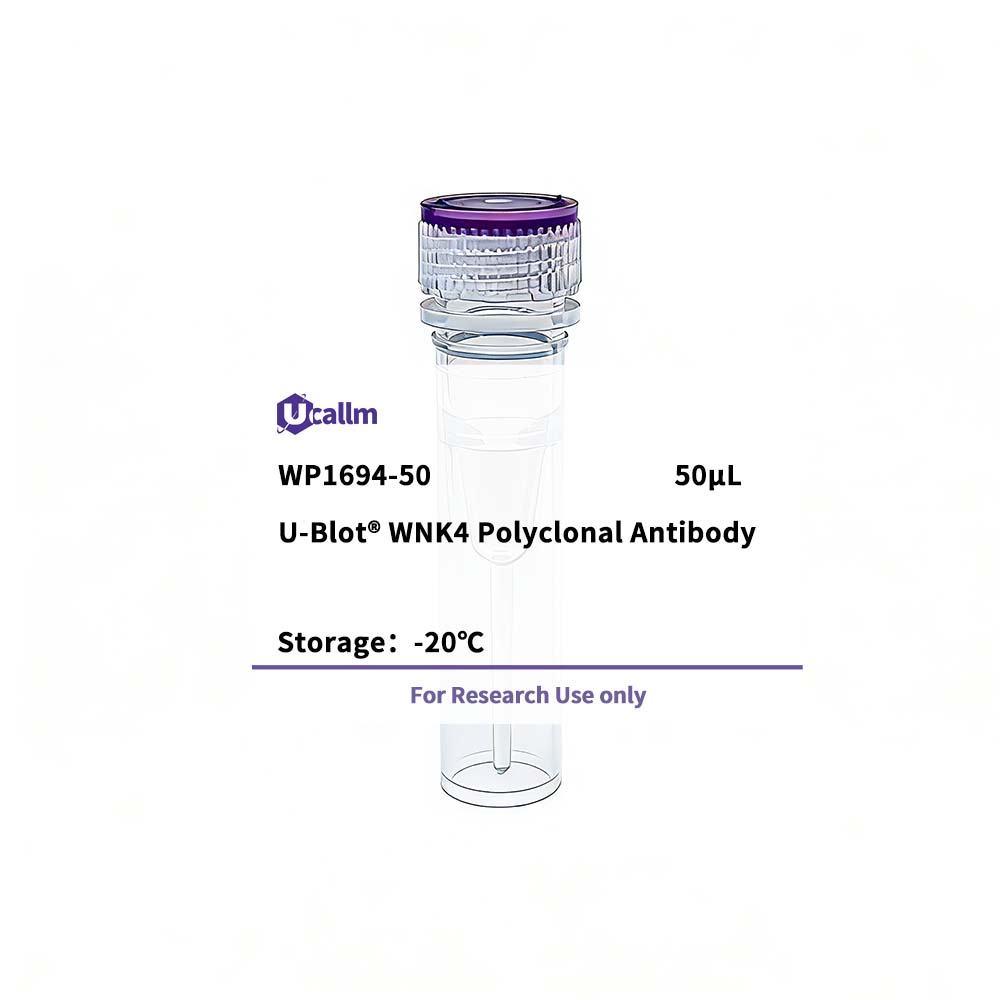
Ucallm_WP1694-50
Price range: $268.00 through $328.00
Product details
Background:
This gene encodes a member of the WNK family of serine-threonine protein kinases. The kinase is part of the tight junction complex in kidney cells, and regulates the balance between NaCl reabsorption and K(+) secretion. The kinase regulates the activities of several types of ion channels, cotransporters, and exchangers involved in electrolyte flux in epithelial cells. Mutations in this gene result in pseudohypoaldosteronism type IIB.[provided by RefSeq, Sep 2009],
Specifications
| Size | 50μL/100μL |
| Target | WNK4 |
| Reactivity | Human, Mouse, Rat |
| Applications | WB, ELISA |
| MW(Calculated) | |
| MW(Observed) | 136kD |
| Host Species | Rabbit |
| Isotype | IgG |
| Conjugate/Modification | Unmodified |
| Recommended Dilution Ratio | WB 1:500-2000; ELISA 1:5000-20000 |
| Formulation | Liquid in PBS containing 50% glycerol,0.5% BSA and 0.02% sodium azide. |
| Purification | The antibody was affinity-purified from rabbit antiserum by affinity-chromatography using epitope-specific immunogen. |
| Storage | -15°C to -25°C/1 year(Do not lower than -25°C) |
| Concentration | 1 mg/ml |
| Clonality | Polyclonal |
| Clone Number | |
| Immunogen | Synthesized peptide derived from part region of human protein |
| Specificity | WNK4 Polyclonal Antibody detects endogenous levels of protein. |
| Gene Name | WNK4 PRKWNK4 |
| Protein Name | Serine/threonine-protein kinase WNK4 (Protein kinase lysine-deficient 4) (Protein kinase with no lysine 4) |
| Other Name | |
| Species | Human |
| Gene ID | 65266 |
| Uniprot | Q96J92, |
| Species.1 | Mouse |
| Gene ID.1 | |
| Uniprot.1 | Q80UE6, |
| Species.2 | Rat |
| Gene ID.2 | |
| Uniprot.2 | Q7TPK6 |
| Cellular Localization | Cell junction, tight junction . Present exclusively in intercellular junctions in the distal convoluted tubule and in both the cytoplasm and intercellular junctions in the cortical collecting duct. WNK4 is part of the tight junction complex. . |
| Tissue Expression | Expressed in kidney, colon and skin. |
| Signaling_pathway | |
| Research Areas | |
| Function | Catalytic activity:ATP + a protein = ADP + a phosphoprotein.,Caution:Cys-203 is present instead of the conserved Lys which is expected to be an active site residue. Lys-186 appears to fulfill the required catalytic function.,cofactor:Magnesium.,Disease:Defects in WNK4 are a cause of pseudohypoaldosteronism type II (PHAII) [MIM:145260]. PHAII is an autosomal dominant disease characterized by severe hypertension, hyperkalemia, and sensitivity to thiazide diuretics which may result from a chloride shunt in the renal distal nephron.,enzyme regulation:Activation requires autophosphorylation of Ser-335. Phosphorylation of Ser-331 also promotes increased activity.,Function:Regulates the activity of the thiazide-sensitive Na-Cl cotransporter, SLC12A3, by phosphorylation which appears to prevent membrane trafficking of SLC12A3. Also inhibits the renal K(+) channel, KCNJ1, via a kinase-independent mechanism by which it induces clearance of the protein from the cell surface by clathrin-dependent endocytosis. WNK4 appears to act as a molecular switch that can vary the balance between NaCl reabsorption and K(+) secretion to maintain integrated homeostasis.,similarity:Belongs to the protein kinase superfamily. Ser/Thr protein kinase family. WNK subfamily.,similarity:Contains 1 protein kinase domain.,subcellular location:Present exclusively in intercellular junctions in the distal convoluted tubule and in both the cytoplasm and intercellular junctions in the cortical collecting duct. WNK4 is part of the tight junction complex.,subunit:Interacts with the C-terminal region of KCNJ1.,tissue specificity:Expressed in kidney, colon and skin., |
Please login to post questions
Related products





