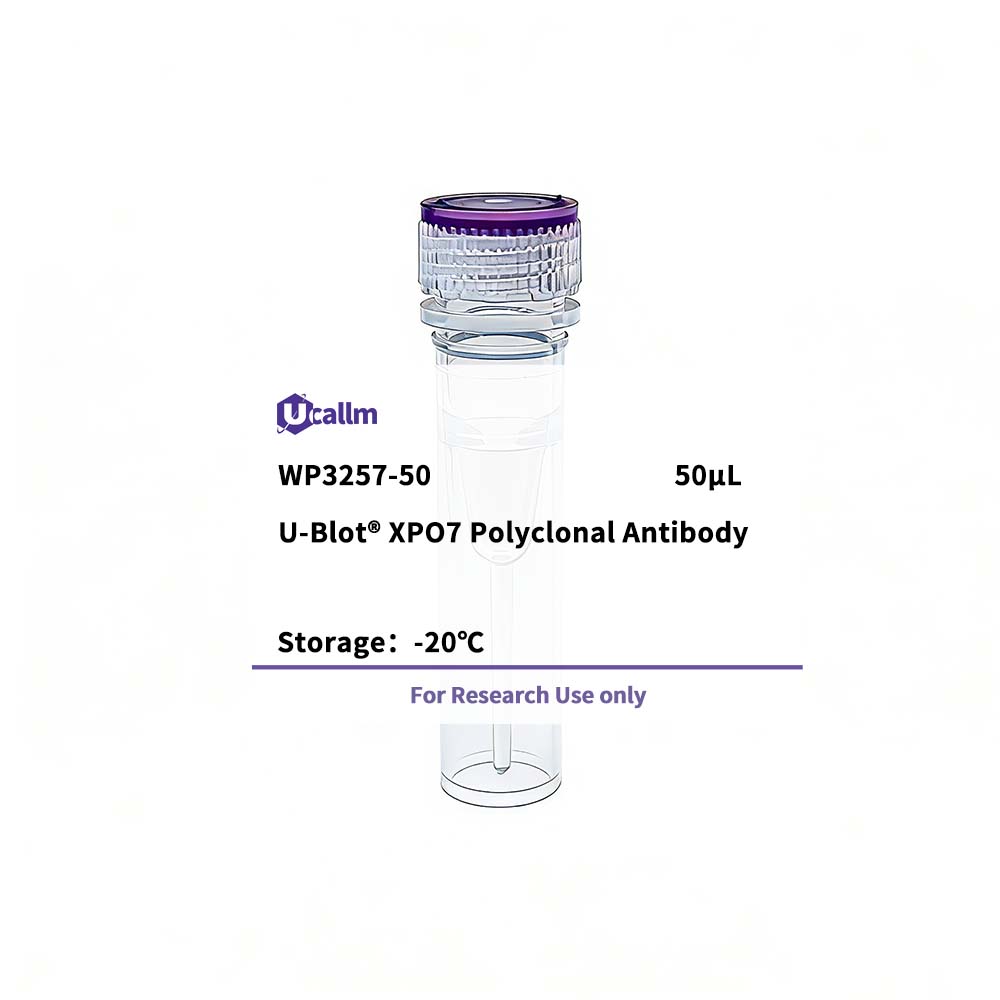
SKU: WP3257 Categories: ,

XPO7 Polyclonal Antibody

Price range: $268.00 through $328.00

SKU: WP3257-100
Enter the quantity you would like, or drag the panel to find the quantity and price that best for you
Bulk QuoteAuthorize OEM & ODM

Product details

Background:

The transport of protein and large RNAs through the nuclear pore complexes (NPC) is an energy-dependent and regulated process. The import of proteins with a nuclear localization signal (NLS) is accomplished by recognition of one or more clusters of basic amino acids by the importin-alpha/beta complex; see MIM 600685 and MIM 602738. The small GTPase RAN (MIM 601179) plays a key role in NLS-dependent protein import. RAN-binding protein-16 is a member of the importin-beta superfamily of nuclear transport receptors.[supplied by OMIM, Jul 2002],

Specifications

Size50μL/100μL
TargetXPO7
ReactivityHuman, Mouse
ApplicationsWB, ELISA
MW(Calculated)
MW(Observed)119kD
Host SpeciesRabbit
IsotypeIgG
Conjugate/ModificationUnmodified
Recommended Dilution RatioWB 1:500-2000; ELISA 1:5000-20000
FormulationLiquid in PBS containing 50% glycerol,0.5% BSA and 0.02% sodium azide.
PurificationThe antibody was affinity-purified from rabbit antiserum by affinity-chromatography using epitope-specific immunogen.
Storage-15°C to -25°C/1 year(Do not lower than -25°C)
Concentration1 mg/ml
ClonalityPolyclonal
Clone Number
ImmunogenSynthesized peptide derived from part region of human protein
SpecificityXPO7 Polyclonal Antibody detects endogenous levels of protein.
Gene NameXPO7 KIAA0745 RANBP16
Protein NameExportin-7 (Exp7) (Ran-binding protein 16)
Other Name
SpeciesHuman
Gene ID23039
UniprotQ9UIA9,
Species.1Mouse
Gene ID.1
Uniprot.1Q9EPK7
Species.2
Gene ID.2
Uniprot.2
Cellular LocalizationCytoplasm . Nucleus . Shuttles between the nucleus and the cytoplasm. .
Tissue ExpressionStrong expression in testis, thyroid and bone marrow, low expression in lung, liver and small intestine, no expression in thymus, and remaining tissues studied have moderate expression. Expressed in red blood cells; overexpressed in red blood cells (cytoplasm) of patients with hereditary non-spherocytic hemolytic anemia of unknown etiology.
Signaling_pathwayGenetic Information Processing >> Translation >> Nucleocytoplasmic transport
Research Areas>>Nucleocytoplasmic transport
FunctionFunction:Mediates the nuclear export of proteins (cargos) with broad substrate specificity. In the nucleus binds cooperatively to its cargo and to the GTPase Ran in its active GTP-bound form. Docking of this trimeric complex to the nuclear pore complex (NPC) is mediated through binding to nucleoporins. Upon transit of a nuclear export complex into the cytoplasm, disassembling of the complex and hydrolysis of Ran-GTP to Ran-GDP (induced by RANBP1 and RANGAP1, respectively) cause release of the cargo from the export receptor. XPO7 then return to the nuclear compartment and mediate another round of transport. The directionality of nuclear export is thought to be conferred by an asymmetric distribution of the GTP- and GDP-bound forms of Ran between the cytoplasm and nucleus.,similarity:Belongs to the exportin family.,similarity:Contains 1 importin N-terminal domain.,subcellular location:Shuttles between the nucleus and the cytoplasm.,subunit:Binds to nucleoporins. Found in a complex with XPO7, EIF4A1, ARHGAP1, VPS26A, VPS29, VPS35 and SFN. Interacts with ARHGAP1 and SFN. Interacts with Ran and cargo proteins in a GTP-dependent manner.,tissue specificity:Strong expression in testis, thyroid and bone marrow, low expression in lung, liver and small intestine, no expression in thymus, and remaining tissues studied have moderate expression.,
Please login to post questions
Back to Top
Product has been added to your cart
