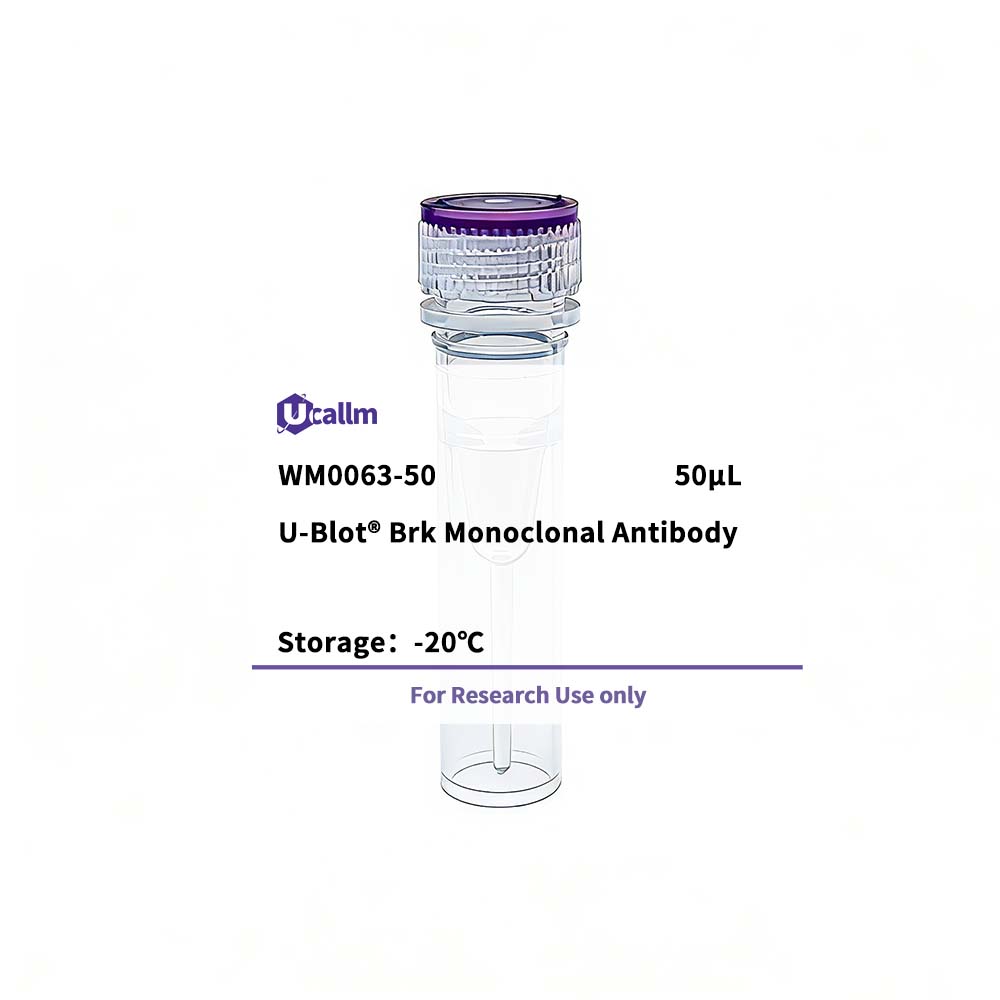
SKU: WM0063 Categories: ,

Brk Monoclonal Antibody

Price range: $268.00 through $328.00

SKU: WM0063-50
Enter the quantity you would like, or drag the panel to find the quantity and price that best for you
Bulk QuoteAuthorize OEM & ODM

Product details

Background:
protein tyrosine kinase 6(PTK6) Homo sapiens The protein encoded by this gene is a cytoplasmic nonreceptor protein kinase which may function as an intracellular signal transducer in epithelial tissues. Overexpression of this gene in mammary epithelial cells leads to sensitization of the cells to epidermal growth factor and results in a partially transformed phenotype. Expression of this gene has been detected at low levels in some breast tumors but not in normal breast tissue. The encoded protein has been shown to undergo autophosphorylation. Alternative splicing results in multiple transcript variants. [provided by RefSeq, Jan 2012],

Specifications

Size50μL/100μL
TargetBrk
ReactivityHuman
ApplicationsWB, ELISA
MW(Calculated)52kD
MW(Observed)
Host SpeciesMouse
Isotype
Conjugate/ModificationUnmodified
Recommended Dilution RatioWB 1:500-1:2000; ELISA 1:10000; Not yet tested in other applications.
FormulationLiquid in PBS containing 50% glycerol, 0.5% BSA and 0.02% sodium azide.
PurificationAffinity purification
Storage-15°C to -25°C/1 year(Do not lower than -25°C)
Concentration
ClonalityMonoclonal
Clone Number20C1
ImmunogenPurified recombinant fragment of human Brk expressed in E. Coli.
SpecificityBrk Monoclonal Antibody detects endogenous levels of Brk protein.
Gene NamePTK6
Protein NameProtein-tyrosine kinase 6
Other NamePTK6; / BRK; / Protein-tyrosine kinase 6; / Breast tumor kinase; / Tyrosine-protein kinase BRK
SpeciesHuman
Gene ID5753
UniprotQ13882
Species.1
Gene ID.1
Uniprot.1
Species.2
Gene ID.2
Uniprot.2
Cellular LocalizationCytoplasm. Nucleus. Cell projection, ruffle. Membrane . Colocalizes with KHDRBS1, KHDRBS2 or KHDRBS3, within the nucleus. Nuclear localization in epithelial cells of normal prostate but cytoplasmic localization in cancer prostate.
Tissue ExpressionEpithelia-specific. Very high level in colon and high levels in small intestine and prostate, and low levels in some fetal tissues. Not expressed in breast or ovarian tissue but expressed in high percentage of breast and ovarian cancers. Also overexpressed in some metastatic melanomas, lymphomas, colon cancers, squamous cell carcinomas and prostate cancers. Also found in melanocytes. Not expressed in heart, brain, placenta, lung, liver, skeletal muscle, kidney and pancreas. Isoform 2 is present in prostate epithelial cell lines derived from normal prostate and prostate adenocarcinomas, as well as in a variety of cell lines.
Signaling_pathway
Research Areas
FunctionCatalytic activity:ATP + a [protein]-L-tyrosine = ADP + a [protein]-L-tyrosine phosphate.,enzyme regulation:Activated enzyme seems to have greater access to its substrates.,Function:Phosphorylates KHDRBS1, KHDRBS2, KHDRBS3 and STAP2/BKS. May function as an intracellular signal transducer in epithelial tissues. Overexpression in mammary cells leads to mitogenically sensitization to EGF, and results in a partially transformed phenotype. Its presence in the nucleus appears to be linked to suppression of tumor progression.,PTM:Autophosphorylated. The phosphorylation of Tyr-447 may lead to the autoinhibition of the enzyme.,similarity:Belongs to the protein kinase superfamily. Tyr protein kinase family. BRK/PTK6/SIK subfamily.,similarity:Contains 1 protein kinase domain.,similarity:Contains 1 SH2 domain.,similarity:Contains 1 SH3 domain.,subcellular location:Colocalizes with KHDRBS1, KHDRBS2 or KHDRBS3, within the nucleus. In secretory epithelial cells from prostate adenocarcinoma, nuclear localization is higher in low-grade and lower in high-grade regions of the tumors.,subunit:Interacts with GAP-A.p65 (By similarity). Interacts with KHDRBS1. Interacts with phosphorylated IRS4.,tissue specificity:Epithelia-specific. Very high level in colon and high levels in small intestine and prostate, and low levels in some fetal tissues. Expressed at low level in some breast tumors, but not in normal breast. Also found in melanocytes. Not expressed in heart, brain, placenta, lung, liver, skeletal muscle, kidney and pancreas.,
Please login to post questions
Back to Top
Product has been added to your cart
