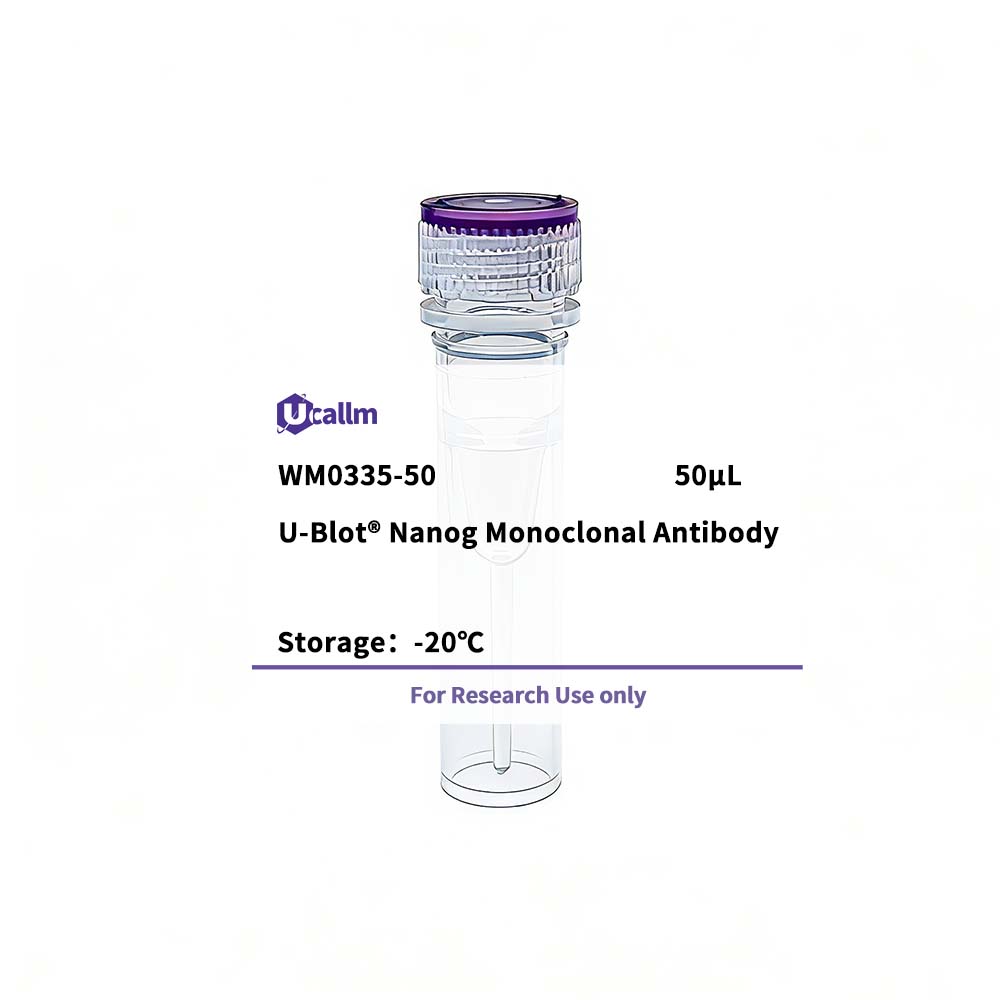
SKU: WM0335 Categories: ,

Nanog Monoclonal Antibody

Price range: $268.00 through $328.00

SKU: WM0335-50
Enter the quantity you would like, or drag the panel to find the quantity and price that best for you
Bulk QuoteAuthorize OEM & ODM

Product details

Background:
The protein encoded by this gene is a DNA binding homeobox transcription factor involved in embryonic stem (ES) cell proliferation, renewal, and pluripotency. The encoded protein can block ES cell differentiation and can also autorepress its own expression in differentiating cells. Two transcript variants encoding different isoforms have been found for this gene. [provided by RefSeq, Sep 2015],

Specifications

Size50μL/100μL
TargetNanog
ReactivityHuman
ApplicationsWB, IF, ELISA
MW(Calculated)35kD
MW(Observed)
Host SpeciesMouse
Isotype
Conjugate/ModificationUnmodified
Recommended Dilution RatioWB 1:500-1:2000; IF 1:200-1:1000; ELISA 1:10000; Not yet tested in other applications.
FormulationLiquid in PBS containing 50% glycerol, 0.5% BSA and 0.02% sodium azide.
PurificationAffinity purification
Storage-15°C to -25°C/1 year(Do not lower than -25°C)
Concentration
ClonalityMonoclonal
Clone Number2C2
ImmunogenPurified recombinant fragment of Nanog (aa20-166) expressed in E. Coli.
SpecificityNanog Monoclonal Antibody detects endogenous levels of Nanog protein.
Gene NameNANOG
Protein NameHomeobox protein NANOG
Other NameNANOG; / Homeobox protein NANOG; / Homeobox transcription factor Nanog; / hNanog
SpeciesHuman
Gene ID79923
UniprotQ9H9S0,
Species.1Mouse
Gene ID.1
Uniprot.1Q80Z64
Species.2
Gene ID.2
Uniprot.2
Cellular LocalizationNucleus .
Tissue ExpressionExpressed in testicular carcinoma and derived germ cell tumors (at protein level). Expressed in fetal gonads, ovary and testis. Also expressed in ovary teratocarcinoma cell line and testicular embryonic carcinoma. Not expressed in many somatic organs and oocytes.
Signaling_pathwayCellular Processes >> Cellular community - eukaryotes >> Signaling pathways regulating pluripotency of stem cells
Research Areas>>Signaling pathways regulating pluripotency of stem cells; / >>Proteoglycans in cancer
Functiondevelopmental stage:Expressed in embryonic stem (ES) and carcinoma (EC) cells. Expressed in inner cell mass (ICM) of the blastocyst and gonocytes between 14 and 19 weeks of gestation (at protein level). Not expressed in oocytes, unfertilized oocytes, 2-16 cell embryos and early morula (at protein level). Expressed in embryonic stem cells (ES). Expression decreases with ES differentiation.,Function:May act as a transcription regulator (By similarity). When overexpressed, promotes cells to enter into S phase and proliferation.,Function:Transcription regulator involved in inner cell mass and embryonic stem (ES) cells proliferation and self-renewal. Imposes pluripotency on ES cells and prevents their differentiation towards extraembryonic endoderm and trophectoderm lineages. Blocks bone morphogenetic protein-induced mesoderm differentiation of ES cells by physically interacting with SMAD1 and interfering with the recruitment of coactivators to the active SMAD transcriptional complexes (By similarity). Acts as a transcriptional activator or repressor (By similarity). Binds optimally to the DNA consensus sequence 5'-TAAT[GT][GT]-3' or 5'-[CG][GA][CG]C[GC]ATTAN[GC]-3' (By similarity). When overexpressed, promotes cells to enter into S phase and proliferation.,miscellaneous:Almost identical to NANOG. There are only one change in the inferred amino acid sequence from 'Gln-253' in NANOG to His-253 in NANOGP8.,miscellaneous:Exists an other tandem duplicated non-processed pseudogene (NANOGP1) and 10 other NANOG-related nucleotide sequences located on different chromosomes, all of which are processed pseudogenes lacking introns (NANOGP2 to NANOGP11); except NANOGP8 which is a retrogene.,online information:Nanog entry,similarity:Belongs to the Nanog homeobox family.,similarity:Contains 1 homeobox DNA-binding domain.,subunit:Interacts with SMAD1 and SALL4.,tissue specificity:Expressed in osteosarcoma cancer cell line (at protein level) (Probable). Expressed in tumor uterine cervix, breast and urinary bladder tissues, and also osteosarcoma, hepatoma, and breast adenocarcinoma cancer cell lines.,tissue specificity:Expressed in testicular carcinoma and derived germ cell tumors (at protein level). Expressed in fetal gonads, ovary and testis. Also expressed in ovary teratocarcinoma cell line and testicular embryonic carcinoma. Not expressed in many somatic organs and oocytes.,
Please login to post questions
Back to Top
Product has been added to your cart
