SKU: WM0511 Categories: ,

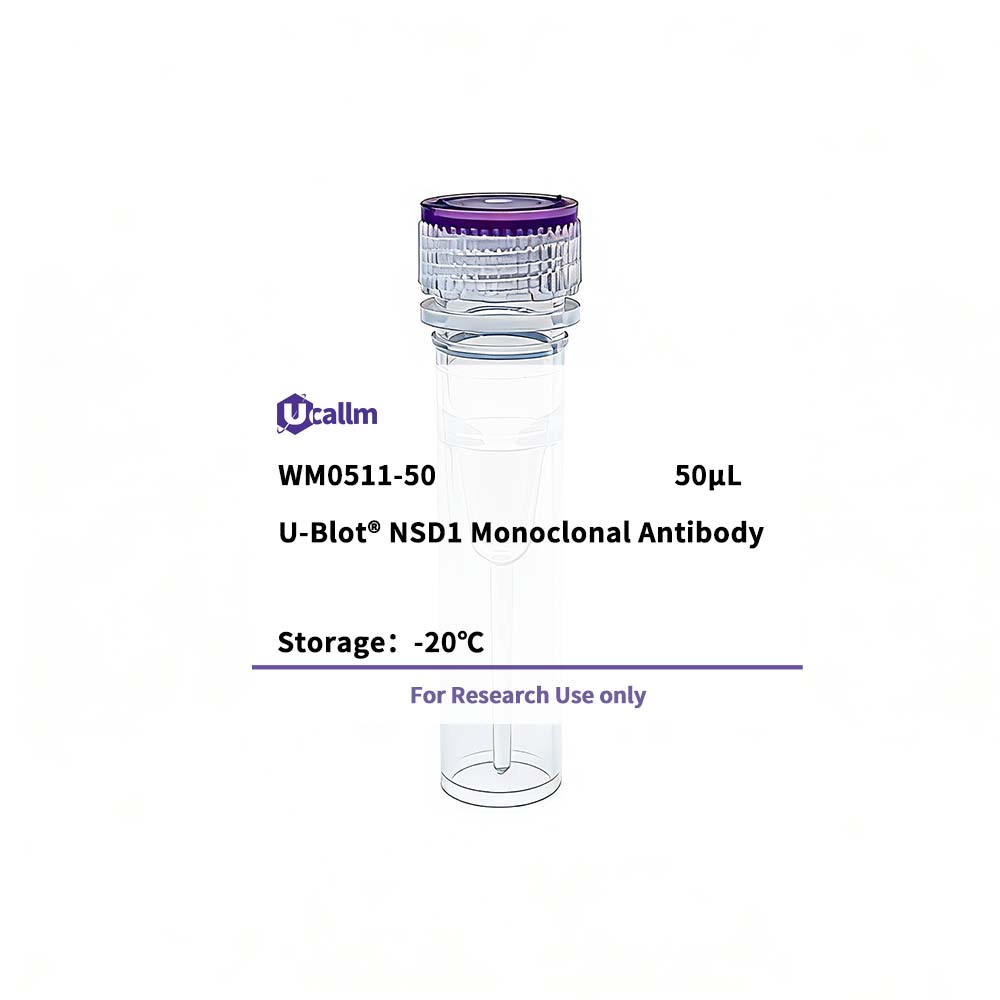
NSD1 Monoclonal Antibody

Price range: $268.00 through $328.00

SKU: WM0511-50
Enter the quantity you would like, or drag the panel to find the quantity and price that best for you
Bulk QuoteAuthorize OEM & ODM

Product details

Background:
This gene encodes a protein containing a SET domain, 2 LXXLL motifs, 3 nuclear translocation signals (NLSs), 4 plant homeodomain (PHD) finger regions, and a proline-rich region. The encoded protein enhances androgen receptor (AR) transactivation, and this enhancement can be increased further in the presence of other androgen receptor associated coregulators. This protein may act as a nucleus-localized, basic transcriptional factor and also as a bifunctional transcriptional regulator. Mutations of this gene have been associated with Sotos syndrome and Weaver syndrome. One version of childhood acute myeloid leukemia is the result of a cryptic translocation with the breakpoints occurring within nuclear receptor-binding Su-var, enhancer of zeste, and trithorax domain protein 1 on chromosome 5 and nucleoporin, 98-kd on chromosome 11. Two transcript variants encoding distinct isofo


Specifications

Size50μL/100μL
TargetNSD1
ReactivityHuman
ApplicationsWB
MW(Calculated)297kD
MW(Observed)
Host SpeciesMouse
Isotype
Conjugate/ModificationUnmodified
Recommended Dilution RatioWB 1:1000-1:2000; Not yet tested in other applications.
FormulationLiquid in PBS containing 50% glycerol, 0.5% BSA and 0.02% sodium azide.
PurificationAffinity purification
Storage-15°C to -25°C/1 year(Do not lower than -25°C)
Concentration
ClonalityMonoclonal
Clone Number4F8
ImmunogenPurified recombinant human NSD1 protein fragments expressed in E.coli.
SpecificityNSD1 Monoclonal Antibody detects endogenous levels of NSD1 protein.
Gene NameNSD1
Protein NameHistone-lysine N-methyltransferase H3 lysine-36 and H4 lysine-20 specific
Other NameNSD1; / ARA267; / KMT3B; / Histone-lysine N-methyltransferase; / H3 lysine-36 and H4 lysine-20 specific; / Androgen receptor coactivator 267 kDa protein; / Androgen receptor-associated protein of 267 kDa; / H3-K36-HMTase; / H4-K20-HMTase; / Lysine N-methyltr
SpeciesHuman
Gene ID64324
UniprotQ96L73,
Species.1Mouse
Gene ID.1
Uniprot.1O88491
Species.2
Gene ID.2
Uniprot.2
Cellular LocalizationNucleus. Chromosome .
Tissue ExpressionExpressed in the fetal/adult brain, kidney, skeletal muscle, spleen, and the thymus, and faintly in the lung.
Signaling_pathway
Research Areas>>Lysine degradation; / >>Metabolic pathways
FunctionCatalytic activity:S-adenosyl-L-methionine + histone L-lysine = S-adenosyl-L-homocysteine + histone N(6)-methyl-L-lysine.,Disease:A chromosomal aberration involving NSD1 is found in an adult form of myelodysplastic syndrome (MDS). Insertion of NUP98 into NSD1 generates a NUP98-NSD1 fusion product.,Disease:A chromosomal aberration involving NSD1 is found in childhood acute myeloid leukemia. Translocation t(5; 11)(q35; p15.5) with NUP98.,Disease:Defects in NSD1 are a cause of Beckwith-Wiedemann syndrome (BWS) [MIM:130650]. BWS is a genetically heterogeneous disorder characterized by anterior abdominal wall defects including exomphalos (omphalocele), pre- and postnatal overgrowth, and macroglossia. Additional less frequent complications include specific developmental defects and a predisposition to embryonal tumors.,Disease:Defects in NSD1 are the cause of Sotos syndrome [MIM:117550]; also known as cerebral gigantism. It is a disorder characterized by excessively rapid growth, acromegalic features, and a nonprogressive cerebral disorder with mental retardation. High-arched palate and prominent jaw are noted in several patients. Most cases of Sotos syndrome are sporadic and may represent new dominant mutation.,Disease:Defects in NSD1 are the cause of Weaver syndrome (WES) [MIM:277590]. WES is a syndrome of accelerated growth and osseous maturation, unusual craniofacial appearance, hoarse and low-pitched cry, and hypertonia with camptodactyly.,Function:Histone methyltransferase. Preferentially methylates 'Lys-36' of histone H3 and 'Lys-20' of histone H4 (in vitro) (By similarity). Transcriptional intermediary factor capable of both negatively or positively influencing transcription, depending on the cellular context.,similarity:Belongs to the histone-lysine methyltransferase family.,similarity:Contains 1 AWS domain.,similarity:Contains 1 post-SET domain.,similarity:Contains 1 SET domain.,similarity:Contains 2 PWWP domains.,similarity:Contains 4 PHD-type zinc fingers.,subunit:Interacts with the ligand-binding domains of RARA and THRA in the absence of ligand; in the presence of ligand the interaction is severely disrupted but some binding still occurs. Interacts with the ligand-binding domains of RXRA and ESRRA only in the presence of ligand (By similarity). Interacts with AR DNA-and ligand-binding domains.,tissue specificity:Expressed in the fetal/adult brain, kidney, skeletal muscle, spleen, and the thymus, and faintly in the lung.,
Please login to post questions
Back to Top
Product has been added to your cart